 Most progressives in the US Senate and House voted in favor of the “fiscal cliff” deal worked out between Vice President Joe Biden and Senate Minority Leader Mitch McConnell, R-Kentucky. They did this despite the fact that the agreement compromised on what was supposed to be a hard-and-fast principle: that tax rates on Americans making $250,000 or more must go up to at least the rates that were in place when Bill Clinton was president. Instead, the deal only ends Bush-era tax cuts on those with incomes above $400,000. That rate, thoughtful progressives argue, “does not generate the revenue necessary for the country to meet its needs for everything from education for our children, to job training, to other critical supports for the middle class.”
Showing posts with label Fiscal Cliff. Show all posts
Showing posts with label Fiscal Cliff. Show all posts
Wednesday, January 02, 2013
Why Tom Harkin and a Handful of Other Progressives Opposed the Deal
Most progressives in the US Senate and House voted in favor of the “fiscal cliff” deal worked out between Vice President Joe Biden and Senate Minority Leader Mitch McConnell, R-Kentucky. They did this despite the fact that the agreement compromised on what was supposed to be a hard-and-fast principle: that tax rates on Americans making $250,000 or more must go up to at least the rates that were in place when Bill Clinton was president. Instead, the deal only ends Bush-era tax cuts on those with incomes above $400,000. That rate, thoughtful progressives argue, “does not generate the revenue necessary for the country to meet its needs for everything from education for our children, to job training, to other critical supports for the middle class.”Part 1 of the Fiscal Cliff is Over. Now Gird Yourself for Part 2
 The fiscal cliff is dead. Long live the fiscal cliff.
It's over. Sort of. The Senate voted 89-8 to prevent middle-class taxes from rising while allowing rates to increase for taxpayers with incomes over $450,000. Democrats caved in on the estate tax, so the elderly super-wealthy can breathe easy on that front. Capital gains taxes go back up to 20 percent for high earners, and Democrats and Republicans split the difference on dividend taxation, raising it to 20 percent too, rather than the 39.6 percent Obama wanted. The working class got an extension of the stimulus tax cuts, but lost out on an extension of the payroll tax holiday. The deal also includes a bunch of other miscellaneous provisions (Suzy Khimm has the details here), and the end result is a revenue increase of about $600 billion over ten years.
Perspective on the Deal
To make sense of what just happened, we need to ask what is really at stake, and how much difference the budget deal makes in the larger picture.
So, what are the two sides really fighting about? Surely the answer is, the future of the welfare state. Progressives want to maintain the achievements of the New Deal and the Great Society, and also implement and improve Obamacare so that we become a normal advanced country that guarantees essential health care to all its citizens. The right wants to roll the clock back to 1930, if not to the 19th century.
So, what are the two sides really fighting about? Surely the answer is, the future of the welfare state. Progressives want to maintain the achievements of the New Deal and the Great Society, and also implement and improve Obamacare so that we become a normal advanced country that guarantees essential health care to all its citizens. The right wants to roll the clock back to 1930, if not to the 19th century.
So-Called Fiscal Cliff Averted as Congress Begins New Fight over Spending on Social Welfare Programs
 After much drama, the "fiscal cliff" has come to an end — for now. We
look at what is in the Senate deal approved by the House Tuesday night
with economist Juliet Schor. The bill lays the groundwork for future
battles between Democrats and Republicans over decisions on federal
spending and debt, when much of the focus is expected to be on cuts to
so-called entitlements. "The government needs to be spending to do the
things the country needs," Schor says. "So we need to be spending on
shifting into a clean energy paradigm." Schor is a professor of
economics and sociology at Boston College and author of "True Wealth:
How and Why Millions of Americans Are Creating a Time-Rich, Ecologically
Light, Small-Scale, High-Satisfaction Economy."
After much drama, the "fiscal cliff" has come to an end — for now. We
look at what is in the Senate deal approved by the House Tuesday night
with economist Juliet Schor. The bill lays the groundwork for future
battles between Democrats and Republicans over decisions on federal
spending and debt, when much of the focus is expected to be on cuts to
so-called entitlements. "The government needs to be spending to do the
things the country needs," Schor says. "So we need to be spending on
shifting into a clean energy paradigm." Schor is a professor of
economics and sociology at Boston College and author of "True Wealth:
How and Why Millions of Americans Are Creating a Time-Rich, Ecologically
Light, Small-Scale, High-Satisfaction Economy."Video
Source: Democracy Now!
Author: --
Fiscal cliff: Washington’s long drama over the ‘fiscal cliff’ ends
 WASHINGTON—Past its own New Year’s deadline, a weary Congress sent U.S. President Barack Obama legislation to avoid a national “fiscal cliff” of middle class tax increases and spending cuts late Tuesday night in the culmination of a struggle that strained America’s divided government to the limit.
The bill’s passage on a bipartisan 257-167 vote in the House sealed a hard-won political triumph for the American president less than two months after he secured re-election while calling for higher taxes on the wealthy.
Tuesday, January 01, 2013
Fiscal Cliff Passes For 'Disgusted,' 'Disappointed' Congress
 WASHINGTON -- Congress stumbled ingloriously off Capitol Hill New Year's Eve, with the Senate passing a "fiscal cliff" deal two hours after the deadline to address the tax and spending problems that Capitol Hill had created for itself, and leaving the final resolution for the start of 2013.
The lawmakers managed that feat despite knowing about the deadline for a year and a half, and despite having the deal in sight Sunday night. It preserves Bush-era tax cuts for income under $450,000 for couples and under $400,000 for individuals. The tentative deal also would extend emergency unemployment insurance and secure other tax policies that generally help the middle class.
Fiscal Cliff: Senate Remains Deadlocked, Mitch McConnell And Harry Reid Say
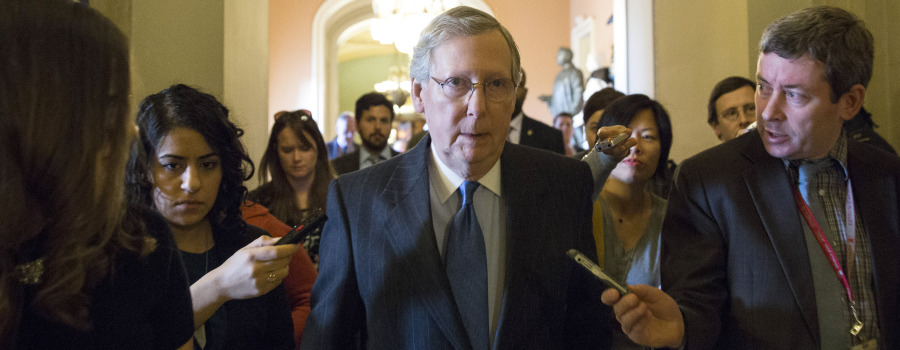
"I'm concerned about the lack of urgency here. We all know we're running out of time," said Senate Minority Leader Mitch McConnell (R-Ky.), complaining that he had worked into the night Saturday to make an offer to the Democrats, but hadn't received a response.
The Bully in the Asylum: Is the G.O.P. Headed for its Cliff?
 On Thursday, Senator Harry Reid came to the floor of the Senate to condemn a “dictatorship“—a petty sort of tyranny, one in the chamber down the hall, led by John Boehner, which Reid blamed for the lack of a deal to prevent the country from going over the fiscal cliff. “It’s being operated with a dictatorship of the speaker, not allowing the vast majority of the House of Representatives to get what they want,” Reid said.
Friday, December 28, 2012
Republicans Now 100 Percent AWOL From Fiscal Cliff Talks
 John Boehner gave up on fiscal cliff negotiations after he was unable to get House Republicans to agree to any proposal at all, even one that he himself had crafted. The fate of the Republic, he said, was now in the Senate's hands. So how is Mitch McConnell handling things?
An aide said Wednesday that McConnell had not been in contact with any top Democrats, including Sen. Harry Reid (D-Nev.), the majority leader, during the holiday break....Always cautious, McConnell has kept a decidedly low profile during the last few weeks of political theater in the Capitol....Behind the scenes, he [] helped devise Boehner's Plan B maneuver, which failed to gain enough Republican votes to be brought up in the House. In the aftermath of that defeat, however, McConnell may be unwilling to take on the job of deal-maker. The reasons reflect the pressures that have buffeted his fellow Republicans.
Paul Krugman: Deficit Hawks Are 'Remarkably Foolish'
Paul Krugman is doubling down in his battle with deficit hawks.
The Nobel Prize-winning economist struck back at those who doubted his rationale for not being concerned about the budget deficit in a blog post Monday afternoon. Krugman described in a column in The New York Times that morning how The Wall Street Journal, former Federal Reserve Chairman Alan Greenspan and others predicted that fears over rising U.S. government debt would spook investors. In reality, he noted, interest rates on U.S. government debt are at historic lows, indicating that investors aren’t worried about America’s ability to pay off its debt.
The Nobel Prize-winning economist struck back at those who doubted his rationale for not being concerned about the budget deficit in a blog post Monday afternoon. Krugman described in a column in The New York Times that morning how The Wall Street Journal, former Federal Reserve Chairman Alan Greenspan and others predicted that fears over rising U.S. government debt would spook investors. In reality, he noted, interest rates on U.S. government debt are at historic lows, indicating that investors aren’t worried about America’s ability to pay off its debt.
Sunday, December 23, 2012
Fiscal Fail: Government Agencies Plan Few Significant Changes For January, Despite Cliff Hype
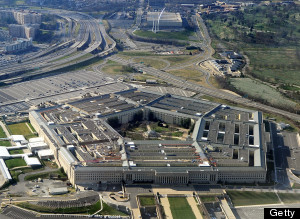 WASHINGTON -- On Jan. 1, 2000, the world awoke to find that little had changed since the night before. After years of hype around what was then called Y2K -- the fear that computer systems across the globe would collapse, unable to handle the year shifting from '99 to '00 -- the date change turned out to be a momentous non-event.
Next week, the United States is in for much the same, after months of frantic hype about the economic disruption that awaits if Congress and the president fail to reach a deal and the federal government goes "over the fiscal cliff."
Saturday, December 22, 2012
Playing Taxes Hold ’Em
A few years back, there was a boom in poker television — shows in which you got to watch the betting and bluffing of expert card players. Since then, however, viewers seem to have lost interest. But I have a suggestion: Instead of featuring poker experts, why not have a show featuring poker incompetents — people who fold when they have a strong hand or don’t know how to quit while they’re ahead?
On second thought, that show already exists. It’s called budget negotiations, and it’s now in its second episode.
On second thought, that show already exists. It’s called budget negotiations, and it’s now in its second episode.
Boehner Budget Failure Followed Pressure From Conservative Groups
WASHINGTON -- Thursday night's failure by House Speaker John Boehner (R-Ohio) to garner enough support among House Reopublicans for his fiscal cliff "Plan B" was a major setback for his role as speaker. It was also a clear example of the growing influence of outside groups over the GOP caucus.
"We were on the phone all day long today, talking to members of Congress," said Mike Needham, executive director of Heritage Action, the political arm of the powerful conservative nonprofit Heritage Foundation. "I think we definitely changed people's minds today, absolutely."
"We were on the phone all day long today, talking to members of Congress," said Mike Needham, executive director of Heritage Action, the political arm of the powerful conservative nonprofit Heritage Foundation. "I think we definitely changed people's minds today, absolutely."
Boehner’s Choice
 Last night, the House of Representatives declined to take up Speaker John Boehner’s “Plan B”—a measure that would have simply extended the Bush tax cuts on everyone who earns under $1 million annually, and put off the rest of the fiscal cliff issues off until a later date.
Up until, Boehner had been negotiating a deal with Obama, and doing a pretty decent job, from his point of view. He got Obama off the $250,000 benchmark for extending the Bush tax cuts, and up to $400,000. He got Obama to scrap his demand for a permanent debt-ceiling fix. He got Obama to propose a Social Security benefit cut, which has enraged progressives.
Boehner Sabotaged by Lunatic Wing of Republican Party
 Even after larding up his Plan B bill with lots of goodies, John Boehner apparently couldn't get his Republican caucus to support it. So he's now pulled the bill and adjourned the House, promising only to return after Christmas "when needed."
This is truly an epic fail. Boehner couldn't even get a piece of obvious political theater passed. He's completely unable to control the lunatic wing of his own party. So what's next?
Fiscal cliff: Obama says he is 'ready and willing' to get a deal
WASHINGTON—President Barack Obama says he is "ready and willing" to get a big package done to deal with the "fiscal cliff," and says there's no reason not to protect middle-class Americans from tax increases.
Obama says he spoke Friday with House Speaker John Boehner and met with Senate Majority Leader Harry Reid. He says Congress should pass a plan to extend tax breaks for the middle class and extend unemployment benefits.
Obama says no one can get 100 per cent of what they want and there are "real consequences" to how they deal with the across-the-board tax increases and steep spending cuts scheduled to kick in Jan. 1.
Economists fear the combination could deliver a blow to the U.S. economy.
Original Article
Source: the star
Author: Jim Kuhnhenn
Obama says he spoke Friday with House Speaker John Boehner and met with Senate Majority Leader Harry Reid. He says Congress should pass a plan to extend tax breaks for the middle class and extend unemployment benefits.
Obama says no one can get 100 per cent of what they want and there are "real consequences" to how they deal with the across-the-board tax increases and steep spending cuts scheduled to kick in Jan. 1.
Economists fear the combination could deliver a blow to the U.S. economy.
Original Article
Source: the star
Author: Jim Kuhnhenn
Erskine Bowles Blames Both Sides In Fiscal Cliff Talks Like A Good 'Bipartisanship Cult' Member
 Over at Daily Intel, Jonathan Chait dings Erskine Bowles, correctly, for succumbing to the same Beltway dyskinesia that you often see in famous columns from David Brooks, Thomas Friedman, and the rest of the gang of bipartisan Grand Bargaineers. Those who suffer from this malady chiefly present with some well-known symptoms. First, they tend to take President Barack Obama's major contributions to the field of gentlemanly compromise and throw them into the memory hole, thus maintaining the illusion that the government's failures to enact long-term budget deals and other attendant reforms are the fault of both parties, and not simply because the GOP (which would ordinarily leap at the chance to take Obama up on his deals and then run a million victory laps up and down Independence Avenue) has become a mouth-foaming band of lycanthropes in recent years.
Thursday, December 20, 2012
Richard Trumka On Fiscal Cliff: Not Ready To Blow Up Deal Over Obama's Social Security Concession

AFL-CIO president Richard Trumka called the chained-CPI proposal offered by Obama as part of his recent effort to resolve the so-called fiscal cliff standoff, "bad policy" that he and his group were strongly against. But in an interview with The Huffington Post on Thursday morning, Trumka stopped notably short of urging Democrats to walk away from the table because of it.
Fiscal Cliff Negotiations: Obama And Boehner Staffs Haven't Talked Since Monday
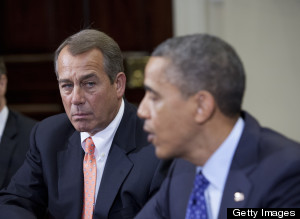 WASHINGTON -- Negotiations over resolving the so-called fiscal cliff have hit a standstill as top Obama administration officials say they have not had formal talks with House Speaker John Boehner's office since Monday.
The officials, who briefed reporters on the condition that they not be quoted, flatly rejected the speaker's latest proposal to fully extend the Bush-era tax rates for income under $1 million. The White House's veto threat issued earlier in the day was sincere, they said. Moreover, they said they would not consider the offer as a formal proposal as a starting point to conduct future negotiations. Instead, they said they would work off Boehner's previous offer, which included a variety of entitlement reforms and spending cuts to go along with $1 million in revenue increases.
Wednesday, December 19, 2012
Why Democrats Must Break With Obama on Social Security Cuts
 There are a lot of complicated ways in which to describe the schemes being floated by President Obama and congressional Republicans to abandon the traditional Consumer Price Index in favor of the so-called “chained-CPI” scheme. But there is nothing complicated about the reality that changing the calculations on which cost-of-living increases for Social Security recipients are based has the potential to dramatically reduce the buying power of Americans who rely on this successful and stable federal program.
So the word for what is being proposed is “cut”—as in: President Obama and congressional Republicans are proposing to cut Social Security.
Subscribe to:
Posts (Atom)