Democracy Gone Astray

Democracy, being a human construct, needs to be thought of as directionality rather than an object. As such, to understand it requires not so much a description of existing structures and/or other related phenomena but a declaration of intentionality.
This blog aims at creating labeled lists of published infringements of such intentionality, of points in time where democracy strays from its intended directionality. In addition to outright infringements, this blog also collects important contemporary information and/or discussions that impact our socio-political landscape.

All the posts here were published in the electronic media – main-stream as well as fringe, and maintain links to the original texts.

[NOTE: Due to changes I haven't caught on time in the blogging software, all of the 'Original Article' links were nullified between September 11, 2012 and December 11, 2012. My apologies.]

Showing posts with label Guatemala. Show all posts

Sunday, March 05, 2017

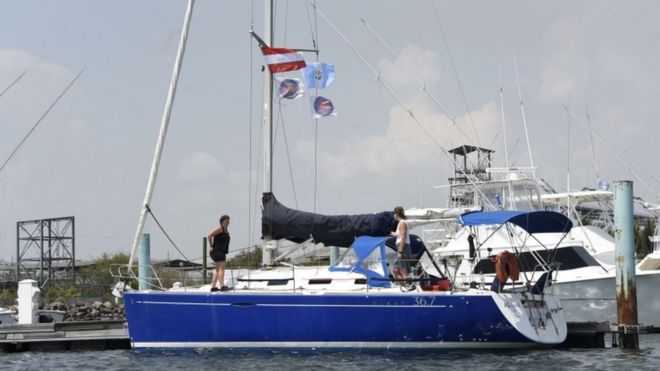
Guatemala army blocks Dutch boat offering abortions

The Guatemalan army says it will block the activities of a non-profit "abortion boat" docked on its shores.

The Dutch non-profit group, Women on Waves, offers free abortion services to women in countries where the procedure is banned.

It takes women in the early stages of pregnancy out to international waters, where the abortion is performed.

Friday, July 31, 2015

Mass Die-Off of Fish Underscores Dangers of Palm Oil Industry in Guatemala

Crossing the River Pasión today, nothing would appear out of the ordinary: Boats ferry people across the river while a woman washes clothing in the murky brown water. But a little over a month ago, the scene was different. On May 30, residents of the municipality of Sayaxché, in the Guatemalan department of Petén, awoke to find tens of thousands of fish floating in the river. For residents, it was clear who was responsible for the die-off: the local palm company, Reforestadora de Palma del Petén (REPSA), a member of the powerful Olmeca Group.

Saturday, July 25, 2015

US Policy Driving Militarization in Guatemala

Residents of Guatemala City are angry with the United States Marines. Early in June, a Marine CH-53 Sea Stallion helicopter flew low over Zone 9 of Guatemala city, causing damage to buildings in the area.

The United States Embassy confirmed to the Guatemalan press that the helicopter did indeed belong to the United States Marine Corps Southern Command. The embassy explained that, "due to high winds, the helicopter could not maintain altitude after takeoff. It regained its altitude, but apparently the airstream caused by the rotors damaged buildings."

Friday, June 26, 2015

Guatemalans Are Taking Their Democracy Back

Guatemalans are clamoring for change, pouring into the capital city's central plaza on a weekly basis. From massive national mobilizations down to local consultations, defending territories from extractive industries, people all over Guatemala are taking action to take their country back from transnational corporations and the political, business and military elite.

The historic protests at the national level stem from a groundswell of outrage and indignation over revelations of widespread corruption within the highest levels of government. Guatemala prosecutors and the UN International Commission against Impunity in Guatemala cracked down on two major corruption rings within the National Tax Office and the Guatemalan Social Security Institute in April and May. The heads of both institutions have been arrested, along with the president of the country's central bank and dozens of others inside and outside the government.

Friday, January 31, 2014

Guatemala Factory Supplying Walmart and Other US Retailers Stole $6 Million From Workers

A factory company that made clothes for at least sixty American labels, including Macy’s, JCPenney, Kohl’s and Walmart, allegedly owes Guatemalan workers more than $6 million in back wages and benefits, according to an investigation by the Institute for Global Labour and Human Rights.

Investigators obtained more than 200 internal documents smuggled out of Alianza Fashion factory last spring, including invoices, pay stubs and manufacturing instructions from some of the most well-known brands in the world. The factory, owned by South Korean national Boon Chong Park, went out of business last March.

Monday, December 30, 2013

Genocide on Trial

People began lining up even before the sun rose over the mountain ridge, quietly waiting their turn at a makeshift desk outside a home of wood and earth. One by one, relatives of the dead come forward.

Brother. Uncle. Father. Nephew. Grandfather. Cousin. Son. Do you know where their bodies are? Estrella Polar. North Star. All the men were rounded up in the church, executed and dumped in a mass grave in the plantation.

10 years ago, representatives from the National Coordination of Widows of Guatemala (CONAVIGUA) visited the Communities of Population in Resistance (CPR) of the Sierra, gathering information from family members of indigenous civilians killed by military and paramilitary forces in the 1980s. It's seven hours of bus and pick-up rides from Guatemala City to the end of the road in the municipality of San Gaspar Chajul, department of El Quiché, and an even longer hike to CPR communities further up into the Cuchumatanes, leaving the shrill hum of insects behind.

Saturday, December 14, 2013

Genocide on Trial

People began lining up even before the sun rose over the mountain ridge, quietly waiting their turn at a makeshift desk outside a home of wood and earth. One by one, relatives of the dead come forward.

Brother. Uncle. Father. Nephew. Grandfather. Cousin. Son. Do you know where their bodies are? Estrella Polar. North Star. All the men were rounded up in the church, executed, and dumped in a mass grave in the plantation.

Ten years ago, representatives from the National Coordination of Widows of Guatemala (CONAVIGUA) visited the Communities of Population in Resistance (CPR) of the Sierra, gathering information from family members of Indigenous civilians killed by military and paramilitary forces in the 1980s. It’s seven hours of bus and pick-up rides from Guatemala City to the end of the road in the municipality of San Gaspar Chajul, department of El Quiché, and an even longer hike to CPR communities further up into the Cuchumatanes, leaving the shrill hum of insects behind.

Tuesday, May 21, 2013

Efrain Rios Montt Conviction Overturned: Guatemala Court Annuls Proceedings In Genocide Case

GUATEMALA CITY, May 20 (Reuters) - Guatemala's constitutional court on Monday overturned a genocide conviction against former dictator Efrain Rios Montt, throwing out all proceedings in his case since a dispute broke out last month over who should hear it.

Rios Montt was found guilty on May 10 of overseeing the deliberate killings by the armed forces of at least 1,771 members of the Maya Ixil population during his 1982-83 rule. He was sentenced to 80 years in prison.

But the constitutional court said it had thrown out all proceedings in the case dating back until April 19. It was then that the trial against Rios Montt was suspended after a spat between judges over who should take the case. (Reporting by Mike McDonald; Editing by Dave Graham)

Original Article
Source: huffingtonpost.com
Author: Reuters  

Thursday, May 16, 2013

Three brave women behind human rights case against former Guatemalan president

Former Guatemalan President Efrain Rios Montt was hauled off to prison last Friday. It was a historic moment, the first time in history that a former leader of a country was tried for genocide in a national court. More than three decades after he seized power in a coup in Guatemala, unleashing a U.S.-backed campaign of slaughter against his own people, the 86-year-old stood trial, charged with genocide and crimes against humanity. He was given an 80-year prison sentence. The case was inspired and pursued by three brave Guatemalan women: the judge, the attorney general and the Nobel Peace Prize laureate.

Friday, May 03, 2013

The Maya Genocide Trial

Efraín Ríos Montt, the eighty-six-year-old former dictator of Guatemala, has, for the past six weeks, been spending his days in a courtroom in Guatemala City with his former chief of intelligence, José Mauricio Rodríguez Sánchez, where they are being tried for genocide and crimes against humanity. (Both men maintain their innocence.) The trial is unprecedented. It’s the first time a former head of state has gone on trial for genocide in a national, as opposed to an international, court. Even more importantly, in a country with one of the highest crime rates in the world and a long history of legal impunity, it’s a defining moment for a justice system that has been painstakingly rebuilt with help from the international community (including the United States) since 1996, when peace accords ended Guatemala’s civil war.

Friday, April 19, 2013

Exclusive: Allan Nairn Exposes Role of U.S. and New Guatemalan President in Indigenous Massacres

In 1982, investigative journalist Allan Nairn interviewed a Guatemalan general named "Tito" on camera during the height of the indigenous massacres. It turns out the man was actually Otto Pérez Molina, the current Guatemalan president. We air the original interview footage and speak to Nairn about the U.S. role backing the Guatemalan dictatorship. Last week, Nairn flew to Guatemala where he had been scheduled to testify in the trial of former U.S.-backed dictator Efraín Ríos Montt, the first head of state in the Americas to stand trial for genocide. Ríos Montt was charged in connection with the slaughter of more than 1,700 people in Guatemala’s Ixil region after he seized power in 1982. His 17-month rule is seen as one of the bloodiest chapters in Guatemala’s decades-long campaign against Maya indigenous people, which resulted in the deaths of hundreds of thousands. The trial took a surprising turn last week when Guatemala President Gen. Otto Pérez Molina was directly accused of ordering executions. A former military mechanic named Hugo Reyes told the court that Pérez Molina, then serving as an army major and using the name Tito Arias, ordered soldiers to burn and pillage a Maya Ixil area in the 1980s.

Video
Source: democracynow.org
Author: -

Friday, March 22, 2013

Tensions rise after murder of Guatemalan indigenous activist opposed to Canada’s Tahoe Resources silver project

An indigenous Guatemalan activist opposed to Canadian mining company Tahoe Resources’ plan for a silver mine was found dead on the morning of Monday, March 18.

Four indigenous Xinca leaders, including the President of the Xinca Indigenous Parliament, were abducted by a group of heavily armed men shortly after 8 pm on the night of Sunday, March 17. Two of the kidnapped men escaped, and Roberto González Ucelo, President of the Xinca Parliament, was freed a day later.

Thursday, September 20, 2012

Watchdog group questions MP trip to Guatemala

A trip by five Canadian parliamentarians to Guatemala at the invitation of Canadian mining giant Goldcorp has drawn questions from a mining industry watchdog group over lobbying regulations.

The group MiningWatch said the recent report to the lobbying commissioner does not provide enough detail about the trip. At the end of August, a senator and four MPs boarded the company's jet in Ottawa for the three-day trip.

Thursday, March 08, 2012

Guatemala women defenders defy Canadian mines and plead for help

GUATEMALA -- The road to San Miguel Ixtahuacán, Guatemala is a descent into a valley along an asphalt road riddled with potholes that could easily swallow your tire. In the chilly pre-dawn of a February day, six of us -- a videographer, human rights activists, a photographer, an interpreter and a driver -- make our way in the dark. We share the road with large and old slatted trucks carrying cattle, rickety brightly-painted school buses packed with sleeping passengers, women in traje, their indigenous dress, walking to town carrying babies across their chests. It's cold and the stars outline the silhouette of the mountains that separate Guatemala from Mexico just an hour and a half to the west. On our right we start to see the first rays of the sun as we climb into the Sierra of the Cuchumatanes mountains, high above the clouds.

We're moving into a conflict-torn area where communities, like San Miguel Ixtahuacán and neighbouring Sipacapa, have been drastically changed by the arrival of mining companies like Montana Exploradora, a Guatemalan subsidiary of the Canadian-owned mining company Goldcorp, which began the exploitation of the Marlin Mine in 2004. We're not sure what to expect, but our role is clear: Record first-hand testimonies from women who say their lives have been changed dramatically by the mining in the area. We're here as part of a larger fact-finding mission sent to Mexico, Honduras and Guatemala in January by the Nobel Women's Initiative (NWI). Based in Ottawa, the organization was founded by six female recipients of the Nobel Peace Prize, and is led by Laureate Jody Williams, winner of the 1997 prize for her anti-land mine work. The organization sends delegations of prominent citizens -- lawyers, journalists, human rights defenders, artists -- into high-conflict areas around the world to investigate the plight of women and human rights defenders, defensoras, including those who are targeted as women -- raped, assaulted, denied the power to protect their land, livelihood, health and families. We've heard some terrible stories during the past 10 days travelling through these countries.