
Showing posts with label Hunger Strike. Show all posts
Showing posts with label Hunger Strike. Show all posts
Wednesday, July 12, 2017
Refugees In a Troubled Private Detention Center Are On Hunger Strike
Tuesday, April 29, 2014
Kentucky Inmate Starved To Death

Friday, March 14, 2014
Guantanamo Bay Prisoner Files Historic Lawsuit Against Obama Over Force-Feeding

The case marks the first legal challenge requiring a federal judge to oversee an inmate's testimony on Guantanamo prison conditions.
Hassan, who has reportedly engaged in a continuous hunger strike since 2007, was turned over to the U.S. by Pakistani security forces for suspected affiliation with armed groups, but was cleared for release in 2009.
Friday, December 13, 2013
Hunger strikers protest indefinite detentions in Lindsay, Ontario
 "We are taking a stand. We want Immigration to know what’s going on. We want the public to contact Immigration Canada. We need the Canadian public to put pressure on the Immigration minister so they can stop this lengthy and cruel and unusual detentions." -- Martin Sisay, from inside Lindsay’s maximum-security prison
"I missed three of my sons birthdays, I missed three anniversaries with my wife…I can not see myself here being detained indefinitely and thinking about them. That will drive me crazy. So I have to keep it out of sight and out of mind. How inhumane is that. I am a father and I am a husband. Should I even be allowed to feel like this." -- Amin Mjasiri, from inside Lindsay’s maximum-security prison
Monday, December 09, 2013
Starving for Justice

Initially locked up in 2002 for violent crimes, Issawi was released in 2011 as part of the Gilad Shalit prisoner exchange. In July 2012, Israeli forces imprisoned him again after he violated the terms of his parole by traveling to the West Bank. A military committee refused to let him see the evidence against him as it sought to impose the remainder of his original twenty-six-year sentence. Facing an unfair trial and seventeen more years in prison, he started a hunger strike in August 2012. He was still fasting on April 22 when the committee held a bedside hearing. Issawi had become a hero to many Palestinians, a symbol of resistance. News of his debilitation had triggered clashes between Israeli soldiers and Palestinian protesters in Bethlehem. Clearly fearing what would happen if he died, the committee agreed to release him in eight months. If Israel keeps its word, Issawi will leave prison in December.
Friday, October 25, 2013
Letters detail punitive tactics used on Guantánamo hunger strikers
The US military secretly used a variety of tactics to break the resolve of the Guantánamo Bay hunger strikers, including placing them in solitary confinement if they continued to refuse food, newly declassified interviews with detainees reveal.
One prisoner also said that the last British resident held inside the camp, Shaker Aamer, had been targeted and humiliated by the authorities to the point where it became impossible for the 44-year-old to continue his protest.
One prisoner also said that the last British resident held inside the camp, Shaker Aamer, had been targeted and humiliated by the authorities to the point where it became impossible for the 44-year-old to continue his protest.
Tuesday, September 24, 2013
Pussy Riot's Nadezhda Tolokonnikova: Why I have gone on hunger strike

The penal colony administration refuses to hear me. But I, in turn, refuse to back down from my demands. I will not remain silent, resigned to watch as my fellow prisoners collapse under the strain of slavery-like conditions. I demand that the colony administration respect human rights; I demand that the Mordovia camp function in accordance with the law. I demand that we be treated like human beings, not slaves.
Saturday, August 03, 2013
With One Prisoner Dead, Will California Listen to the Hunger Strikers?

Officials at the California Department of Corrections and Rehabilitation (CDCR) originally disputed Sell’s involvement in the hunger strike, investigating his death as an apparent suicide. Corcoran staff found Sell unresponsive in his cell during their half-hour welfare checks of SHU prisoners. Sell was taken to the hospital, where he was pronounced dead.
Friday, July 12, 2013
Tens of Thousands of California Prisoners Launch Mass Hunger Strike

Hunger strikers issued five core demands:
1. Eliminate group punishments for individual rules violations.
2. Abolish the debriefing policy and modify active/inactive gang status criteria.
3. Comply with the recommendations of the US Commission on Safety and Abuse in Prisons (2006) regarding an end to long-term solitary confinement.
4. Provide adequate food.
5. Expand and provide constructive programs and privileges for indefinite SHU inmates.
Sunday, May 19, 2013
‘Only way to end Gitmo strike fairly is to set cleared inmates free’
 As the Guantanamo hunger strike enters day 100, the inmates’ lawyers
have revealed details of abuses their clients are subject to, while the
prison authorities keep denying they are resorting to practices
violating human rights.
As the Guantanamo hunger strike enters day 100, the inmates’ lawyers
have revealed details of abuses their clients are subject to, while the
prison authorities keep denying they are resorting to practices
violating human rights.A fair trial would have been a natural step. To have all of the parties heard and resolve the crisis, believes Clive Stafford Smith, founder of legal group Reprieve, and an attorney for several detainees in the Guantánamo Bay camp.
Tuesday, May 14, 2013
ACLU, Human Rights Groups: 'Cruel' Force-Feeding Of Hunger-Striking Guantanamo Detainees Must End
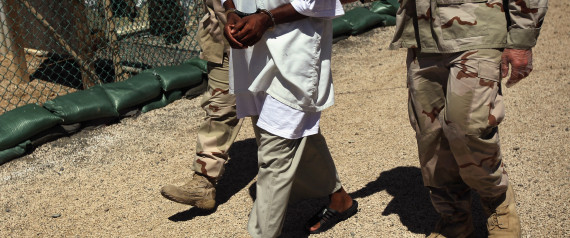
In a letter addressed to Hagel, the organizations describe the process being used to deliver nutrients to 29 of the 100 prisoners who are currently protesting by not eating:
The force-feeding process is inherently cruel, inhuman, and degrading. The prisoner is strapped into a chair with restraints on his legs, arms, body, and sometimes head, immobilizing him. A tube is inserted up his nostril, and snaked down his throat into his stomach. A liquid nutritional supplement is then forced down the tube. The prisoner is restrained in the chair for upwards of two hours to prevent him from vomiting. As Guantánamo hunger-striker Samir Naji al Hasan Moqbel explained recently: “I can’t describe how painful it is to be force-fed this way. As it was thrust in, it made me feel like throwing up. I wanted to vomit, but I couldn’t. There was agony in my chest, throat and stomach. I had never experienced such pain before.” 1 Debilitating risks of force-feeding include major infections, pneumonia, collapsed lungs, heart failure, post-traumatic stress disorder and other psychological trauma.
Thursday, May 02, 2013
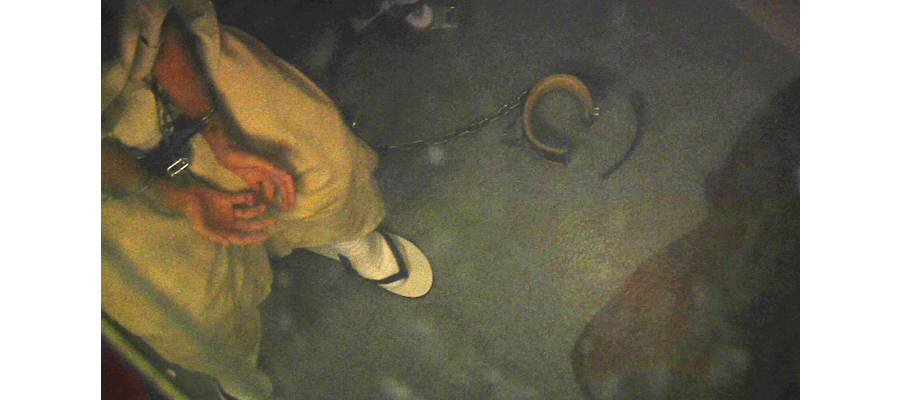
Guantanamo Hunger Strike Lays Bare Detainees' Growing Desperation
Wednesday, May 01, 2013
Guantánamo 'not in the best interests of the American people', says Obama
Barack Obama vowed to take action to close the controversial prison camp at Guantánamo Bay on Tuesday, declaring that he did not want any of its hunger-striking inmates to die of starvation.
At a press conference in Washington, Obama said it was not sustainable to keep Guantánamo open, warning its continued existence was a "recruitment tool" for extremists. The president promised to take the issue back to Congress, which blocked his earlier attempts to fulfill a 2008 campaign promise to close the camp.
At a press conference in Washington, Obama said it was not sustainable to keep Guantánamo open, warning its continued existence was a "recruitment tool" for extremists. The president promised to take the issue back to Congress, which blocked his earlier attempts to fulfill a 2008 campaign promise to close the camp.
A Hundred Hungry Men at Guantánamo

Tuesday, April 30, 2013
Can Obama Stop the Uprising at Gitmo?

A hunger strike at the detention center has now swelled to what may be the largest act of civil disobedience in the camp's history, with at least 100 of the camp's 166 detainees refusing to eat. Beginning in February after detainees claimed guards were searching their holy books, the protest has since broadened into what observers have called an "act of despair" over being held indefinitely without trial. "The fact that so many detainees have now been held at Guantanamo for over a decade and their belief that there is still no end in sight for them is a reason there is a growing problem of more and more detainees on a hunger strike," Sen. Dianne Feinstein (D-Calif.), the chair of the Senate intelligence committee, wrote in a letter to National Security Director Tom Donilon last Thursday.
Monday, April 29, 2013
A Desperate Situation at Guantánamo: Over 130 Prisoners on Hunger Strike, Dozens Being Force-Fed
The U.S. military has acknowledged for the first time the number of
prisoners on hunger strike at the military prison has topped 100. About a
fifth of the hunger strikers are now being force-fed. Lawyers for the
prisoners say more than 130 men are taking part in the hunger strike,
which began in February. One of the hunger strikers is a Yemeni man
named Samir Naji al Hasan Moqbel. In a letter published in The New York
Times, he wrote: "Denying ourselves food and risking death every day is
the choice we have made. I just hope that because of the pain we are
suffering, the eyes of the world will once again look to Guantánamo
before it is too late." We speak to attorney Carlos Warner, who
represents 11 prisoners at Guantánamo. He spoke to one of them on
Friday. "Unfortunately, they’re held because the president has no
political will to end Guantánamo," Warner says. "The president has the
authority to transfer individuals if he believes that it’s in the
interests of the United States. But he doesn’t have the political will
to do so because 166 men in Guantánamo don’t have much pull in the
United States. But the average American on the street does not
understand that half of these men, 86 of the men, are cleared for
release."
Video
Source: Democracy Now!
Author: -
Video
Source: Democracy Now!
Author: -
Friday, April 26, 2013
Gitmo Hunger Strike Rises To 97 Prisoners

Lt. Col. Samuel House said Friday that 97 men are now on strike, up three from the day before. He says 19 of them are receiving liquid nutrients through a nasal tube to prevent dangerous weight loss. Another five are under observation at the hospital on the U.S. base in Cuba.
He says none have life-threatening conditions.
The hunger strike began in February, with prisoners protesting conditions and their indefinite confinement. Lawyers for the prisoners say the military is undercounting the number of hunger strikers.
The U.S. holds 166 prisoners at Guantanamo, most without charges.
Original Article
Source: huffingtonpost.com
Author: AP
Wednesday, April 24, 2013
Guantanamo Hunger Strike Holds, Half Of Detainees Involved: Military

Lt. Col. Sam House said that 84 Guantanamo detainees were on a hunger strike, the same number as were recognized on Monday. Seventeen of the detainees were being force-fed and four of that group were in the hospital. The numbers have grown since a raid on Guantanamo's Camp Six earlier this month.
The military's Muslim advisor told a small group of reporters in Guantanamo last week that more than one detainee would die before the hunger strike ended.
Original Article
Source: huffingtonpost.com
Author: Ryan J. Reilly
Wednesday, April 17, 2013
Gitmo hunger strike on rise, 15 prisoners force-fed

Gitmo spokesman Navy Capt. Robert Durand said the number of prisoners classified as hunger strikers has increased in just one day.
At the same time, lawyers for Guantanamo inmates say the strike is more widespread than the military acknowledges and the majority of all 166 prisoners are fasting.
Meanwhile, senior military officials at the Guantanamo Bay detention center defended a raid on Saturday that resulted in a violent clash with detainees. Two US soldiers received head wounds and five prisoners suffered assorted injuries.
Lawyers for the inmates claim they are barred from speaking with their clients.
The atmosphere is tense as a weeks-long hunger strike by detainees protesting their indefinite detention continues.
Soldiers equipped with riot gear swept into a recreation area and were met with resistance from several dozen prisoners, the commander of the detention center told journalists visiting Guantanamo Bay detention facility (Gitmo).
"The appropriate amount of force was used for the situation," Navy Rear Adm. John W. Smith, commander of the detention center, told the small group of reporters.
Guards carried out a raid on Camp 6 because the prisoners had repeatedly blocked 147 of the 160 security cameras, making it impossible to monitor the detainees during the hunger strike, the AP article said.
Smith said the guards were concerned a prisoner might try to commit suicide. Officials said there were two attempted suicides since the first broke out around February 6.
Shortly before the raid, the International Committee of the Red Cross (ICRC) had conducted a visit to Gitmo, after which it confirmed that force-feeding is occurring at the facility, a practice that the ICRC and groups like Physicians for Human Rights condemn.
The Pentagon has countered the argument, saying it wouldn't be humane to let an inmate die from starvation. Detainees who are force-fed are strapped down to a gurney while a tube is forced up their nose and into the esophagus.
A New York Times op-ed written by a Guantanamo prisoner on Monday described the process as extremely painful.
"There was agony in my chest, throat and stomach," Samir Naji al Hasan Moqbel wrote.
"I had never experienced such pain before. I would not wish this cruel punishment upon anyone." News of the prison clash surfaced as the US military is conducting closed door tribunals, which have been marred from the start by controversy.
Lawyers for the detainees have criticized the use of listening devices planted in the cells designed to eavesdrop on private conversations between the prisoners and their military legal counsel. The court itself has complained of testimony from the defendants being cut off in mid-sentence by unknown sources.
The list of obstructions to achieving some semblance of justice, never an easy thing in a military tribunal to begin with, threatens to turn the tribunals into a kangaroo court.
"Defense emails have ended up being provided to the prosecution, material has disappeared off the defense server, and sometimes reappeared, in different formats, or with different names," Rick Kammen, a lawyer for Abd Al Rahim Al Nashiri, who is accused of plotting the 2000 attack on the USS Cole, said, as quoted by the public interest website, ProPublica.
The legal defenders said they were unsure whether the emails were intentionally grabbed or collected erroneously due to “technical or procedural errors.” Meanwhile, a Guantanamo Bay lawyer who represents 11 detainees was denied an emergency call to communicate with one of his clients on Tuesday, an email obtained by Rolling Stone reveals.
Defense attorney Carlos Warner requested an emergency call with his client, Fayiz Muhammad Ahmed al Kandari, on Monday morning and received notice that his request had been denied Tuesday afternoon. The Pentagon's refusal to grant Warner's call comes just days after US forces raided the communal prison unit at Gitmo.
"The military is closing ranks and restricting access to clients," Warner said in an email to reporters.
"They don't want the public to know what happened during its raid." Warner was told he could re-apply and give the normal 15 days notice – a procedure he said he understood was "routinely not followed," though this was his first request to place an emergency call.
The Pentagon declined to comment on the allegations.
Following the clash, military authorities decided to terminate communal housing, which permitted detainees to eat and associate together, and place the prisoners into solitary cells.
Although journalists are forbidden to speak with the prisoners, one of the detainees had managed to display a crudely scrawled message in broken English that read:
"Stop torturing us. Stop desecrating our religion." Commander Smith said the prisoners may later be permitted to return to the communal detention areas if they complied with prison rules.
Meanwhile, the hunger strike continues, with 45 prisoners refusing meals and 13 being force fed, officials said.
Original Article
Source: rt.com
Author: --
Guantanamo Bay Hunger Strike: 'The Situation Is An Emergency'

"The situation is an emergency," Pardiss Kebriaei, senior staff attorney at the Center for Constitutional Rights, told HuffPost Live host Ahmed Shihab-Eldin.
Subscribe to:
Posts (Atom)