Democracy Gone Astray

Democracy, being a human construct, needs to be thought of as directionality rather than an object. As such, to understand it requires not so much a description of existing structures and/or other related phenomena but a declaration of intentionality.
This blog aims at creating labeled lists of published infringements of such intentionality, of points in time where democracy strays from its intended directionality. In addition to outright infringements, this blog also collects important contemporary information and/or discussions that impact our socio-political landscape.

All the posts here were published in the electronic media – main-stream as well as fringe, and maintain links to the original texts.

[NOTE: Due to changes I haven't caught on time in the blogging software, all of the 'Original Article' links were nullified between September 11, 2012 and December 11, 2012. My apologies.]

Showing posts with label Mali. Show all posts

Wednesday, May 08, 2013

International intervention heats up in Mali

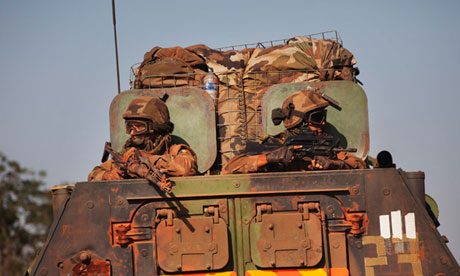
France's National Assembly and Senate have voted to extend the country's military intervention in Mali. A resolution passed both houses of parliament on April 22. Not a single vote was cast in opposition.

Three days later, the United Nations Security Council approved Resolution 2100, creating a policing mission beginning July 1, 2013. The mission is called by its French acronym MINUSMA. Its projected size is 11,200 soldiers and 1,440 police.

Wednesday, April 03, 2013

Families in Mali splintered by slavery as culture and conflict converge

"I haven't heard anything about my brother for more than a year," says Raichatou Walet Touka. She's been living at a safehouse in Bamako, Mali's capital, after fleeing the northern town of Gao following an attack by the National Movement for the Liberation of Azawad (MNLA), a Tuareg rebel group that briefly took over northern Mali in early 2012.

Thousands were displaced by the fighting, and the subsequent battle for control of northern Mali between Islamist rebels and the MNLA. But the situation facing Raichatou has been particularly perilous, for she comes from a family considered by many in the MNLA leadership as slaves.

Thursday, March 14, 2013

Harper: Canada Pondering Contribution To Proposed UN Mali Mission

OTTAWA - Prime Minister Stephen Harper is leaning towards development assistance for Mali rather than a further military contribution as he consults with cabinet and opposition parties on Canada's next steps, says a senior aide.

Harper faces a decision in the coming months on a further military contribution because France is pushing for a possible United Nations peacekeeping mission for Mali so its forces can be brought home.

Harper said Thursday during a press conference with the visiting French Prime Minister Jean-Marc Ayrault that Canada's contribution to the Mali military mission, a C-17 military transport, "will remain there as long as we feel there is a need."

Wednesday, February 27, 2013

No sign of peace or reconciliation in Mali

France perpetrated two large deceptions in conducting its military intervention into Mali six weeks ago. These have been universally accepted in mainstream media reporting.

The first is that the unilateral decision to invade Mali on January 11, 2013 was hastily made, prompted by imminent military threats by Islamic fundamentalist forces against the south of the country where the large majority of Malians live.

Saturday, February 16, 2013

Mali: The war no one wants to talk about

The news didn’t get much prominence. In the Star, it merited two paragraphs. But Canada has quietly extended its military support mission in Mali for another 30 days.

And after that? Well, no one seems to know.

Mali is the war no one wants to talk about. Canada’s Conservative government is adamant that our troops won’t be involved, even though some already are.

Sunday, February 10, 2013

Islamic extremists stage surprise attack in Mali town

Black-robed Islamic extremists armed with AK-47 automatic rifles snuck into the city of Gao in canoes Sunday to launch a surprise attack on the Malian army in the most populous city in northern Mali, two weeks after French and Malian troops ousted the jihadists.

The combat started at about 2 p.m. in downtown Gao and the fighting was continuing as night fell. Later the sound of gunfire was replaced by the clattering of French military helicopters overhead.

Saturday, February 09, 2013

Weak support in poll for sending Canadian troops to Mali

A new poll suggests most Canadians would oppose the deployment of combat troops to Mali to fight Islamist rebels.

Fewer than one in five respondents to the Canadian Press-Harris/Decima survey favour sending troops to the landlocked African country to fight a violent insurgency.

Thursday, February 07, 2013

Bob Rae Questions John Baird's 'Courage' During Mali Debate

Bob Rae questioned John Baird's courage Tuesday night during a debate in the House of Commons on Canada's role in the conflict in Mali.

And say what you will about the interim Liberal leader, but he certainly has a way with words.

After a lengthy speech, which he delivered without notes, Rae dove into the debate with his fellow MPs, expanding upon his main argument that Canada can, and should, be doing more to support the French and UN in the war-torn east African nation. You can read the full text of what Rae said here.

Wednesday, February 06, 2013

Harper Government’s Position On Mali Marked By Confusion, Says Liberal Defence Critic

Parliamentarians got their first public glimpse into the Government’s thinking last week with a formal briefing by Officials from the Departments of Foreign Affairs and National Defence. It was instructive but possibly not in the way that the Harper Government intended.

General Vance was asked “what is Canada’s military goal?” He replied that it was to support France. The follow up question is “what are France’s goals?” France has a long history in the region dating back to the colonial era and has specific national interests that is pursuing. If we are going to hitch our wagon to theirs let’s hope that our goals are the same as theirs.

Canada’s role in Mali: Little clarity, a lot of confusion

Parliamentarians got their first public glimpse into the government’s thinking last week with a formal briefing by officials from the Departments of Foreign Affairs and National Defence. It was instructive but possibly not in the way that the Harper government intended.

Maj.-Gen. Jonathan Vance was asked, “What is Canada’s military goal?” He replied that it was to support France. The follow-up question is, “What are France’s goals?” France has a long history in the region dating back to the colonial era and has specific national interests that it is pursuing. If we are going to hitch our wagon to theirs let’s hope that our goals are the same as theirs.

Monday, February 04, 2013

Terrorism is just one of many scourges to beset the people of Mali

There are two versions of recent events in Mali, which have emerged in recent weeks, each suggesting that the explanation for the takeover of the country's north by Islamist groups is terribly simple.

We wouldn't be in this mess, runs the first argument, if it weren't for the huge numbers of weapons that came into Mali after the west brought down the Gaddafi regime in neighbouring Libya; and if the US military advisers had not trained some of those who defected to the Islamist cause; and if the west was not secretly just interested in Mali's resources. In other words, it's the west's neocolonialism that is to blame.

Our military objectives in Mali make no sense

Do France's objectives for Operation Serval, its military intervention in Mali, make sense? This question matters to everyone, not least to the countries from which France is seeking assistance. As the world learned in Afghanistan, to name just the most obvious recent example, if expectations are unrealistic foreign troops tend to remain long after any conceivable justification exists.

French President Francois Hollande seems to have learned no lessons at all from past experience. Mr. Hollande initiated the French military mission ostensibly to stop Islamist insurgents from moving south towards Mali's capital, Bamako. It took almost no time for mission creep to take hold.

Sunday, February 03, 2013

France continues strikes in northern Mali

French warplanes have pounded rebel camps in the far north of Mali, hours after French President Francois Hollande visited the West African country.

Thierry Burkhard, spokesman for the French army in Paris, said on Sunday the overnight raids targeted logistics bases and training camps used by the al Qaeda-linked rebels to the north of the desert town of Kidal.

Saturday, February 02, 2013

French president makes victory stop in Mali

French President Francois Hollande met Mali's interim President Dioncounda Traore and spoke to French troops on Saturday, after landing in Timbuktu, making a triumphant stop, six days after French forces parachuted in to liberate the desert city from the rule of al-Qaeda-linked militants.

Hollande, who was accompanied by France's foreign and defence ministers, also visited Timbuktu's library of ancient manuscripts, a section of which was set on fire by the Islamists when they fled the city ahead of the advancing French troops last week.

Mali’s civilians face human rights abuses from both sides

More than a dozen civilians rounded up and executed. Bullet-riddled bodies dumped into a well.

Reports of abuses by the violent Islamists who were driven out of northern Mali’s major towns have been widely decried. But according to two prominent human rights groups, executions and other rights violations were also perpetrated by the Malian army, as civilians fell victim to violence by both sides.

“People are very frightened and they don’t feel safe,” said Gaetan Mootoo, Amnesty International’s researcher in Mali. “They are reluctant even to talk about what they’ve experienced and seen.”

Wednesday, January 30, 2013

Canadian troops drawn into Mali’s war, despite what Prime Minister Stephen Harper says

Inch by inch, Canada and the West are being drawn into an African war we don’t understand.

Prime Minister Stephen Harper insists Canadian troops are not involved in any meaningful way in Mali’s civil war. But they are.

We now have an unspecified number of special-forces commandos in Mali — in addition to one C-17 cargo plane and the 35 military personnel that go with it.

Tuesday, January 29, 2013

Canada to provide $13M more for Mali aid

Canada will provide another $13 million in aid to Mali, International Co-operation Minister Julian Fantino announced Tuesday in Ethiopia.

Fantino is the Canadian representative at a donor's conference in Addis Ababa, Ethiopia's capital.

Canadian special forces on ground in Mali, sources say

Canadian special forces are on the ground inside the troubled West African country of Mali to protect Canadian assets there, CBC News has learned.

The special forces are not there to train Malian troops — and they are not involved in any combat role, as the government has repeatedly stressed and Prime Minister Stephen Harper repeated again Monday in the House of Commons.

Canada In Mali: Special Forces On The Ground Say DND Sources

OTTAWA - Canada's special forces are on the ground in Mali to help protect Canadian personnel who are already operating in the troubled African country, say sources within the Department of National Defence.

Few other details were immediately available, although the Department of Foreign Affairs went to lengths to spell out that the presence of special forces soldiers does not signal an involvement in combat.

Monday, January 28, 2013

Aboriginal issues, economy, Mali, F-35s to capture House attention

Prime Minister Stephen Harper’s majority-governing Conservatives will remain focused on the economy in this winter House session, and although it appears to be a light legislative agenda, expect the government to move on some aboriginal issues, after Attawapiskat Chief Theresa Spence, the Assembly of First Nations,  and the Idle No More grassroots movement pushed aboriginal affairs in Canada into the international spotlight over the last two months.