Democracy Gone Astray

Democracy, being a human construct, needs to be thought of as directionality rather than an object. As such, to understand it requires not so much a description of existing structures and/or other related phenomena but a declaration of intentionality.
This blog aims at creating labeled lists of published infringements of such intentionality, of points in time where democracy strays from its intended directionality. In addition to outright infringements, this blog also collects important contemporary information and/or discussions that impact our socio-political landscape.

All the posts here were published in the electronic media – main-stream as well as fringe, and maintain links to the original texts.

[NOTE: Due to changes I haven't caught on time in the blogging software, all of the 'Original Article' links were nullified between September 11, 2012 and December 11, 2012. My apologies.]

Showing posts with label Narendra Modi. Show all posts

Thursday, October 12, 2023

India is weaponising FATF recommendations against civil society

The October 3 raids on the news website “NewsClick” and the arrest of its founder, Prabir Purkayastha and human resources head, Amit Chakravarty, are the latest attempts by the Indian government to decimate independent and critical media in the country.

The use of draconian anti-terror laws against the media organisation and its journalists is an alarming reminder of the Indian government’s determination to crack down on free press and systematically stifle dissenting voices.

How a landmark caste census in India threatens Modi’s grip on power

In a landmark move, the eastern Indian state of Bihar has announced the findings of the first-ever caste census since the country’s independence in 1947. The survey found that over two-thirds of the state’s population of over 130 million belonged to “backward” or marginalised communities.

As part of the decades-old government affirmative action, marginalised communities have been categorised as backward, extremely backward, scheduled caste (the former “untouchables”) and scheduled tribe (the Indigenous communities). India is one of the most unequal countries in the world with the bulk of the resources and jobs controlled by the privileged castes.

Wednesday, October 11, 2023

Mahatma Gandhi's great-grandson fears India is once again entering a time of hate

Tushar Gandhi says that as politicians have used societal division as a political tool to get elected in India, hate has been normalized in the country.

Tushar is the great-grandson of Mahatma Gandhi, the Indian lawyer who helped lead his country to freedom from British colonial rule in 1947.

But, after 10 years of rule by Prime Minister Narendra Modi and his Hindu nationalist Bharatiya Janata Party (BJP), Tushar Gandhi says his great-grandfather's legacy has been openly attacked and even vilified. 

Sunday, October 08, 2023

Canada hits pause on trade mission to India after tensions at G20 summit

Canada has announced it would postpone an October trade mission to India, in the midst of strained relations between the two countries.

A spokesperson for Canadian Trade Minister Mary Ng confirmed the change on Friday, though no reason was offered for the delay.

“At this time, we are postponing the upcoming trade mission to India,” the spokesperson, Shanti Cosentino, said.

Thursday, October 05, 2023

Biden and Modi pledge to deepen ties in talks ahead of G20 summit

US President Joe Biden and Indian Prime Minister Narendra Modi have pledged to deepen ties between their two countries, as the leaders held direct talks ahead of a Group of 20 summit in New Delhi at the weekend.

In a joint statement on Friday, shortly after Biden landed in the Indian capital, the US and India reaffirmed their support for “a free, open, inclusive, and resilient Indo-Pacific” as members of the Quad alliance, which also includes Australia and Japan.

The US should not normalize Modi’s autocratic and illiberal India at the G20 Jason Stanley

In December 2021, President Joe Biden hosted an event billed as a “Summit for Democracy”. Biden opened his address to the summit by describing his motivation for holding it: “in the face of sustained and alarming challenges … democracy needs champions”.

Since that time Biden has embraced, as allies, autocrats and would-be autocrats all over the world, including the Saudi crown prince Mohammed bin Salman, who US intelligence has said was responsible for the brutal murder of the Washington Post journalist Jamal Khashoggi. More recently, Biden invited Benjamin Netanyahu, who is presiding over the destruction of Israel’s democracy by targeting its judicial system, for an official visit to the United States.

At G-20 and in Vietnam, Biden to sell American partnerships — all at China’s expense

President Joe Biden is traveling to Beijing’s backyard to make his latest pitch that a U.S.-led global alliance is a safer bet for the world’s countries than China.

Biden is journeying to the G-20 grouping of nations in New Delhi this week, where he’ll talk up multilateral institutions to developing countries. Biden will then travel to Vietnam to formally strengthen ties with a Communist country growing fearful of China’s aggression and grateful for its economic windfall from the U.S.-China trade war.

Sunday, October 01, 2023

G20: Putin tells India PM Modi he will not attend Delhi summit

Russian President Vladimir Putin has told Indian Prime Minister Narendra Modi that he will not attend the G20 Summit in Delhi next month.

India is hosting this year's summit, which will be held in the capital Delhi from 9-10 September.

Mr Putin rang Mr Modi and told him that Foreign Minister Sergei Lavrov would attend the summit on his behalf.

Wednesday, September 20, 2023

Should we fear for India’s democracy?

Weeks before the general elections in India, opinion polls were already showing that Prime Minister Narendra Modi had a fair chance of returning to office. He was riding on the crest of militaristic nationalism which gripped the nation after the military escalation with Pakistan in February.

But few had expected the tidal wave with which Modi’s Bharatiya Janata Party (BJP) swept the opposition aside to win a second term. The official results released on May 23 revealed that the ruling party had gone beyond even what Modi and his most-trusted aide and party president, Amit Shah, had set as a goal: going above the 300 mark in the 543-member Lok Sabha, the Lower House of Parliament.

Modi’s Win Bodes Ill for India, and the World

The world’s largest secular democracy has just moved further away from its foundational ideals—exemplifying a worrisome global phenomenon.

India, like the United States, was established as a secular, democratic republic. The ascension to power five years ago of Prime Minister Narendra Modi, a Hindu nationalist who was banned from the United States for almost a decade for allegedly presiding over an anti-minority pogrom in his home state, struck a severe blow at these principles. His re-election (with a bigger parliamentary majority this time) cripples these values even further.

India's Right Wing Tightens Grip As Modi And BJP Set To Sweep Elections

NEW DELHI — Narendra Modi, leader of the Hindu nationalist Bharatiya Janata Party (BJP), on Thursday won a second consecutive five-year term as prime minister of India, months after bringing India to the brink of war with Pakistan, its nuclear-armed neighbor.

The BJP and its allies won a sizable majority in India’s lower House of Parliament, proving Modi’s continuing popularity despite his inability to provide jobs for India’s legions of unemployed youth — a central promise from his 2014 campaign.

Five years after he was first elected, the economy remains sluggish and the credibility of many of India’s democratic institutions — from the judiciary, to the election commission, to the media, and even the country’s central bank, Reserve Bank of India — have been compromised.

Sunday, July 29, 2018

What's behind Narendra Modi's high popularity in India?

New Delhi, India - Prime Minister Narendra Modi remains "by far the most popular national figure in Indian politics" more than three years after coming to power, according to a survey released by the Pew Research Center last week.

Nearly nine out of 10 Indians say they have a favourable view of Modi, says the survey conducted between February 21 and March 10 this year among 2,464 respondents.

Tuesday, March 07, 2017

Up Close on How Caste Discrimination in India Can Be Deeply Traumatic for a Woman

It’s like being told you are not poor, deprived or spat upon. You are not Dalit.

India today lives under a regime with a prime minister who, in the runup to his stunning May 2014 victory, broadcast the fact that he came from humble origins—a tea-brewing (chaiwallah) family. Never mind that nothing in his pre- and post-prime ministerial demeanor had anything humble about it; he sports suits worth an Indian Rs 10,00,000 and uses a pen worth a tenth of that amount.

So when this regime responds and humiliates a single mother, Radhika Vemula, a Dalit, who lost her older son when he committed suicide out of humiliation and desperation—and does so by saying ‘You are not a Dalit’—we must take serious pause.

Tuesday, March 08, 2016

Refusing to Rein in Hindu Zealots Could Spell the Undoing of Narendra Modi

NEW DELHI -- Here are the telltale signs of a government in serious trouble: when it sniffs a conspiracy in every criticism aimed at it; when it deploys state power in a ham-handed manner to curb dissent; when it looks the other way as its supporters abuse, intimidate, injure and even murder its ideological and political foes; when it seeks shelter behind a veil of high-decibel nationalism; when it dons the mantle of victimhood; and, not least, when it attracts ridicule more than rage.

Saturday, September 05, 2015

US Professors Protest Indian Prime Minister Narendra Modi's Silicon Valley Visit

More than 100 academics from major US universities have issued a scathing critique of Indian Prime Minister Narendra Modi ahead of his visit to Silicon Valley and warned US technology executives against supporting his Digital India initiative.

A letter sent last week to leaders of Silicon Valley tech companies said Modi's initiative — which seeks to expand Internet access and develop online tools to improve government performance — lacks adequate privacy protections and could impinge on Indians' rights.

But the letter goes further by accusing Modi's conservative government of authoritarian practices, including harassing critics, clamping down on advocacy groups, meddling with academic institutions and denying foreign scholars entry into India for conferences.

Monday, April 27, 2015

Is Canada's warm welcome what Narendra Modi deserves?

When Stephen Harper hosts Indian Prime Minister Narendra Modi on his visit to Canada this week, they will be greeted both with adoring fans and with protests. Modi, an extremist Hindu nationalist, has support within a section of Canadian Indians. But his past comes back to haunt him. A human rights organization called Sikhs for Justice has appealed to the Canadian government to prosecute Modi for his alleged role in the massacre of Muslims in Gujarat, a western state of India.

Monday, September 22, 2014

What Is India?

In May, in a national election widely perceived as marking a dramatic new phase for India, the Hindu right-wing Bharatiya Janata Party (BJP) won an absolute majority in Parliament. The Indian National Congress Party (INC), the country’s oldest political party and the winner of more elections than any of its rivals, saw itself jeered to defeat, its prime-ministerial candidate, the Harvard-educated Rahul Gandhi, portrayed as an ineffectual representative of a political lineage out of touch with the impatient, assertive mood of contemporary India. That mood, it was said, was far better captured by the 64-year-old Narendra Modi, who led the BJP campaign and is now the fifteenth prime minister of India. Of far more humble origins than Rahul Gandhi (the scion of a family that has produced three generations of prime ministers), Modi is thought to have presided, as chief minister of Gujarat from 2001 to 2014, over a remarkable economic and social renaissance in his home state, even as India, under the tutelage of the Congress Party, went from boom to bust.

Friday, September 19, 2014

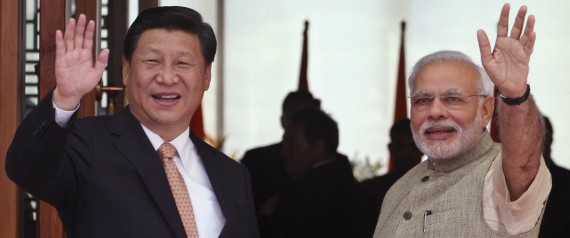
Chinese President Xi Jinping Sees 'Factory' China And 'Back Office' India As Global Engine

AHMEDABAD, India, Sept 17 (Reuters) - The "world's factory" and the "world's back office" could together drive global economic growth, Chinese President Xi Jinping said as he began a rare visit to India on Wednesday, playing down mistrust that has long kept the Asian giants apart.

India's new prime minister, Narendra Modi, is determined to build closer relations with the world's second-largest economy, whose leader arrived on Modi's 64th birthday armed with pledges to invest billions of dollars in railways, industrial parks and roads.

Sunday, June 29, 2014

Narendra Modi's Hindi-only-tweets order stirs fears of India language shift

Narendra Modi's landslide victory in the Indian general election last month marked a turning point in the country's politics – but it has also resulted in a radical change in the country's language of power.

India's home ministry has instructed civil servants in Delhi to use Hindi rather than English in all their communications on Facebook, Twitter and other social media, it emerged this week. Hindi is to also get priority on all government websites.

Thursday, May 29, 2014

Narenda Modi’s Transformation From International Outcast to India’s Prime Minister

It isn’t often that President Obama makes a flattering telephone call to a man who has been denied entrance to the United States for nearly a decade. But he did just that on Friday, May 16, when he telephoned Hindu nationalist hardliner Narendra Modi, India’s prime minister elect, to congratulate him on a clear victory in the Indian elections and to invite him to visit the land of the free. In doing so, some claim, Obama has “pressed the reset button.”