Democracy Gone Astray

Democracy, being a human construct, needs to be thought of as directionality rather than an object. As such, to understand it requires not so much a description of existing structures and/or other related phenomena but a declaration of intentionality.
This blog aims at creating labeled lists of published infringements of such intentionality, of points in time where democracy strays from its intended directionality. In addition to outright infringements, this blog also collects important contemporary information and/or discussions that impact our socio-political landscape.

All the posts here were published in the electronic media – main-stream as well as fringe, and maintain links to the original texts.

[NOTE: Due to changes I haven't caught on time in the blogging software, all of the 'Original Article' links were nullified between September 11, 2012 and December 11, 2012. My apologies.]

Showing posts with label Online Spying. Show all posts

Friday, October 04, 2013

CIRA President Byron Holland: Canadian Internet Users Can Avoid NSA Spying

The head of the agency that manages Canada’s .ca domain says the country should build out its own internet infrastructure to avoid spying by the U.S. National Security Agency.

Byron Holland, president of the Canadian Internet Registration Authority (CIRA), says internet traffic in Canada is often routed through U.S. exchange points, making it vulnerable to NSA monitoring.

Monday, June 10, 2013

Data-collection program got green light from MacKay in 2011

Defence Minister Peter MacKay approved a secret electronic eavesdropping program that scours global telephone records and Internet data trails – including those of Canadians – for patterns of suspicious activity.

Mr. MacKay signed a ministerial directive formally renewing the government’s “metadata” surveillance program on Nov. 21, 2011, according to records obtained by The Globe and Mail. The program had been placed on a lengthy hiatus, according to the documents, after a federal watchdog agency raised concerns that it could lead to warrantless surveillance of Canadians.

NSA Surveillance Program Oversight: White House, Congress Point Fingers At Each Other

WASHINGTON -- Revelations of massive data mining by the National Security Agency have prompted a blame game between the White House and Congress over how much responsibility each has for the program.

President Barack Obama on Friday defended his administration’s broad surveillance operations by arguing that checks and balances ensure privacy concerns were addressed. If they weren’t, he added, citizens could point the finger at Congress in addition to him.

Friday, June 07, 2013

Does Verizon records case mean an end to privacy?

Someday, a young girl will look up into her father’s eyes and ask, “Daddy, what was privacy?”

The father probably won’t recall. I fear we’ve already forgotten that there was a time when a U.S. citizen’s telephone calls were nobody else’s business. A time when people would have been shocked and angered to learn that the government was compiling a detailed log of ostensibly private calls made and received by millions of Americans.

PRISM scandal: tech giants flatly deny allowing NSA direct access to servers

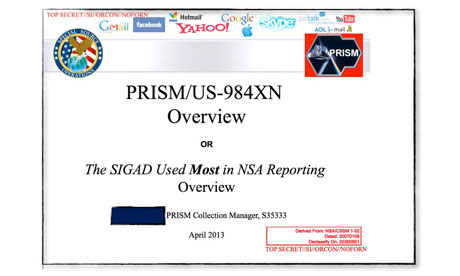
Two different versions of the PRISM scandal were emerging on Thursday with Silicon Valley executives denying all knowledge of the top secret program that gives the National Security Agency direct access to the internet giants' servers.

The eavesdropping program is detailed in the form of PowerPoint slides in a leaked NSA document, seen and authenticated by the Guardian, which states that it is based on "legally-compelled collection" but operates with the "assistance of communications providers in the US."

US intelligence chief denounces 'reprehensible' release of information

Disclosure of the massive surveillance of phone records and internet communications risks “long-lasting and irreversible harm” to US national security, the director of national intelligence says.

Late on Thursday night US time James Clapper issued a bullet-point defence of the surveillance programs disclosed by the Guardian and the Washington Post, saying they contained “numerous safeguards that protect privacy and civil liberties”. To correct the “misleading impression left in the article” – apparently a reference to the Guardian’s original story – Clapper said he approved the declassification of his defence of the National Security Agency’s collection of every phone record from millions of Verizon customers.

U.S., British intelligence mining data from nine U.S. Internet companies in broad secret program

The National Security Agency and the FBI are tapping directly into the central servers of nine leading U.S. Internet companies, extracting audio and video chats, photographs, e-mails, documents, and connection logs that enable analysts to track foreign targets, according to a top-secret document obtained by The Washington Post.

The program, code-named PRISM, has not been made public until now. It may be the first of its kind. The NSA prides itself on stealing secrets and breaking codes, and it is accustomed to corporate partnerships that help it divert data traffic or sidestep barriers. But there has never been a Google or Facebook before, and it is unlikely that there are richer troves of valuable intelligence than the ones in Silicon Valley.

NSA Prism Data Mining Is All Up In Ur Microsoft, Yahoo, Google, Facebook, PalTalk, AOL, Skype, YouTube, Apple

America, here's hoping you've had enough time to come to terms with the National Security Agency scooping up all of your metadata pertaining to all of the phone calls you've been making with Verizon, because here comes the next fun news about the government's far-reaching panopticon of total information surveillance, courtesy of Barton Gellman and Laura Poitras of The Washington Post:

    The National Security Agency and the FBI are tapping directly into the central servers of nine leading U.S. Internet companies, extracting audio, video, photographs, e-mails, documents and connection logs that enable analysts to track a person’s movements and contacts over time.

"A Massive Surveillance State": Glenn Greenwald Exposes Covert NSA Program Collecting Calls, Emails

The National Security Agency has obtained access to the central servers of nine major Internet companies — including Google, Microsoft, Apple, Yahoo! and Facebook. The Guardian and The Washington Post revealed the top-secret program, codenamed PRISM, after they obtained several slides from a 41-page training presentation for senior intelligence analysts. It explains how PRISM allows them to access emails, documents, audio and video chats, photographs, documents and connection logs. "Hundreds of millions of Americans, and hundreds of millions – in fact, billions of people around the world – essentially rely on the Internet exclusively to communicate with one another," Greenwald says. "Very few people use landline phones for much of anything. So when you talk about things like online chat and social media messages and emails, what you’re really talking about is the full extent of human communication." This comes after Greenwald revealed Wednesday in another story that the NSA has been collecting the phone records of millions of Verizon customers. "They want to make sure that every single time human beings interact with one another … that they can watch it, and they can store it, and they can access it at any time."

Video
Source:  democracynow.org
Author: --

Saturday, May 18, 2013

Is the Government Spying on Reporters More Often Than We Think?

The Justice Department's seizure of call logs related to phone lines used by dozens of Associated Press reporters has provoked a flurry of bipartisan criticism, most of which has cast the decision as a disturbing departure from the norm. AP head Gary Pruitt condemned the decision, part of an investigation into leaks of classified information, as a "massive and unprecedented intrusion." Yet there's plenty of circumstantial evidence suggesting the seizure may not be unprecedented—just rarely disclosed.

Monday, May 13, 2013

Chinese hackers caught trying to steal secrets of our new stealth fighter as tens of thousands of cyber attacks are launched on jet manufacturer every week

Chinese cyber spies have been caught trying to steal the secrets of Britain’s most sophisticated combat jet, The Mail on Sunday has learned.

A covert unit within the Chinese Army has been using highly sophisticated cyber weapons in a desperate attempt to acquire classified information about the stealthy Joint Strike Fighter (JSF).

Bloomberg Terminal Spying Targeted Ben Bernanke, Tim Geithner: CNBC

The Bloomberg terminal spying scandal has reached new heights, CNBC reports.

A former Bloomberg employee told CNBC that he accessed information on the terminals of Federal Reserve chairman Ben Bernanke and former Treasury Secretary Tim Geithner. The employee didn't say specifically what he was looking at, but that it concerned usage of specific functions.

Thursday, March 28, 2013

FBI's Lawyer Says Modernizing Surveillance Law For Real-Time Online Snooping Is A 'Top Priority' In 2013

The FBI’s "top priority" in 2013 is to modernize surveillance law so authorities can monitor in real time the Web activities of Americans suspected of committing crimes, the FBI’s general counsel said.

At a luncheon for the American Bar Association in Washington last week, Andrew Weissman said that a 1994 federal law designed to help law enforcement conduct lawful surveillance was not keeping up with modern forms of communication.

Friday, March 15, 2013

FinFisher Spyware: Canada Among 25 Countries Hosting Servers For Controversial Software

Canada is among 25 countries linked to a spyware network that is being used by repressive governments to stifle dissent, according to researchers at the University of Toronto.

A new study from the Citizen Lab at the Munk School of Global Affairs has identified Canada as one of the countries where servers are hosted for FinFisher, a trojan horse program that can log keystrokes on a computer, turn on cameras and microphones, grab screen images and even listen in on Skype chats.

Wednesday, March 13, 2013

FinSpy Software Used To Surveil Activists Around The World, Report Says

FinSpy surveillance software, marketed worldwide to law enforcement agencies as a way to monitor criminals, is widely used by repressive governments to spy on human rights groups and dissidents, according to a report released Wednesday.

The report by researchers at the Citizen Lab of the Munk School of Global Affairs at the University of Toronto found the software is "regularly sold to countries where dissenting political activity and speech is criminalized."

Wednesday, February 20, 2013

Anonymous Helps Researchers Link Hackers To Chinese Army

An American computer security company released an explosive report Tuesday linking a Chinese military unit to a growing number of cyber attacks against American companies, organizations and government agencies.

But some of those connections -- including profiles of the individual hackers in China -- could not have been made without the work of the hacker group Anonymous, according to the report by the security firm Mandiant.

Chinese Army Unit Is Seen as Tied to Hacking Against U.S.

On the outskirts of Shanghai, in a run-down neighborhood dominated by a 12-story white office tower, sits a People’s Liberation Army base for China’s growing corps of cyberwarriors.


 The building off Datong Road, surrounded by restaurants, massage parlors and a wine importer, is the headquarters of P.L.A. Unit 61398. A growing body of digital forensic evidence — confirmed by American intelligence officials who say they have tapped into the activity of the army unit for years — leaves little doubt that an overwhelming percentage of the attacks on American corporations, organizations and government agencies originate in and around the white tower.

Sunday, February 03, 2013

Telus buys forensic computer security firm

Telus Corp. is beefing up its ability to offer security solutions for customers by buying a digital forensics company.

The carrier said Friday it has bought Digital Wyzdom Inc. of Toronto for an undisclosed price.

Digital Wyzdom is an independent security consulting firm with about 25 investigators that provide digital forensics, network security, E-discovery, intellectual property, and fraud advisory services to organizations across the country.

Tuesday, December 06, 2011

Stop hiding behind the phone book, Mr. Toews

Canada’s federal Privacy Commissioner, along with her provincial and territorial counterparts, has serious concerns regarding the federal government’s proposed lawful access legislation. These include the fact that the government has provided no evidence for the necessity of this expansion of state surveillance powers or why it requires departures from the standards of judicial oversight we usually apply when the police want access to private information. Public Safety Minister Vic Toews has responded by throwing the phone book at them, including in a recent letter to The Globe.

Usually, if the state wants access to private information, our Constitution requires prior judicial authorization (a warrant) on a standard of reasonable and probable grounds. The point is not to prevent state access but to ensure that such access occurs within a framework of accountability and oversight. Some departures from this are tolerated, such as when the state interest goes beyond routine law enforcement or where there is a diminished expectation of privacy in the information.

What Mr. Toews seems to have in mind with his phone-book analogy is something like the following: The police can get access to the content of your telephone calls through a special warrant that receives our highest level of protection. The police can also get access to your incoming and outgoing telephone numbers by getting a warrant on a much lower standard of reasonable suspicion. Finally, the police can match people’s names and addresses to particular telephone numbers by using the phone book (ignore for a moment the fact that one can request an unlisted number).

Tuesday, November 22, 2011

'Lawful Access' Online Spying Law Could Kill Small Internet Providers In Canada, Industry Group Says

The controversial online spying laws Ottawa has promised to reintroduce in Parliament could force independent Internet service providers to shut down, an industry advocacy group says.

The Canadian Network Operators’ Consortium, a trade group composed of 25 small and mid-sized ISPs, says the “lawful access” legislation the Conservative government has promised could put Internet providers out of business with its requirement that they retrofit their networks so that law enforcement can monitor communications in real time.

The Conservatives introduced a set of three bills in the last Parliament that would vastly expand the ability of law enforcement to gather information online. One provision would force Internet providers to hand over subscriber information -- such as names, email addresses and phone numbers -- without a warrant.