Democracy Gone Astray

Democracy, being a human construct, needs to be thought of as directionality rather than an object. As such, to understand it requires not so much a description of existing structures and/or other related phenomena but a declaration of intentionality.
This blog aims at creating labeled lists of published infringements of such intentionality, of points in time where democracy strays from its intended directionality. In addition to outright infringements, this blog also collects important contemporary information and/or discussions that impact our socio-political landscape.

All the posts here were published in the electronic media – main-stream as well as fringe, and maintain links to the original texts.

[NOTE: Due to changes I haven't caught on time in the blogging software, all of the 'Original Article' links were nullified between September 11, 2012 and December 11, 2012. My apologies.]

Showing posts with label Peacekeeping. Show all posts

Tuesday, September 29, 2015

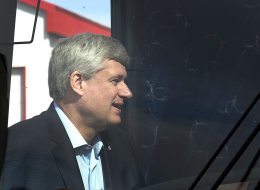
Harper's UN Peacekeepers Claim Contains 'Some Baloney'

OTTAWA — "Canada is still involved in peacekeeping in areas like the Sinai. We still contribute peacekeepers around the world." — Conservative Leader Stephen Harper, responding to Liberal Leader Justin Trudeau's suggestion that Canada is out of the peacekeeping business.
___
As Canada's political leaders slugged it out in a foreign policy debate in Toronto, world leaders meeting in New York pledged to increase the size of United Nations peacekeeping forces by 30,000.

Monday, December 03, 2012

Time for Canada to get back to peacekeeping

For years now, the Canadian army has fretted about finding a new role for itself after Afghanistan. Well, that day has arrived and it can no longer dodge the stark post-war questions: What next, and where?

Spare us an eternity of training at home and aiding with floods and ice storms, is a common lament among soldiers who see little that's challenging or career-enhancing ahead.

Tuesday, September 04, 2012

Canada always was a warrior nation

Is Canada a peacekeeping nation? Or is it a warrior nation? These questions are the subject of two Spring 2012 books by Noah Richler (What We Talk About When We Talk About War) and Ian McKay and Jamie Swift (Warrior Nation: Rebranding Canada in an Age of Anxiety). They are notable for the vigour of their arguments and, not least, because both take aim at the Canadian Defence and Foreign Affairs Institute and at David Bercuson and Jack Granatstein. Yes, David and me. Ordinarily, I would not respond to attacks of this sort (David can make his own decisions!), but the issue is important and I’ve decided it’s worth a reply.

Monday, August 13, 2012

Canada’s peacekeeping tradition is worth defending

“I always thought Canada was on the side of the angels.”

This was the assessment of Rev. Theodore Hesburgh, the esteemed president emeritus of the University of Notre Dame, former chair of the U.S. Civil Rights Commission, and founder of the world-renowned Kroc Institute for International Peace Studies.

I was visiting Notre Dame for a conference, and popped in to give my regards to Father Hesburgh, who expressed concern over Canada’s retreat from its celebrated role as postwar peacekeeper and “honest broker” in world affairs.

Tuesday, August 07, 2012

UN ignores abuse by peacekeepers in Congo

What do we do when those we entrust with our greatest hopes betray that trust? If the betrayers are United Nations peacekeepers, the answer seem to be nothing at all. There is distressing new evidence, most of it reported here for the first time, that foreign soldiers in the Democratic Republic of Congo can sexually and violently violate young girls with impunity so long as they wear that iconic blue beret or blue helmet.

This is not, alas, a unique story. Documented cases of girls being victimized by UN forces -- or, more precisely, the troops from the many countries who serve in UN missions -- has a long and squalid history. The landmark 1996 UNICEF study The Impact of Armed Conflict on Children reported that "In 6 out of 12 country studies, the arrival of peacekeeping troops has been associated with a rapid rise in child prostitution." A review eight years later concluded that prostitution and sexual abuse followed most UN interventions. "Even the guardians have to be guarded," it concluded.

Friday, June 08, 2012

Blue helmets cast aside, Canada keeps the peace no more

Once pre-eminent among peacekeeping nations with thousands of “blue berets” deployed around the world, Canada now ranks 53 – between Paraguay and Slovakia – on the United Nations contributors’ list with less than a schoolbus-load of Canadian soldiers serving on UN missions overseas.

Since then 1990s, successive Canadian governments, both Conservative and Liberal, have shunned traditional UN-mandated peacekeeping for U.S.-led war-fighting missions in Kosovo, Afghanistan and Libya. Those campaigns have eclipsed the UN as Ottawa’s favoured military expeditionary effort. From being the top contributor in the early 1990s, the Canadian commitment dropped precipitously from thousands, to hundreds a decade ago to only a few dozen in recent years.

Thursday, February 23, 2012

The truth about Lester Pearson's peacekeeping

Lester Pearson’s Peacekeeping: The Truth May Hurt
by Yves Engler
(Fernwood Publishing, 2012; $15.95)

In his new book, Yves Engler sets to demolish the near saintly status of Lester Bowles ("Mike") Pearson in the public sphere, Canadian foreign policy circles and even on the social democratic left. And in the process, he takes on the much repeated slogan that "the world needs more of Canada."

Much like Noam Chomsky who provides a forward to Lester Pearson's Peacekeeping, the author relies mostly on the excellent but largely unread scholarship plus the former PM's own statements in Parliament and in memos to successfully establish a case.

As a diplomat in Washington, senior foreign affairs bureaucrat, foreign affairs minister and a prime minister in Liberal governments from the 1940s to the 1960s, Pearson figured prominently in the shaping of Canadian foreign policy in the post World War II period.