Democracy Gone Astray

Democracy, being a human construct, needs to be thought of as directionality rather than an object. As such, to understand it requires not so much a description of existing structures and/or other related phenomena but a declaration of intentionality.
This blog aims at creating labeled lists of published infringements of such intentionality, of points in time where democracy strays from its intended directionality. In addition to outright infringements, this blog also collects important contemporary information and/or discussions that impact our socio-political landscape.

All the posts here were published in the electronic media – main-stream as well as fringe, and maintain links to the original texts.

[NOTE: Due to changes I haven't caught on time in the blogging software, all of the 'Original Article' links were nullified between September 11, 2012 and December 11, 2012. My apologies.]

Showing posts with label Robots. Show all posts

Tuesday, September 23, 2014

Robots Are Not Just Taking Over Jobs -- They're Taking Over Economics As We Know It

Economists have been reacting of late to evidence of prolonged structural unemployment by raising the science-fiction specter of robots taking over all sorts of human jobs. What has attracted far less attention is the way in which robots have been taking over modern economics.

This is not to call the economics profession robotic, but rather to highlight that computers have influenced the way economists think about people and markets, and furthermore, how markets are increasingly coming to be defined by computers. Back in 2002, I described in a book Machine Dreams the ways in which game theory and rational choice was highly informed by the spread of electronic computers. I cited the science studies term "cyborg science" to designate the machine-like turn in orthodox choice theory: treating people as part machine, part human. Now, more than a decade later, the trend has intensified to the point of becoming apparent even to people uninterested in the history of economic thought.

Thursday, December 19, 2013

Google’s Robot Army

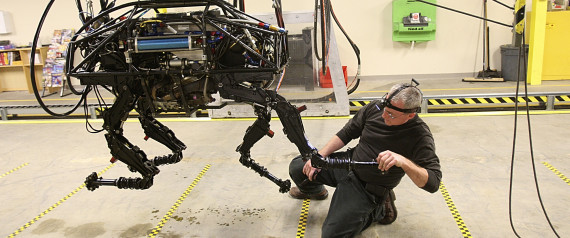
A couple of weeks ago, shortly after the Amazon C.E.O. Jeff Bezos unveiled, on “60 Minutes,” that his company plans to deliver packages to customers with a swarm of autonomous, flying drones, Google made an announcement that seemed far less explosive: Andy Rubin, the former head of Android, would lead an “effort to create a new generation of robots.” Over the weekend, Google revealed how sweeping its ambitions truly are: the company purchased Boston Dynamics, a robotics firm best known for products like Big Dog, a four-legged device that carries cargo across rough terrain, and the Cheetah, which can run faster than Usain Bolt. If Amazon and Google’s collective plans succeed over the next few years, they could usher in a new era of human-robot interaction, one in which we regularly find ourselves face to face with robots in both public and private spaces.

Saturday, December 14, 2013

Google Acquires Boston Dynamics, Adding To Its Fleet Of Robot-Makers

The rich get richer. And they also get more robots.

Google confirmed Friday to The New York Times that it had completed the acquisition of Boston Dynamics, the Waltham, Mass., engineering company that has designed robots for the Pentagon. The company, purchased by Google for an undisclosed sum, is the eighth robotics company Google has acquired in the last several months.

Last week, the Times also reported that Google's newest "moonshot" effort to create a division focused on building and experimenting with robots would be developed by Andy Rubin, the boss behind Google's Android operating system. Unlike Google's computerized glasses or driverless cars, these robots will be available only to businesses that want to streamline the manufacturing process.

Wednesday, December 04, 2013

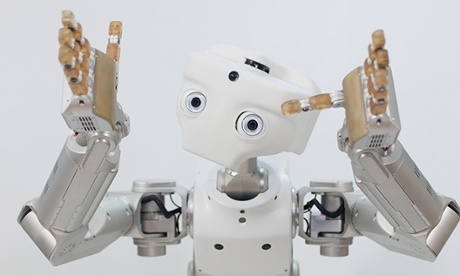
Google sees Amazon's drones, and raises its own army of robots

With Amazon winning headlines (if not universal praise) for its ambitions to deliver packages using drones, rival tech giant Google has announced its latest futuristic "moonshot": robots.

The initiative is led by Andy Rubin, the former head of Google's Android division, who stepped down from that role in March 2013.

Since then, Google has quietly acquired seven robotics companies according to the New York Times, which has published the first interview with Rubin on the company's plans.