Democracy Gone Astray

Democracy, being a human construct, needs to be thought of as directionality rather than an object. As such, to understand it requires not so much a description of existing structures and/or other related phenomena but a declaration of intentionality.
This blog aims at creating labeled lists of published infringements of such intentionality, of points in time where democracy strays from its intended directionality. In addition to outright infringements, this blog also collects important contemporary information and/or discussions that impact our socio-political landscape.

All the posts here were published in the electronic media – main-stream as well as fringe, and maintain links to the original texts.

[NOTE: Due to changes I haven't caught on time in the blogging software, all of the 'Original Article' links were nullified between September 11, 2012 and December 11, 2012. My apologies.]

Showing posts with label Sarin Gas. Show all posts

Monday, July 17, 2017

Sarin used in April Syria attack, chemical weapons watchdog confirms

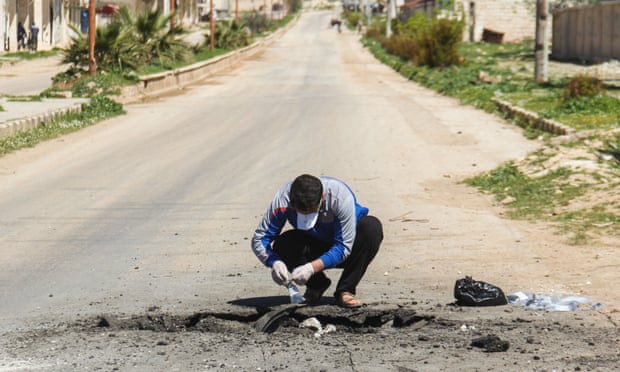
The nerve agent sarin was used in an attack in April on the Syrian town of Khan Sheikhun and was likely to have spread from a crater in a road where a projectile had hit, the global chemical weapons watchdog has confirmed.

A report by the Organisation for the Prohibition of Chemical Weapons (OPCW) also found that hexamine – a known component of the Syrian regime’s stockpiles – was contained in samples taken from the scene and from the blood and urine of victims.

Tuesday, December 10, 2013

Seymour Hersh Stirs Dispute After Casting Doubt on Syrian Chemical Weapons Intel

As most of you probably know by now, Seymour Hersh has written a major piece on the claims by the US (and others) that the pro-Assad forces used Sarin gas in Syria, and President Obama’s eventual response. This came after the article was turned down both by The Washington Post (which planned to publish it) and Hersh’s frequent home, The New Yorker.

Months ago I was among those strongly criticizing media coverage of what I saw as hyped, unproven (if not necessarily false) claims that nearly took us to war. After much protest from the left, and some on right (plus many MPs in the UK), Obama pulled back, somewhat mysteriously—and Assad then agreed to dismantle his arsenal. Soon Iran’s leaders were also responding favorably on nuclear inspections.
Monday, December 09, 2013

Whose sarin?

Barack Obama did not tell the whole story this autumn when he tried to make the case that Bashar al-Assad was responsible for the chemical weapons attack near Damascus on 21 August. In some instances, he omitted important intelligence, and in others he presented assumptions as facts. Most significant, he failed to acknowledge something known to the US intelligence community: that the Syrian army is not the only party in the country’s civil war with access to sarin, the nerve agent that a UN study concluded – without assessing responsibility – had been used in the rocket attack. In the months before the attack, the American intelligence agencies produced a series of highly classified reports, culminating in a formal Operations Order – a planning document that precedes a ground invasion – citing evidence that the al-Nusra Front, a jihadi group affiliated with al-Qaida, had mastered the mechanics of creating sarin and was capable of manufacturing it in quantity. When the attack occurred al-Nusra should have been a suspect, but the administration cherry-picked intelligence to justify a strike against Assad.

Seymour Hersh: Obama "Cherry Picked" Intelligence on Syrian Chemical Attack to Justify U.S. Strike

Investigative journalist Seymour Hersh joins us to discuss his new article casting doubt on the veracity of the Obama administration’s claims that only the Assad regime could have carried out the chemical attacks in the Damascus suburb of Ghouta earlier this year. Writing in the London Review of Books, Hersh argues that the Obama administration "cherry-picked intelligence to justify a strike against Assad." The administration failed to disclose it knew Syrian rebels in the al-Nusra front had the ability to produce chemical weapons. Evidence obtained in the days after the attack was also allegedly distorted to make it appear it was gathered in real time.

Video
Source: democracynow.org
Author: --

Thursday, September 19, 2013

Sarin: the deadly history of the nerve agent used in Syria

Now we know. On the morning of 21 August, as the air above Damascus cooled, rockets filled with the nerve agent sarin fell on rebel-held suburbs of the Syrian capital and left scores of men, women and children dead or injured. UN inspectors had been in the country for three days, on a mission to investigate allegations of earlier atrocities. They quickly changed tack. They brokered a temporary ceasefire with the regime and the rebels and made straight for Ghouta. Video reports from the area showed hospital staff overwhelmed and desperate.

Never before had UN inspectors worked under such pressure and in the midst of a war zone. The small team, headed by the Swedish chemical weapons expert Åke Sellström, was threatened with harm. Their convoy was shot at. But their 41-page report was completed in record time.

Tuesday, September 03, 2013

John Kerry: Evidence Of Sarin Gas Used In Syria, U.S. 'Case Is Building' For Strike

WASHINGTON — Secretary of State John Kerry asserted Sunday that the United States now has evidence of sarin gas use in Syria and said "the case gets stronger by the day" for a military attack.

A day after President Barack Obama stepped back from his threat to launch an attack, Kerry said in a series of interviews on the Sunday news shows that the administration learned of the sarin use within the past 24 hours through samples of hair and blood provided to Washington by first responders in Damascus.

Monday, May 06, 2013

U.N. Has Gathered Testimony Indicating That Syrian Rebels Have Used Sarin Gas, Says Investigator

GENEVA, May 5 (Reuters) - U.N. human rights investigators have gathered testimony from casualties of Syria's civil war and medical staff indicating that rebel forces have used the nerve agent sarin, one of the lead investigators said on Sunday.

The United Nations independent commission of inquiry on Syria has not yet seen evidence of government forces having used chemical weapons, which are banned under international law, said commission member Carla Del Ponte.