Democracy Gone Astray

Democracy, being a human construct, needs to be thought of as directionality rather than an object. As such, to understand it requires not so much a description of existing structures and/or other related phenomena but a declaration of intentionality.
This blog aims at creating labeled lists of published infringements of such intentionality, of points in time where democracy strays from its intended directionality. In addition to outright infringements, this blog also collects important contemporary information and/or discussions that impact our socio-political landscape.

All the posts here were published in the electronic media – main-stream as well as fringe, and maintain links to the original texts.

[NOTE: Due to changes I haven't caught on time in the blogging software, all of the 'Original Article' links were nullified between September 11, 2012 and December 11, 2012. My apologies.]

Showing posts with label Solar Power. Show all posts

Monday, October 02, 2023

The Unplugging of a Promising Alberta Solar Project

A solar energy project in western Alberta was poised to not only power 1,200 homes but innovate a new way to pay for such initiatives, say its backers. But then came the “gut-wrenching” decree by Premier Danielle Smith.

Now the future of Western Canada’s first co-operatively financed solar farm is uncertain, following the United Conservative Party’s sudden freeze on approvals for renewable energy projects in Alberta.

The Peace Energy Cooperative, or PEC, was days away from Alberta Utilities Commission approval that would allow construction to begin on a 13-hectare solar farm. Unless the UCP lifts the seven-month moratorium, the co-operative will have to convince investors to not withdraw their money. 
Monday, June 26, 2017

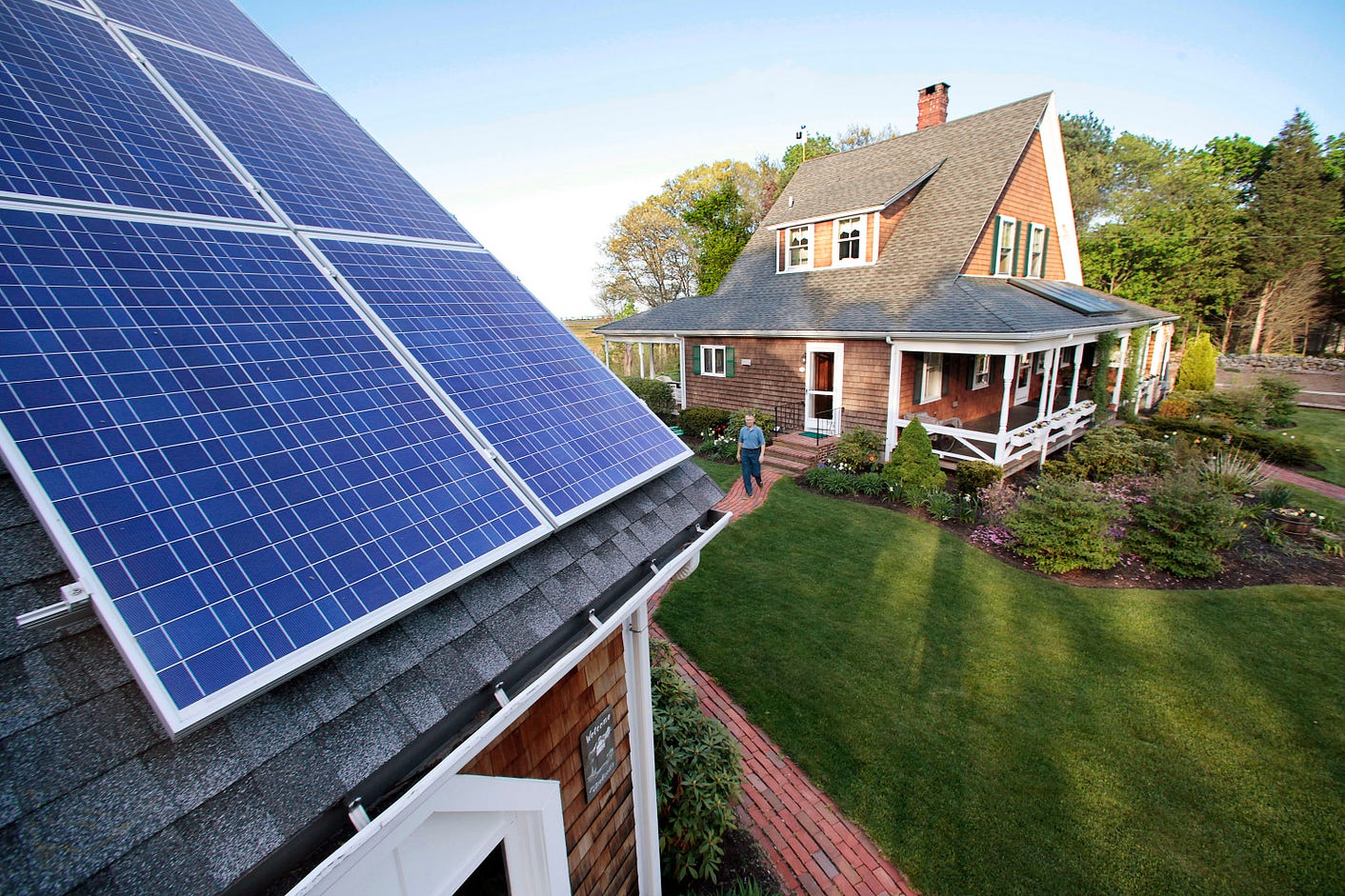
Indiana House passes a bill designed to cripple the state’s growing rooftop solar industry

The Indiana House voted Tuesday for a bill that opponents say will cripple the state’s solar industry.

If enacted, the bill would reduce the amount solar power users are compensated for routing unused electricity back on the grid.

Over the next five years, utilities would reduce net metering — a policy that ensures homeowners are compensated for electricity they add to the grid from solar generation — before bottoming out in 2022. Solar owners will then be compensated at much-reduced level, roughly around the wholesale price for electricity. The bill would also put a legislative cap on the amount of non-utility solar in the state.

Saturday, May 28, 2016

Storing The Sun’s Energy Just Got A Whole Lot Cheaper

With prices dropping rapidly for both renewables and battery storage, the economics of decarbonizing the grid are changing faster than most policymakers, journalists, and others realize. So, as part of my ongoing series, “Almost Everything You Know About Climate Change Solutions Is Outdated,” I will highlight individual case studies of this real-time revolution.

My Monday post discussed the Federal Energy Regulatory Commission’s (FERC) report that in the first quarter, the U.S. grid added 18 megawatts of new natural gas generating capacity, but 1,291 MW of new renewables. But one of FERC’s “Electric Generation Highlights” for March deserves special attention as a leading indicator of the revolutionary new economics of solar plus storage:

    Half Moon Ventures LLC’s 4.2 MW Minster Solar Project in Auglaise County, OH is online. This project includes an energy storage capacity.

Wednesday, April 06, 2016

Florida Will Vote This Year On Measure That Would Block Solar Leasing In The State

Score one for the Koch brothers.

A measure that opponents say is intentionally confusing and will stifle solar growth was given the go-ahead by the Florida Supreme Court on Thursday. It will appear on the Florida ballot in November.

Environmental and solar advocates challenged the measure, titled, “Rights of Electricity Consumers Regarding Solar Energy Choice,” saying that it does not reflect any choice and does not create new rights. Sponsored by utility companies and other groups tied to the Koch brothers, the measure will prevent people from selling their electricity to third parties. This would effectively prevent solar leasing in the state, because under that system, an owner — usually a solar company — installs panels at a home and then sells the generated electricity back to the homeowner.

Tuesday, March 08, 2016

Buffett Says He Loves Renewables, So Why Is His Company Trying To Kill Solar Energy?

Warren Buffett’s recent annual letter to shareholders extols renewable energy. Yet he fails to mention that his company is working to crush solar energy in Nevada and around the western United States.

In Part One, I explored how Buffett, despite being one of the world’s most successful investors, mistakenly downplays the climate risk to his company, Berkshire Hathaway (BH). In particular, he fails to tell investors of the climate risk associated with his massive $1.1 billion investment in Canadian tar sands giant Suncor, a company that can only make a big profit by helping to destroy a livable climate.

Monday, February 29, 2016

The United States Has Blocked a Plan By India to Expand Solar Power and Create Local Jobs

LONDON—India has been told that it cannot go ahead as planned with its ambitious plan for a huge expansion of its renewable energy sector, because it seeks to provide work for Indian people. The case against India was brought by the US.

The ruling, by the World Trade Organisation (WTO), says India’s National Solar Mission—which would create local jobs, while bringing electricity to millions of people—must be changed because it includes a domestic content clause requiring part of the solar cells to be produced nationally.

Monday, February 15, 2016

The Koch Brothers' Dirty War on Solar Power

After decades of false starts, solar power in America is finally poised for its breakthrough moment. The price of solar panels has dropped by more than 80 percent since President Obama took office, and the industry is beginning to compete with coal and natural gas on economics alone.

But the birth of Big Solar poses a grave threat to those who profit from burning fossil fuels. And investor-owned utilities, together with Koch-brothers-funded front groups like American Legislative Exchange Council (ALEC), are mounting a fierce, rear-guard resistance at the state level – pushing rate hikes and punishing fees for homeowners who turn to solar power. Their efforts have darkened green-energy prospects in could-be solar superpowers like Arizona and Nevada. But nowhere has the solar industry been more eclipsed than in Florida, where the utilities' powers of obstruction are unrivaled.

Tuesday, January 26, 2016

The Problem With Rooftop Solar That Nobody Is Talking About

A couple of years ago, Steven Weissman, an energy lawyer at the University of California-­Berkeley, started to shop around for solar panels for his house. It seemed like an environmental no-brainer. For zero down, leading residential provider SolarCity would install panels on his roof. The company would own the equipment, and he’d buy the power it produces for less than he had been paying his electric utility. Save money, fight climate change. Sounds like a deal.

Thursday, May 28, 2015

The World’s First Solar Road Is Producing More Energy Than Expected

In its first six months of existence, the world’s first solar road is performing even better than developers thought.
The road, which opened in the Netherlands in November of last year, has produced more than 3,000 kilowatt-hours of energy — enough to power a single small household for one year, according to Al-Jazeera America.
“If we translate this to an annual yield, we expect more than the 70kwh per square meter per year,” Sten de Wit, a spokesman for the project — dubbed SolaRoad — told Al Jazeera America. “We predicted [this] as an upper limit in the laboratory stage. We can therefore conclude that it was a successful first half year.”

Thursday, March 19, 2015

Government rejects gift of solar panels for Kirribilli House

It was a present intended for the Prime Minister's residence in Sydney.

But a government decision to reject a gift of a set of solar panels for Kirribilli House has seen it come under fire for its attitude toward renewable energy.

Christian lobby group Common Grace crowd funded a set of solar panels in December, hoping the government would agree to install them on Kirribilli House.

Friday, February 27, 2015

How regulators and legislators make it harder for you to use solar power

When homeowners or businesses install solar panels, state laws ensure utility companies pay for unused electricity that is routed back into the power grid - a practice known as net metering.

Currently, 43 states and the District of Columbia have implemented net metering policies, some of which are more favorable than others, but all of which turn the power grid into a two-way street.

The cost of rooftop solar-powered electricity will be on par with prices for common fossil-fuel power generation in just two years, and the technology to produce it will only get cheaper, according to Deutsche Bank's leading solar industry analyst, Vishal Shah.

Monday, September 22, 2014

Putting Solar Panels On School Roofs Could Dramatically Increase America’s Solar Capacity

Any building with a large, flat rooftop is a prime candidate for a solar installation. And one particular large, flat roof that’s ubiquitous in the U.S. is on schools.
According to a new report by the Energy Department and the Solar Foundation — the research arm of the Solar Energy Industries Association, a solar trade organization — if schools took advantage of their full potential for solar, they would add 5.4 gigawatts to the country’s solar capacity. That’s just over a third of the 16 gigawatts of total capacity America currently boasts. That would be enough to power roughly one million homes, and a carbon emissions reduction equivalent to taking around one million passenger vehicles off the road.

Tuesday, September 16, 2014

Push To Impose Extra Fees On Solar Customers Draws Outrage In Wisconsin

A recent move by Wisconsin utility We Energies to not only raise electricity rates on all consumers but also to add an additional charge on those who produce their own energy and sell it back to the grid has sparked outrage within the state and beyond. The plan would raise the “fixed charge” on all customers’ electric bills from $9 to $16 a month, as well as reduce net metering — a policy that enables customers with solar panels or other forms of distributed generation to sell their excess electricity back to the grid — and add a new charge on these electricity-generating customers.

Tuesday, May 06, 2014

This Amazing Solar City Produces 4 Times the Energy it Consumes

Although net-zero projects have been creating a lot of buzz lately in the field of green building, the Sonnenschiff solar city in Freiburg, Germany is very much net positive. The self-sustaining city accomplishes this feat through smart solar design and lots and lots of photovoltaic panels pointed in the right direction. It seems like a simple strategy — but designers often incorporate solar installations as an afterthought, or worse, as a label.

Thursday, May 01, 2014

Round-the-Clock Solar Power is Here

LONDON—Solar power’s greatest drawback has always been that it is intermittent and, even in the sunniest climes, peak electricity demand is frequently in the evening when the Sun is going down.

The engineering challenge has been to design a system in which enough of the Sun’s heat can be stored to produce full power continuously even on cloudy days – and better still, all night.

Many different designs have been tried, but finally a commercial plant in Spain seems to have cracked the problem, and as a result has won an award from a panel of independent judges.

Thursday, April 24, 2014

Oklahoma Will Charge Customers Who Install Their Own Solar Panels

Oklahoma residents who produce their own energy through solar panels or small wind turbines on their property will now be charged an additional fee, the result of a new bill passed by the state legislature and expected to be signed into law by Gov. Mary Fallin (R).
On Monday, S.B. 1456 passed the state House 83-5 after no debate. The measure creates a new class of customers: those who install distributed power generation systems like solar panels or small wind turbines on their property and sell the excess energy back to the grid. While those with systems already installed won’t be affected, the new class of customers will now be charged a monthly fee — a shift that happened quickly and caught many in the state off guard.

Friday, March 28, 2014

U.S. Tries To Stop India's Solar Policy While Pushing Fight Against Climate Change

WASHINGTON -- The Obama administration talks a lot about the need to develop renewable energy around the world to curb climate change. But right now, it's trying to kill India's effort to boost its domestic solar industry.

The U.S. wants India to back off a policy that would require local sourcing for solar energy technology, and has sought World Trade Organization enforcement action. Representatives from the two nations reportedly met last week to try to settle the trade battle over India's rapidly developing solar industry, but reached no resolution.

Thursday, March 27, 2014

Solar Power Is Now Just As Cheap As Conventional Electricity In Italy And Germany

Once all its costs are accounted for, the price of commercial solar power has pulled even with retail electricity rates in Italy and Germany, according to a new report.
The analysis is the third installment in a regular report by the consulting firm Eclareon, done on behalf of an international group of sustainable energy interests. This installment was also the first to look at solar power in the commercial sector rather than the residential sector. It looked at a standard 30 kilowatt solar photovoltaic system for your average commercial building, and the built a methodology to assess its “leveled cost of energy” (LCOE) in seven different countries: Brazil, Chile, France, Germany, Italy, Mexico and Spain.

Thursday, August 22, 2013

When Will Solar Get Cheap Enough for Everyone to Use?

The prices of solar cells are falling rapidly, and will keep doing so for the next few years. The big questions revolve around the rate of the price declines. And the panels themselves aren't the only place where cost reductions will be found. America has very high "soft costs"—installation, permitting, marketing etc. Whittling down these expenses will help, too.

Solar is taking off at a breakneck pace (admittedly from a tiny base). Stephen Lacey at Greentech Media provides the striking figures illustrating the exponential growth of solar photovoltaics (PV) in the past few years:

It took nearly four decades to install 50 gigawatts of PV capacity worldwide. But in the last 2 ½ years, the industry jumped from 50 gigawatts of PV capacity to just over 100 gigawatts. At the same time, global module prices have fallen 62 percent since January 2011. Even more amazingly, the solar industry is on track to install another 100 gigawatts worldwide by 2015—nearly doubling solar capacity in the next 2 1/2 years.

Monday, July 15, 2013

Native American tribes are blazing a trail for solar power

In the past five years or so, a combination of factors including government mandates surrounding clean energy and lower costs for equipment, have led to what has been dubbed a "solar gold rush" in parts of the US.

As energy companies compete fiercely to find large tracts of land with ample sunshine to develop solar projects, Native Indian tribes, many of which have an abundance of both, have been presented with a unique opportunity to become leaders as solar developers and users.