Democracy Gone Astray

Democracy, being a human construct, needs to be thought of as directionality rather than an object. As such, to understand it requires not so much a description of existing structures and/or other related phenomena but a declaration of intentionality.
This blog aims at creating labeled lists of published infringements of such intentionality, of points in time where democracy strays from its intended directionality. In addition to outright infringements, this blog also collects important contemporary information and/or discussions that impact our socio-political landscape.

All the posts here were published in the electronic media – main-stream as well as fringe, and maintain links to the original texts.

[NOTE: Due to changes I haven't caught on time in the blogging software, all of the 'Original Article' links were nullified between September 11, 2012 and December 11, 2012. My apologies.]

Showing posts with label Spending Cuts. Show all posts

Monday, May 18, 2015

Funding slashed for all safety programs at Transport Canada

OTTAWA —The Conservative government is slashing funding for all safety and security programs at Transport Canada, with a significant chunk coming out of safety oversight initiatives, planning documents show.

The amount of funding set to be clawed away varies between programs — the budget for transportation of dangerous goods is going down 32 per cent while the budget for aviation safety is dropping 9.2 per cent, for example — but all are seeing decreases, just as the wreckage of Air Canada Flight 624 was pulled off a runway in Halifax and the Quebec town of Lac-Megantic continues to rebuild.

Friday, February 20, 2015

CSIS, RCMP, National Defence's Lapsed Funds Total $11 Billion Since 2007

OTTAWA - New figures show the country's three major national security institutions were collectively unable to spend $11 billion of their budgets over the last eight years.

The statistics on lapsed funds at National Defence, the Canadian Security Intelligence Service and the RCMP were presented today at the annual Conference of Defence Associations Institute meeting, which also heard a renewed warnings that the military is on the verge of a major equipment rust out.

The numbers stand in contrast to the rosy assessment of the Harper government's defence spending record as presented by Jason Kenney, the newly appointed minister.

Wednesday, October 15, 2014

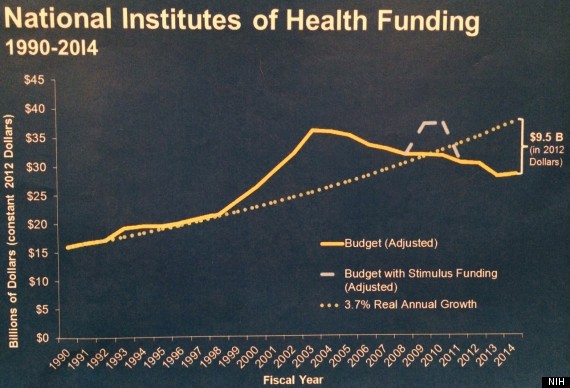
Ebola Vaccine Would Likely Have Been Found By Now If Not For Budget Cuts: NIH Director

francis collins
BETHESDA, Md. -- As the federal government frantically works to combat the Ebola outbreak in West Africa, and as it responds to a second diagnosis of the disease at home, one of the country's top health officials says a vaccine likely would have already been discovered were it not for budget cuts.

Dr. Francis Collins, the head of the National Institutes of Health, said that a decade of stagnant spending has "slowed down" research on all items, including vaccinations for infectious diseases. As a result, he said, the international community has been left playing catch-up on a potentially avoidable humanitarian catastrophe.

Thursday, September 25, 2014

It's Time For B.C. Teachers To Stop Lying To Parents

I work in the arts. I work an average of 57 hours a week, and last year I broke even for the first time in my 11-year career.

I will never own a home in my hometown. We don't have nearly enough saved up for retirement, or our daughter's university tuition. We live paycheque to paycheque. (My husband's paycheques. Because I work in the arts.)

Thursday, March 01, 2012

Stop Starving Public Universities and Shrinking the Middle Class

Last week Rick Santorum called the president "a snob" for wanting everyone to get a college education (in fact, Obama never actually called for universal college education but only for a year or more of training after high school).

Santorum needn't worry. America is already making it harder for young people of modest means to attend college. Public higher education is being starved, and the middle class will shrink even more as a result.

Over just the last year 41 states have cut spending for public higher education. That's on top of deep cuts in 2009 and 2010. Some public universities, such as the University of New Hampshire, have lost over 40 percent of their state funding; the University of Washington, 26 percent; Florida's public university system, 25 percent.

Rising tuition and fees are making up the shortfall. This year, the average hike is 8.3 percent. New York's state university system is increasing tuition 14 percent; Arizona, 17 percent; Washington state, 16 percent. Students in California's public universities and colleges are facing an average increase of 21 percent, the highest in the nation.

The children of middle and lower-income families are hardest hit. Remember: The median wage has been dropping since 2000, adjusted for inflation.

Friday, February 24, 2012

Romney’s Economic Closet

According to Michael Kinsley, a gaffe is when a politician accidently tells the truth. That’s certainly what happened to Mitt Romney on Tuesday, when in a rare moment of candor — and, in his case, such moments are really, really rare — he gave away the game.

Speaking in Michigan, Mr. Romney was asked about deficit reduction, and he absent-mindedly said something completely reasonable: “If you just cut, if all you’re thinking about doing is cutting spending, as you cut spending you’ll slow down the economy.” A-ha. So he believes that cutting government spending hurts growth, other things equal.

The right’s ideology police were, predictably, aghast; the Club for Growth quickly denounced the statement as showing that Mr. Romney is “not a limited-government conservative.” On the contrary, insisted the club, “If we balanced the budget tomorrow on spending cuts alone, it would be fantastic for the economy.” And a Romney spokesman tried to walk back the remark, claiming, “The governor’s point was that simply slashing the budget, with no affirmative pro-growth policies, is insufficient to get the economy turned around.”

But that’s not what the candidate said, and it’s very unlikely that it’s what he meant. Almost surely, he is, in fact, a closet Keynesian.

Wednesday, February 15, 2012

Katimavik Cuts: Trudeau-Era Youth Program On Tories' Chopping Block

OTTAWA — Katimavik, the youth service program championed by former prime minister Pierre Elliott Trudeau, is on the Conservative government’s chopping block, The Huffington Post Canada has learned.

“This has been coming for a long time,” Liberal MP Justin Trudeau said Tuesday of the program that his father established in 1977.

“It has been obvious that a program that empowers young people, that encourages them to get out and across the country and serve communities and discover how much they can make a difference in the world, and across Canada, is going to be cut.”

Sources told HuffPost the Tories have discussed slashing the group's funding completely but what the government has settled on hasn't been confirmed.

Heritage Minister James Moore’s office insisted Tuesday, however, that Katimavik isn’t on its deathbed just yet.

“No decisions have been made,” Moore’s spokesman James Maunder said.

Katimavik, which means “meeting place” in Inuktitut, is a national volunteer service program for Canadians aged 17 to 21 and involves placements in many communities across the country. More than 30,000 people have taken part in the program, which saw its federal funding killed in 1986 by the Brian Mulroney government, then revived in 1994 by the Liberals under Jean Chrétien. A registered charity, the program is currently funded the Canadian Heritage department and donations.

Moody's, Fitch Ratings Question Need For Ottawa's Austerity Agenda

The federal government doesn’t need to ramp up spending cuts, and implementing them could harm Canada’s economy as it struggles with weak global demand, two major ratings agencies have said.

Steven Hess, the lead Canada analyst for Moody’s, told the Wall Street Journal that there is a “risk to growth” if the government moves too quickly with austerity measures designed to return the country to balanced budgets.

With a budget deficit that amounts to about two per cent of GDP, there is “no rush” for Canada to address the problem, Hess said.

Though Ottawa has been systematically finding efficiencies in government departments since 2007, lower tax rates and the global economic crisis have forced the government into deficit spending in recent years.

Ahead of this year’s budget, expected to be tabled before the end of March, the Prime Minister’s Office has asked government departments to find 10 per cent in spending reductions.

Tuesday, January 10, 2012

Hawks Hysterical Over Pentagon Cuts

To no one’s surprise, the military-industrial complex and its allies are pushing back against the Obama administration’s plans to trim some fat at the Pentagon.

The big boys—namely, the Aerospace Industries Association, the National Defense Industrial Association and the Professional Services Council—co-wrote a letter to Secretary of Defense Leon Panetta warning that even Panetta’s modest efforts to slow defense spending could lead to catastrophe. Panetta’s proposed $480 billion reduction might fatally undermine the defense industrial base, the letter warned, and it added that they expect further cuts in years to come.

Noting that the Congressional supercommittee’s failure to reach an accord might trigger another $600 billion in defense cuts, the three industry heavyweights said, “Even if the trillion-dollar ‘doomsday’ scenario is avoided, respondents were operating under the assumption that, based on past history, more cuts would be added on top of the $480 billion over the next decade.”

Hawks, including many cited in a Washington Times survey of reaction to the strategic review, are especially alarmed by the administration’s decision to reverse the current strategy that calls on the Defense Department to be capable of fighting two wars at once. In addition, President Obama and Panetta want to shrink the Army and the Marines, cut back on counterinsurgency capabilities and fall back on air and naval deployments, high-tech gizmos and intelligence, while shifting America’s priority from the Middle East to Asia and the Pacific.

Sunday, January 08, 2012

Obama's Leaner, Meaner Military

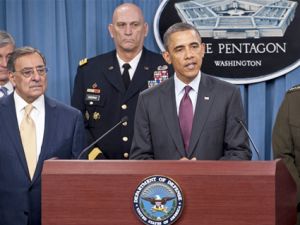
In an announcement long on ambition and short on specifics, President Obama and Defense Secretary Leon Panetta rolled out a new national security strategy Thursday that aims to drastically downsize the military. "[W]e have the opportunity and the responsibility to look ahead to the force we need for the future," the president said. His plan, "Sustaining US Global Leadership," aims to slash troops, fighter jets, and $450 million from the Pentagon bureaucracy. "Whenever possible, we will develop innovative, low-cost, and small-footprint approaches to achieve our security objectives," the 16-page plan states.

If the strategy takes hold—and that's hardly a given, considering how heavily the defense industry lobbies Congress—progressives may like a lot of what they see in the military's newer, leaner look. Still, the plan leaves open the possibility that drones, contractors, and reservists will take over any gaps left in the mammoth, post-9/11 national security complex.

U.S. defence cuts put Harper on the spot

Sheer budget pressure, not a safer world, is driving the new defence policy U.S. President Barack Obama rolled out this past week. The Pentagon’s bloated $700 billion budget could face a $100 billion hit, depending on Congress’s zeal for cuts. So the White House is suddenly playing up the virtues of a smaller military and of thinking twice before getting involved in wars.

To Canadians this may look like housekeeping as heavy U.S. action in Iraq and Afghanistan winds down. To a degree it is. Even a truncated U.S. military will vastly outgun any adversary. But the new posture promises to put Prime Minister Stephen Harper’s Conservative government on the spot, not so much because of its hard military implications as its softer diplomatic ones.

Looking forward, the U.S. hopes to rally more “allies and partners” to help police the world, Obama said. That involves thwarting terror, containing aggressors without all-out war, and keeping the peace.

While the idea of burden-sharing is hardly new, Obama seems to be setting the table to rely more heavily on diplomacy at the United Nations and elsewhere to contain threats such as Iran and North Korea. At the same time he plans to affirm U.S. interests across Asia in part by working with Australia, an old ally, and with India, a new one. Finally, he sees the volatile Middle East as a priority and is wooing Gulf Arab allies there.

As it happens, these are three key areas in which the Harper government’s diplomacy has been deficient, blundering or distorted. If Ottawa aspires to be more than a passive onlooker as the U.S. redefines its relations with much of the world, Harper will have to step up his game and shore up Canada’s credibility.

Sunday, October 16, 2011

Ford still befuddled with budget

After many weeks of wrangling over the core service review and with many more debates to come, Mayor Rob Ford took the opportunity yesterday to reinforce his position on the city’s fiscal crisis.

And his position will come as no surprise.

Toronto cannot reach its full potential until it gets its debt situation under control, Mr. Ford told the crowd, invited by the Empire Club of Canada, at an event sponsored by the National Post.

“The sad truth is that we are losing the ability to make our own decisions,” Mr. Ford warned the audience at Toronto’s Royal York Hotel. According to the Mayor, years of balancing the books only with unexpected windfalls and one-time revenues have left Toronto with $4-billion in debt, plans to borrow an additional $2-billion and annual debt-servicing costs that will climb 50%, to more than $600-million, by 2014. That mounting figure, says the Mayor, combined with the city’s structural deficit, leaves Toronto unable to make long-term plans and invest in its future. The city’s efforts are perpetually focused on staying solvent for the next 12 months.

Monday, September 12, 2011

Sell zoos and theatres, cut daycare, think about closing libraries: City manager

City council should consider cuts to the library system, eliminating late-night TTC buses, selling or closing the Toronto Zoo and Riverdale Farm, and cutting the number subsidized child care spaces, Toronto’s top bureaucrat says.

In a report on Toronto’s “core service review” released Monday morning, city manager Joe Pennachetti also endorsed a host of other cuts and service changes proposed by consulting firm KPMG earlier in the year.

If all of them were implemented, Pennachetti wrote, the city would save $100 million in 2012.

That is far less than the $774 million Mayor Rob Ford has insisted the city needs to find to balance its budget. Even though the true budget gap is less than $500 million because of surplus funds and other revenues, the recommendations suggest that most of the shortfall will not be covered through cuts.

Tuesday, August 09, 2011

Jim Flaherty's Budget Cuts: Are They Too Much, Too Soon?

With debt crises in the United States and Europe threatening to send a still-shaky world economy teetering over the edge, Canada’s finances have rarely looked so good.

Despite racking up a hefty federal budget deficit of $36.2 billion last year, or about 3 per cent of GDP, Finance Minister Jim Flaherty's plan to get back to balance by 2015 — which includes an estimated $4 billion in annual spending cuts — has made Canada the poster child for fiscal responsibility.

But as global economic uncertainty once again reaches a fever pitch, how much austerity is too much?

According to Andrew Jackson, chief economist for the Canadian Labour Congress, the belt-tightening underway in Canada is more extreme than in most other industrialized nations.

Friday, July 29, 2011

KPMG’s ‘opportunities’ for saving

A brief summary of consultant KPMG’s suggestions for cost-cutting in the 2012 Toronto operating budget.

Public works

 • Environment days: Scrap service that allows citizens to bring in household hazardous waste, exchange bins or pick up compost one day a year: $500,000

 • Street events: Consider setting fees from all events high enough to recover all city costs such as cleanup: $700,000

 • Fluoride: Eliminate fluoridation of water, which dentists say prevents cavities: $1.9 million

 • Snow: Stop clearing snow piles left by the plow at the end of suburban driveways: $3.7 million.

 • Toxic taxi: End household pickup of hazardous items such as paint cans. $185,859

 • Garbage tags: Stop giving residents free tags allowing them to put out extra garbage up to four times a year: $593,000

 • Commercial waste: Stop picking up garbage from retailers on commercial strips: $7 million

Economic development

 • Reduce or eliminate Business Services: End programs such as support to film industry and 7,000 entrepreneurs: $3.1 million

 • Reduce or eliminate Cultural Services: $17.3 million

 • Reduce Trade and Sector Development activities: a portion of $3.9 million

 • Reduce staff support to BIAs, or recover costs of support: a portion of $1.3 million

 • Reduce or eliminate TESS Social Supports: $1.5 million

Community development

 • Child care: Transfer or sell city-operated child-care centres: $16 million

 • Child-care subsidies: Eliminate the 2,000 city-only subsidies: $24 million

 • Emergency services: Consider integrating fire and ambulance: $81 million.

 • Nursing homes: Sell or transfer nine of 10 city nursing homes: about $40 million (Star’s estimate)

Parks

 • Attractions: Eliminate zoo and farm attractions: $1.3 million

 • Planting: Eliminate urban agriculture activities: $490,000

 • Environment: Reduce or eliminate Toronto Environment Office: $3.2 million

 • Trees: Allow a lower rate of tree planting and maintenance of existing trees: Net budget for planting is $2 million

 • Flowers: Scrap the greenhouse program, where the city grows 1.3 million annuals every year to plant in parks: estimated $700,000.

Licensing

 • Cats and dogs: Review the value of cat and dog licensing. Program brings in $660,000 a year.

 • Rescue: Reduce response time for emergency animal rescue: $225,000.

 • Shelters: Outsource animal care and enforcement: $1.7 million

 • Licences: Consider eliminating licensing that doesn’t serve the public interest. Licensing fees net the city $5.9 million

 • Recycling: Outsource waste diversion enforcement in apartment buildings: $258,000

 • Delivery: Require people to deliver animals to shelter themselves: $640,000

Government Management

 • 311: Outsource some 311 call centre work to a private contractor: $540,000

 • Tax payment: Offer online payment of property taxes: $355,000

 • Caretaking: Outsource cleaning and security at city buildings: $1.6 million

 • Fleet: Place police, fire and certain transit vehicles under central fleet management: $2.4 million

 • Payroll: Outsource payroll administration: $1.8 million

Planning and growth

 • Public art: Eliminate public art program such as statues and other artworks outside buildings: $95,000.

 • Signs: Cut or end illegal-sign inspections and investigation of illegal-sign complaints: $855,000.

 • Planning: Scale back site plan approval requirements on small developments: $970,000.

Executive

 • Library: Close an unspecified number of branches: up to $13.4 million; reduce hours or days of service: up to $17.5 million.

 • Toronto Zoo: Sell to private owners or divest to other levels of government to avoid taxpayer subsidy: $11.4 million.

 • Exhibition Place: Sell or privatize. Talk to the province about merging Exhibition Place with Ontario Place. (Exhibition Place is budgeted to break even this year.)

 • Public health: Scrap grants budget that supports 685 student nutrition programs for low income children; 42 AIDS prevention programs; 38 community drug prevention projects: $6.2 million.

 • Toronto Atmospheric Fund: Wind up fund that provides grants for energy-saving projects. Or have the city look after investments that fund the grants: up to $23 million

 • Theatres: Place Sony Centre, St. Lawrence Centre and Toronto Centre for the Performing Arts under a single board. Consider selling one of the theatres. Total subsidy in 2011: $3.3 million.

 • Parking authority: Sell parking lots and garages. (Profit-making parking authority will earn about $56 million this year.)

 • Police: Negotiate with the police union to approve one-officer patrols and restrain wages and benefits when contract comes up for renewal in 2015: up to $195 million.

 • TTC: Roll back service improvements and end overnight bus service or raise fares: up to $29 million.

Origin
Source: Toronto Star 

Wednesday, July 27, 2011

The myth of expansionary austerity

As the U.S. and Europe turn from stimulus to fiscal austerity, claims are heard that spending cuts actually stimulate economic growth. That is the argument heard, not just from the Republicans in the U.S. Congress, but also from the Obama Administration who have pretty much stopped listening to even mainstream macro-economists. And it is the argument of European finance ministers and the European Central Bank who think that a sharp dose of fiscal austerity across the Eurozone need not imperil economic recovery.

However, there is very rarely any such thing as expansionary austerity, according to IMF staff economists.

In a careful review of the historical evidence, they find that, typically, a 1 per cent of GDP fiscal consolidation reduces real private consumption over the next two years by 0.75 per cent, while real GDP declines by 0.62 per cent.

They do allow that the drag on GDP coming from spending cuts can sometimes be offset by positive confidence and interest rate effects if a country is facing an acute fiscal crisis, and that the effects of fiscal contraction can also be offset by a weaker exchange rate, as was the case for Canada under Chretien and Paul Martin.

But, as a rule, the Keynesian position that reduction of government spending reduces short-term effective demand and thus growth and employment is found to be supported by a less selective reading of the evidence than that of Alesina and other right-wing economists.

For Canadians this is surely sobering. We face no fiscal crisis -- our net debt is far below the OECD average. Austerity cannot produce lower interest rates -- short-term rates are near zero and the 10-year Government of Canada bond rate is at a near historic low of under 3 per cent. And, with the dollar hugely over-valued and the U.S. teetering on the edge of another downturn, there will be no offset to fiscal contraction from higher exports this time around.

As we begin the 2012 federal budget debate, Flaherty must be asked why his planned cuts do not risk derailing an already very fragile recovery.

Origin
Source: Rabble.ca