Democracy Gone Astray

Democracy, being a human construct, needs to be thought of as directionality rather than an object. As such, to understand it requires not so much a description of existing structures and/or other related phenomena but a declaration of intentionality.
This blog aims at creating labeled lists of published infringements of such intentionality, of points in time where democracy strays from its intended directionality. In addition to outright infringements, this blog also collects important contemporary information and/or discussions that impact our socio-political landscape.

All the posts here were published in the electronic media – main-stream as well as fringe, and maintain links to the original texts.

[NOTE: Due to changes I haven't caught on time in the blogging software, all of the 'Original Article' links were nullified between September 11, 2012 and December 11, 2012. My apologies.]

Showing posts with label Technocrats. Show all posts

Tuesday, December 06, 2011

Radical eurozone shakeup could see Brussels get austerity powers

The European commission could be empowered to impose austerity measures on eurozone countries that are being bailed out, usurping the functions of government in countries such as Greece, Ireland, or Portugal.

Bailed-out countries could also be stripped of their voting rights in the European Union, under radical proposals that have been circulating at the highest level in Brussels before this week's crucial EU summit on the sovereign debt crisis.

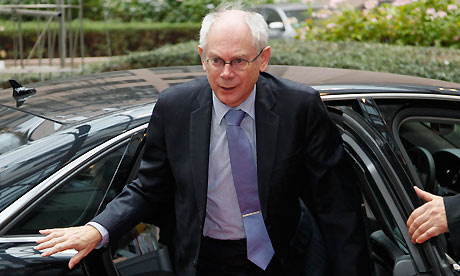
A confidential paper for EU leaders by the EU council president, Herman Van Rompuy, who will chair the summit on Thursday and Friday, said eurobonds or the pooling of eurozone debt would be a powerful tool in resolving the crisis, despite fierce German resistance to the idea.

It called for "more intrusive control of national budgetary policies by the EU" and laid out various options for enforcing fiscal discipline supra-nationally.

The two-page paper, obtained by the Guardian, formed the basis for discussions on an interim report tabled by Van Rompuy, the European commission and the Eurogroup of countries that have adopted the euro, which is to be debated on Wednesday among senior officials in an attempt to build a consensus ahead of the summit.

Sunday, December 04, 2011

The cabinet of Italian Prime Minister Mario Monti approved an emergency package of austerity and growth measures Sunday night, worth about €30-billion ($41-billion), designed to restore the credibility of the European Union’s most-indebted country ahead of this week’s make-or-break EU crisis summit.

To burnish the credentials of his unelected government, and to show that he would share in the sacrifices imposed on the Italian people, Mr. Monti said he would take no salary as prime minister.

Seated next to Mr. Monti at Sunday night’s press conference in Rome, Elsa Fornero, his welfare minister, was so overcome by emotion in announcing her pension reforms that she broke into tears and had to stop speaking. The photos of her weeping appeared almost immediately on the websites of Italian newspapers, earning her respect throughout the country. “Bless that woman’s heart, she actually has one,” was typical of the comments.

“The package of measures are designed to save Italy,” said Mr. Monti, who replaced Silvio Berlusconi late last month as soaring Italian bond yields thrust Italy into the euro zone debt crisis spotlight. Italy, with €1.9-trillion of debt, is considered too big to bail out.

There is near-universal agreement that the collapse of the Italian bond market, should it come, would wreck the euro and push Europe, and probably North America, into deep recession. Already, the EU is expected to enter a shallow recession next year.

Thursday, November 24, 2011

Dexia, Franco-Belgian Bank, Using Emergency Liquidity Facilities To Tackle 'Very Dramatic' Problem

BRUSSELS (Ben Deighton) - Franco-Belgian bank Dexia (DEXI.BR) is accessing emergency liquidity facilities in Belgium, France, Spain and Italy, a banking source said on Thursday, as analysts described its liquidity situation as "very dramatic."

The source said the bank was making use of the Emergency Liquidity Assistance (ELA) facility of the Belgian central bank as well as "national central banks in France, in Spain, in Italy," where Dexia has units.

One analyst said the fact Dexia was tapping national central banks' liquidity via the European Central Bank network showed how bad the situation had become for the lender.

"The emergency window of the ECB ... is very expensive, so it shows that the liquidity situation is very dramatic," the analyst said, speaking on condition of anonymity.

"At some point you run out of unencumbered assets to post at the ECB, and then the only way to fund yourself is via the ELA, which is clearly not a good sign," the analyst said.

Dexia and the central banks of France and Belgium both declined to comment.

The source added that Dexia would try to raise money on markets again after the finalization of a 90 billion euro ($120 billion) guarantee scheme agreed in October by France, Belgium and Luxembourg.

Belgian Finance Minister Didier Reynders said Wednesday that he hoped to reach an agreement with the European Commission about the restructuring plan for Dexia (DEXI.BR) in the coming days.

($1 = 0.7490 euros)

(Additional reporting by Dan Flynn in Paris; Editing by Luke Baker and Will Waterman)

Origin
Source: Huff 

Tuesday, November 22, 2011

Revenge of the Technocrats

Three weeks ago, I suggested that democratic politics had reasserted itself in Europe – to the consternation of those who wanted Greece and Italy to fall into line on the policies needed to address the eurozone crisis.

This past week, by contrast, has seen moves to minimize those democratic impulses. On Friday, Italy’s newly appointed prime minister and respected eurocrat, Mario Monti, won a vote of confidence on the composition of his new government in Italy’s lower house of parliament – a government whose cabinet does not include a single elected official.

Monti proposes to double up as Finance Minister, with a plan to balance the budget, stimulate growth, overhaul Italy’s pension system, and fight against decades of tax evasion. It’s an agenda that technocrats have long wanted to pursue, but that democratic politics in Italy had apparently made very difficult.