Democracy Gone Astray

Democracy, being a human construct, needs to be thought of as directionality rather than an object. As such, to understand it requires not so much a description of existing structures and/or other related phenomena but a declaration of intentionality.
This blog aims at creating labeled lists of published infringements of such intentionality, of points in time where democracy strays from its intended directionality. In addition to outright infringements, this blog also collects important contemporary information and/or discussions that impact our socio-political landscape.

All the posts here were published in the electronic media – main-stream as well as fringe, and maintain links to the original texts.

[NOTE: Due to changes I haven't caught on time in the blogging software, all of the 'Original Article' links were nullified between September 11, 2012 and December 11, 2012. My apologies.]

Showing posts with label The Sharing Economy. Show all posts

Sunday, August 05, 2018

Lipstick on a Gig: Why We Should Be Very Skeptical of Uber’s New “Portable Benefits” Scheme

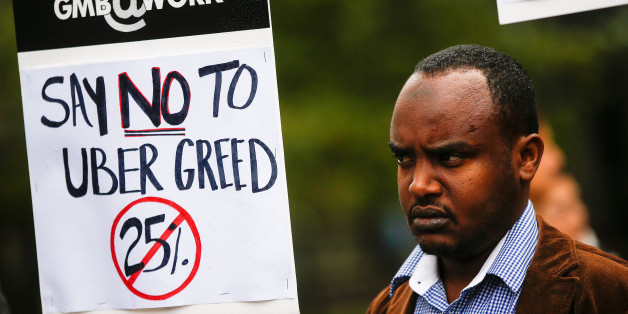
In 2016, the New York Taxi Workers Alliance (NYTWA) filed a class-action lawsuit against Uber, claiming the rideshare giant denied them benefits, even though they were full-time workers. The company accomplished this, the suit charged, by classifying workers who spent “six or seven” days a week “laboring for 12-plus-hour shifts” as independent contractors.

These grievances will likely sound familiar. Uber is widely reviled for its instrumental role in creating a tenuous 21st-century gig economy fueled by a precariat of contracted drivers — a point countless news outlets have exhaustively detailed. As a result of that negative press, and a rash of additional lawsuits challenging Uber’s labor abuses, the company now ostensibly seeks to mitigate the damage it’s done.

Saturday, August 04, 2018

Is there such thing as an ethical ride-hailing service?

When a power outage knocked out subway service on the Bloor line last week, Uber did what Uber does. The ride-hailing giant ratcheted up surge pricing, to a flurry of angry tweets.

Of course, Uber is used to being hated on. The Twitterverse was ablaze with #deleteuber hashtags virtually every week of 2017.

Now, a year after hundreds of thousands of Uber users ditched the app after its drivers continued operating during taxi driver protests against President Donald Trump’s first attempt at a travel ban, Lyft and two other ride-hailing apps have answered T.O.’s call for a new ride.

Tuesday, February 02, 2016

Taxi drivers prepare to protest again February 12

Toronto taxi drivers are gearing up for another protest against Uber that will shut down major roads downtown.

That the rally falls on one of the busiest weekends this month – on February 12 as the city prepares for Family Day long weekend and to host the NBA All-Star Game – is no coincidence. The only thing that could stop the planned protest is if city council decides to file an injunction against UberX at its meetings this week.

Monday, February 01, 2016

Ottawa examines challenges of ‘disruptive’ expanding sharing economy

OTTAWA—Companies like Uber and Airbnb were the subject of a quiet in-depth study by high-ranking federal bureaucrats, the Star has learned.

A committee of five deputy ministers and a team of analysts undertook a comprehensive study of the so-called sharing economy and its implications for Canadian policy-makers and consumers.

Tuesday, January 26, 2016

How the Sharing Economy Screws American Workers

Fifty-one years ago, Bob Dylan's song "Maggie's Farm," a brilliant satire that compared the job prospects of that generation's youth to that of working on a dystopian plantation, was released on Dylan's album "Bringing It All Back Home." The owners, Maggie, her ma, pa and brother -- a real close-knit unit, like a small "sharing economy" startup -- were quite eager to put you to work, but they were a bit stingy on the compensation side for your menial, TaskRabbit-type work.

Tuesday, September 15, 2015

This Is How Bad the Sharing Economy Is for Workers

Silicon Valley entrepreneurs keep telling us their way of doing business will “change the world.” And in many ways it already has, but it’s changed your world differently than it’s changed theirs.

The “sharing” or “gig” economy—think Airbnb, Uber, and Taskrabbit—has made massive fortunes reducing labor to disassembled microtasks; unfortunately, it’s shrunk workers’ rights too. But as our jobs are redefined by labor-brokering platforms, some advocates are trying to redefine labor rights for a digital economy.

Saturday, January 31, 2015

What the Sharing Economy Takes

Sharing is a good thing, we learned in kindergarten, but that wisdom was soon called into question by the grown-up world of getting and spending. Now, New Age capitalism has spun out a wonderful invention: the “sharing economy,” which holds out the promise of using technology to connect disparate individuals in mutually profitable enterprise, or at least in warm feelings.

The most prominent examples of the sharing economy are a taxi-hailing service called Uber and a real-estate-subletting service called Airbnb. As with most enterprises emerging from Silicon Valley, they come with a very ambitious vocabulary. Brian Chesky, the co-founder of Airbnb, uses words like “revolution” and “movement” to describe his company, which is now valued at $13 billion—a bit less than the price at which the stock market values Starwood, a company that operates 1,200 properties in 100 countries, under names like W, Westin and Sheraton—making Airbnb the best-capitalized revolutionary movement in history. The term “sharing economy” has been making the rounds for about a decade, but the phenomenon has roots in the 1990s: all of its trademark enthusiasms—the flattening of stodgy old hierarchies, the rise of peer-to-peer networks, the decentering of everything—were concepts imported into middlebrow culture by the likes of Thomas Friedman. Then as now, the structure of the Internet was taken as a model for society: a network of peers rather than a gray-suited hierarchy. But in its last iteration, during the dot-com boom, techno-utopianism was more about the production side of the economy—transforming the world of work into a flexible, hip space for creativity and collaboration.

Wednesday, December 07, 2011

Occupy Big Business: The Sharing Economy's Quiet Revolution

Big business is stumbling. Unemployment is still too damn high. And the middle class is increasingly just a memory. With all this bad news, where can we look for hope?
Kickstarter. Zipcar. Shareable. Etsy. Kiva. Prosper. Airbnb.

These and other "collective consumption" companies are part of the new economy arising out of necessity, as traditional businesses and government are increasingly unable to meet Americans' needs and provide basic supports.

This sharing economy is based on people coming together to create their own markets (Airbnb), their own products, (Etsy), and their own currency (TimeBanks). It relies on shared needs, trust, and the belief that the group is stronger than the individual.

This new shared market economy is being driven by a quiet revolution: the millions of Americans who no longer want to prop up our faltering economy with endless and thoughtless consumption.