Showing posts with label Time Warner. Show all posts
Showing posts with label Time Warner. Show all posts
Wednesday, August 08, 2018
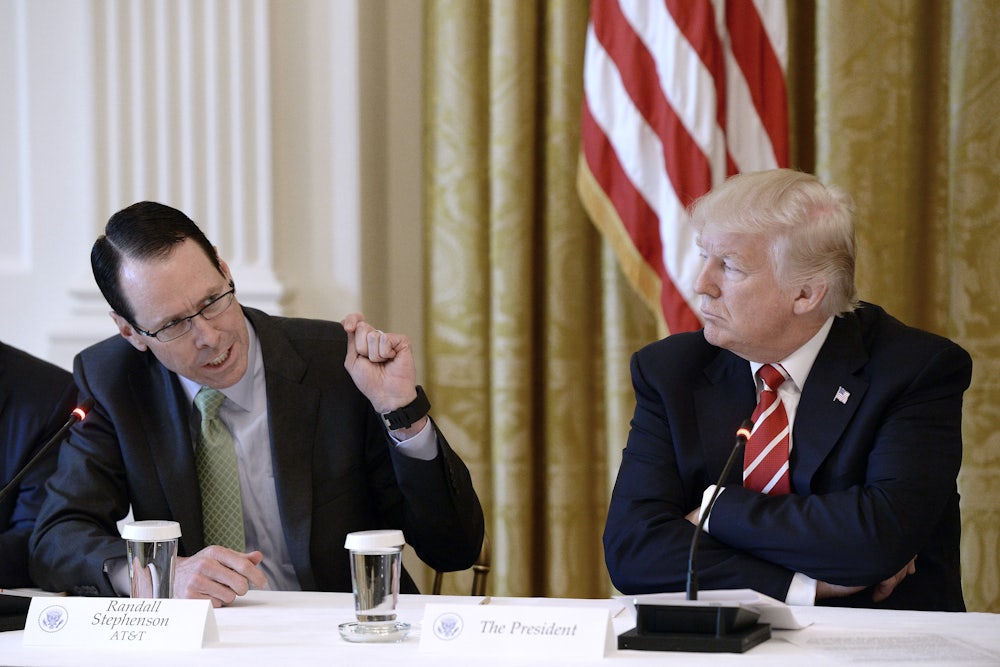
The AT&T–Time Warner Merger Is Already What the Government Feared
Saturday, May 30, 2015
Charter Reportedly Near $55 Billion Deal To Acquire Time Warner Cable
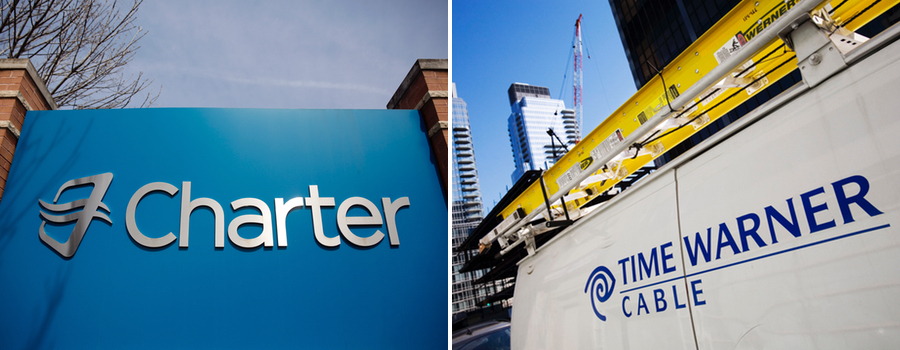
A deal would create a major rival to Comcast Corp, the biggest operator in the U.S. cable and broadband market, and marks a triumph for Charter, which was rejected by Time Warner Cable just last year.
Tuesday, April 28, 2015
FCC Staff Recommends Hearing on Comcast-Time Warner Cable Merger

The FCC staff reached a conclusion that the best option for the FCC is to issue a “hearing designation order,” according to people familiar with the matter. In effect, that would put the $45.2 billion merger in the hands of an administrative law judge, and would be seen as a strong sign the FCC doesn’t believe the deal is in the public interest.
Tuesday, May 13, 2014
Time Warner Cable Makes Hilariously Absurd Argument For Comcast Merger

The two companies are currently engaged in a full-court press to convince regulators and lawmakers that Comcast's $45 billion takeover of Time Warner Cable -- which would create a behemoth of a company that controls nearly 40 percent of the U.S. broadband market and provides cable to almost a third of American homes -- isn't anti-competitive and is in the public interest.
Thursday, February 27, 2014
Just How Dangerous Is A Giant Comcast?

The size of the company didn't automatically violate antitrust law, the court ruled. Rather, it was the way it wielded that size that was a problem. The oil behemoth forced railroads to slash prices and agree to preferential deals to ship its products, driving smaller competitors out of business. Standard Oil came to control 90 percent of U.S. oil production through these methods, and the court determined that this led to higher prices and less oil, harming the overall market.
The Comcast-Time Warner Merger Threatens Democracy
Comcast has announced it intends to merge with Time Warner Cable, joining together the largest and second-largest cable and broadband providers in the country. The merger must be approved by both the Justice Department and the FCC. Given the financial and political power of Comcast, and the Obama administration’s miserable record of protecting the public interest, the time to speak out and organize is now.
“This is just such a far-reaching deal, it should be dead on arrival when it gets to the Department of Justice and the Federal Communications Commission for approval,” Michael Copps told me days after the merger announcement. Copps was a commissioner on the FCC from 2001 to 2011, one of the longest-serving commissioners in the agency’s history. Now he leads the Media and Democracy Reform Initiative at Common Cause. “This is the whole shooting match,” he said. “It’s broadband. It’s broadcast. It’s content. It’s distribution. It’s the medium and the message. It’s telecom, and it’s media, too.” Back in 2011, when Comcast sought regulatory approval of its proposed acquisition of NBC Universal (NBCU), Copps was the sole “no” vote out of the five FCC commissioners.
“This is just such a far-reaching deal, it should be dead on arrival when it gets to the Department of Justice and the Federal Communications Commission for approval,” Michael Copps told me days after the merger announcement. Copps was a commissioner on the FCC from 2001 to 2011, one of the longest-serving commissioners in the agency’s history. Now he leads the Media and Democracy Reform Initiative at Common Cause. “This is the whole shooting match,” he said. “It’s broadband. It’s broadcast. It’s content. It’s distribution. It’s the medium and the message. It’s telecom, and it’s media, too.” Back in 2011, when Comcast sought regulatory approval of its proposed acquisition of NBC Universal (NBCU), Copps was the sole “no” vote out of the five FCC commissioners.
Wednesday, February 26, 2014
Comcast, Time Warner Cable Deal Is A Disaster For Customers

The $45 billion merger announced Thursday might be a win for both companies, but it will be no victory for their combined 30 million customers, who are already among the least-happy customers in all of Corporate America.
Monday, September 09, 2013
Time Warner To Remove U.S. Retirees From Company Health Plan

According to an August memo obtained by Reuters, the media company will make allocations to a Health Reimbursement Arrangement account for retirees to use towards the purchase of coverage on an exchange. Previously, Time Warner provided an indirect subsidy through a supplementary Medicare program.
Subscribe to:
Posts (Atom)