
Showing posts with label Corporate. Show all posts
Showing posts with label Corporate. Show all posts
Sunday, September 08, 2024
Twitter Gave Us an Indispensable Real-Time News Platform. X Took It Away
Friday, October 24, 2014
Kinder Morgan's Qs on Aboriginal food provokes avalanche of fish photos

The fish tale began Friday when Kinder Morgan's lawyer had grilled a Kwantlen First Nation band councillor at a National Energy Board hearing in Chilliwack. The forum is gathering Aboriginal views on the proposed $5.4-billion Trans Mountain expansion pipeline.
“Do you have an estimate in terms of what proportion of Kwantlen members’ diet comes from sources in the Fraser River?” asked Kinder Morgan lawyer Terri-Lee Oleniuk.
Tuesday, September 30, 2014
Hedge Funds Are Richer Than Ever

Things are looking pretty good for the superrich.
The largest Americas-based hedge funds are controlling more money than ever before, according to a new analysis by Absolute Return, a hedge fund news site.
Wednesday, February 26, 2014
Comcast, Time Warner Cable Deal Is A Disaster For Customers

The $45 billion merger announced Thursday might be a win for both companies, but it will be no victory for their combined 30 million customers, who are already among the least-happy customers in all of Corporate America.
Monday, August 19, 2013
When Shareholder Activism Goes Too Far

Monday, April 08, 2013
CEO Perks Packages Rose In Value By 18.7 Percent In 2012
CEOs are living the good life. On the company’s dime.
America's 100 best-paid corporate chiefs got an 18.7 percent boost in their perks packages, according to a survey of executive pay performed by Equilar for The New York Times. Those perks, which range from access to a private jet to company-sponsored security details to life insurance policies, were worth $320,635 on average last year, according to an Equilar analysis of the survey.
America's 100 best-paid corporate chiefs got an 18.7 percent boost in their perks packages, according to a survey of executive pay performed by Equilar for The New York Times. Those perks, which range from access to a private jet to company-sponsored security details to life insurance policies, were worth $320,635 on average last year, according to an Equilar analysis of the survey.
Monday, March 11, 2013
Canada falling behind on women on corporate boards

While participation in the labour force has increased significantly for women, that change has yet to be reflected at the top of Canada's largest companies, according to the report.
Thursday, July 12, 2012
Rising costs push California cities to fiscal brink
 Facing the same financial stressors that pushed San Bernardino toward bankruptcy, cities across California are slashing day-to-day services and taking other drastic actions to skirt a similar fiscal collapse.
For some, it may not be enough.
San Bernardino on Tuesday became the third California city to seek bankruptcy protection in the last month and, while no one expects the state to be consumed by municipal insolvencies, other cities teeter on the abyss.
Monday, June 11, 2012
Paul Krugman: Obama 'Screwed Up' 'Doing Fine' Line
Princeton Professor and New York Times columnist Paul Krugman said President Barack Obama erred by saying Friday that the private sector is "doing fine," but Krugman agreed with the substance of the president's argument that public sector job cuts are hurting the economy.
"That was an unfortunate line," said the Nobel Prize-winning economist Monday on CBS's "This Morning." "The president bungled the line."
"The truth is the private sector is doing better than the public sector, which is not well enough," he said. "The real story of this economy is that cutbacks at the public sector are what's hurting the recovery."
"That was an unfortunate line," said the Nobel Prize-winning economist Monday on CBS's "This Morning." "The president bungled the line."
"The truth is the private sector is doing better than the public sector, which is not well enough," he said. "The real story of this economy is that cutbacks at the public sector are what's hurting the recovery."
Thursday, April 05, 2012
American Legislative Exchange Council, Ultra-Conservative Lobby, Loses 2 Major Funders

Public interest groups, including ColorOfChange.org and Campus Progress, have long been trying to break up the powerful alliance between corporations minding their financial interests and conservative activists pursuing a right-wing social agenda.
The shooting of unarmed teenager Trayvon Martin, whose assailant has to date avoided charges due in part to Florida's Stand Your Ground law, has brought new attention to the controversial law and the seminal role that ALEC, which is corporate funded, played in getting such bills passed.
Consumer-facing corporations are of course the most susceptible to public pressure. Other familiar brands still on ALEC's Private Enterprise Board include Walmart, State Farm and AT&T.
Friday, March 09, 2012
Tax Freedom Day far earlier for corporate Canada than the rest of us
“Corporate Tax Freedom Day,” by the Canadian Labour Congress’s calculation, arrived February 1. On that day, Corporate Canada had paid the equivalent of all the taxes that would be imposed on it this year by all levels of government.
You can argue with the CLC’s methodology and its larger agenda of income equality for Canadians. But the calculation is long overdue. As we prepare this month for individual tax time, it’s helpful, finally, to have a comparison with the “Tax Freedom Day” that right-wing groups have been using for generations to accuse government of dipping too deeply into our pockets.
For Canadians, this year’s supposed Tax Freedom Day will arrive in June. That’s when, according to this 64-year-old conceit of right-wing anti-government types, we will have earned enough income to cover our total annual government tax bite.
The TFD concept is nonsensical, of course. And that’s putting aside the dubious methodology employed by the Fraser Institute, the nest of right-wing vipers who are the TFD’s local branch plant. The concept originated with a Florida businessman, Dallas Hosteler, who sold the U.S. rights to his concept to the Koch brothers- and ExxonMobil-funded Tax Foundation in Washington, D.C.
You can argue with the CLC’s methodology and its larger agenda of income equality for Canadians. But the calculation is long overdue. As we prepare this month for individual tax time, it’s helpful, finally, to have a comparison with the “Tax Freedom Day” that right-wing groups have been using for generations to accuse government of dipping too deeply into our pockets.
For Canadians, this year’s supposed Tax Freedom Day will arrive in June. That’s when, according to this 64-year-old conceit of right-wing anti-government types, we will have earned enough income to cover our total annual government tax bite.
The TFD concept is nonsensical, of course. And that’s putting aside the dubious methodology employed by the Fraser Institute, the nest of right-wing vipers who are the TFD’s local branch plant. The concept originated with a Florida businessman, Dallas Hosteler, who sold the U.S. rights to his concept to the Koch brothers- and ExxonMobil-funded Tax Foundation in Washington, D.C.
Tuesday, February 28, 2012
Corporate Personhood Case Forces Supreme Court To Hack New Path
 WASHINGTON -- On Tuesday morning, the Supreme Court will hear oral argument on whether corporations, like real people, can be held liable in American courts for international human rights violations.
The issue has divided four appeals courts over the past year and a half, as Democrat-appointed judges have uniformly voted for corporate liability while all but one Republican-appointed judge has come down for corporate immunity.
If that pattern holds in the Supreme Court, then the five justices appointed by Republican presidents will surely be hit with more accusations of pro-business bias: Having all voted in Citizens United v. Federal Election Commission to extend to corporations the First Amendment right of actual people to independently spend unlimited sums in this country's elections, they will in the current case have refused to hold corporations responsible, as real people are, for their roles in atrocities abroad.
That kind of application of corporate personhood would be enough to make a casual observer's head explode.
Tuesday, December 06, 2011
Corporate America Is Sitting On The Solution To The Jobs Crisis: Report
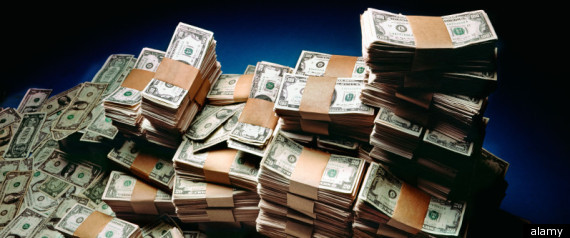 WASHINGTON -- Corporate America is sitting right on top of the solution to the nation's employment crisis, according to a new report from a group of University of Massachusetts economists.
 If America's largest banks and non-financial companies would just loosen their death-grip on a chunk of the $3.6 trillion in cash they're hoarding and move it into productive investments instead, the report estimates that about 19 million jobs would be created in the next three years, lowering the unemployment rate to under 5 percent.
"There is no reason that the U.S. needs to remain stuck in a long-term unemployment crisis," Robert Pollin, lead author of the report and co-director of the Political Economy Research Institute, said in a statement accompanying the report's release Tuesday.
"Getting the banks and corporations to move their hoards into productive investments and job creation requires carrots and sticks -- policies such as a new round of government spending stimulus as well as taxes on the banks' excess reserves -- that can both strengthen overall market demand and unlock credit markets for small businesses," Pollin said.
Thursday, October 13, 2011
Corporate Citizenship: How Public Dissent In Paris Sparked Creation Of The Corporate Person
WASHINGTON -- Of all the Occupy Wall Street refrains, one of the most memorable is, "I refuse to believe that corporations are people until Texas executes one." But, clever as it is, the quip looks to the wrong end of the life cycle: The only thing more corrupt than the legal concept of corporate personhood is the way a Gilded Age judge birthed it.
The discontented have been occupying the streets for a long time. But the convulsions with which the ruling class in America reacted to the Paris Commune of 1871 make Fox News' coverage of Occupy Wall Street sound fawning.
The Paris Commune was the first international incident followed daily in the United States. While President Barack Obama complains about the 24-hour news cycle today, its roots stretch back to Cyrus Field's transcontinental telegraph cable, which allowed the elites of America to focus intently on the two-month uprising and ultimate slaughter of thousands of Parisians. Cyrus Field's brother and his family were in Paris at the time, and a third brother, Supreme Court Justice Stephen Field, obsessively tracked the news back in the states. It was the Paris uprising that transformed Stephen Field from a mundanely corrupt judge in the paid service of the railroads to a zealous crusader for all corporations, with the aim of suppressing what he and other leaders saw as the threat of democracy from below.
For much of the first U.S. century, it was an accepted fact that the people, through their legislators, had the power to pass laws that businesses were required to obey. After the Civil War, Reconstruction-era statutes and constitutional amendments -- particularly the 14th Amendment -- strictly limited the ability of legislators to restrict the rights of the recently freed African Americans.
The discontented have been occupying the streets for a long time. But the convulsions with which the ruling class in America reacted to the Paris Commune of 1871 make Fox News' coverage of Occupy Wall Street sound fawning.
The Paris Commune was the first international incident followed daily in the United States. While President Barack Obama complains about the 24-hour news cycle today, its roots stretch back to Cyrus Field's transcontinental telegraph cable, which allowed the elites of America to focus intently on the two-month uprising and ultimate slaughter of thousands of Parisians. Cyrus Field's brother and his family were in Paris at the time, and a third brother, Supreme Court Justice Stephen Field, obsessively tracked the news back in the states. It was the Paris uprising that transformed Stephen Field from a mundanely corrupt judge in the paid service of the railroads to a zealous crusader for all corporations, with the aim of suppressing what he and other leaders saw as the threat of democracy from below.
For much of the first U.S. century, it was an accepted fact that the people, through their legislators, had the power to pass laws that businesses were required to obey. After the Civil War, Reconstruction-era statutes and constitutional amendments -- particularly the 14th Amendment -- strictly limited the ability of legislators to restrict the rights of the recently freed African Americans.
Thursday, September 01, 2011
A Pipeline to Nowhere?

Enbridge has failed to prove sufficient market demand for the building of its proposed pipeline.
In business, it’s generally considered unwise to launch a new product without clear market research showing a strong customer base and high demand. Moving ahead without confidence that there’s a market for your product is a recipe for failure.
Yet that’s where Canadian pipeline company Enbridge seems to be headed with its proposed Northern Gateway pipeline, which would transport bitumen from the oil sands in Alberta to the Pacific Coast near Kitimat, British Columbia. Without binding agreements that lock in producers to supply the oil and refiners to get it to market, Enbridge doesn’t have the proof of market demand required to build a major new pipeline.
Wednesday, August 31, 2011
Citi Executive: 'Corporate Sector Cannot Continue To Simply Cut Costs'
 High corporate profits have been one of the few bright spots for the global recovery. One high-level financial executive isn't so sure that success can be sustained.
Richard Cookson, global chief investment officer at Citi, told CNBC's Squawk Box on Tuesday that corporation's reliance on cost-cutting to increase growth may soon run out of steam. Many corporations have posted strong profits during the recovery, largely due to cost-cutting and increased productivity from the consequently diminished workforce. That model is simply not sustainable, says Cookson.
"In aggregate, the corporate sector cannot continue to just simply slash costs rather than have top-line growth," he told CNBC. "It just doesn't work."
Corporate profits hit an all-time high of $1.68 trillion in the fourth quarter of 2010, subsequently maintaining solid growth. Three out of four companies on the S&P 500 saw larger profits than expected in the second quarter of this year, according to Bloomberg. But Cookson contends diminishing margins make that a temporary fix at most.
Wednesday, August 10, 2011
Lack of corporate spending marks a different kind of cash crisis
 When Campbell Soup Co. unveiled its most recent quarterly results, it showed a five-fold surge in its cash position. But even with $449-million (U.S.) in the bank, one of corporate America’s signature companies is restructuring, cutting jobs and focusing on growth outside its U.S. home market.
Welcome to a new kind of economic recovery – one with a cash crisis of a different kind than the liquidity crunch that caused the recession three years ago. This is a crisis of spending, or lack of it. Some of the largest and most profitable U.S. corporations are collectively sitting on almost $2-trillion (U.S.) in cash and contributing little in the way of job creation.
Campbell Soup’s cash balance at the end of its fiscal third quarter is a pittance compared with the $91-billion held by General Electric Co., the $28.8-billion that decorates the balance sheet of Oracle Corp. or the $13.8-billion in the coffers of Coca-Cola Co.
But the fact that Campbell’s cash, and the money held by scores of other big corporations, is for the most part sitting idle – and not being invested in growth or new jobs in the U.S. – underscores the fortress mentality that is gripping chief financial officers scarred by the 2008 liquidity crisis.
Tuesday, July 19, 2011
The Face of Climate Corruption in Canada
![]() Oil giants chipped in $180,000 to help Canada's energy ministers have “unbiased” discussions about our energy future.
Oil giants chipped in $180,000 to help Canada's energy ministers have “unbiased” discussions about our energy future.

Energy ministers from across Canada have just returned from an all-expenses-paid tour of the tar sands, given to them by the oil companies themselves. Now, they are sitting down to debate the future of energy policy in Canada at a meeting in Kananaskis, Alberta. This is the face of climate corruption in Canada.
Canada is at a crossroads, and it appears that our leadership has been seriously compromised. While much of the world is investing heavily in the clean, safe, and reliable energy of our future, the Canadian government, along with some provincial support, is insisting that Canada watch from the sidelines while we cling desperately to a resource that is responsible for creating the greatest challenge of our time. I am, of course, talking about fossil fuels and global climate change.
Thursday, June 23, 2011
Name game
 Toronto is spawning a seemingly endless supply of bad new ideas these days. The most recent is the selling of naming rights to generate a little bit of money for a city that cut taxes and now finds it can’t fund basic programs.
 We’re all used to corporate names permeating public space: Rogers Centre, Air Canada Centre. So some ask, what’s the difference if we put a few more brand names on a few more public buildings or public spaces?
Is it just a matter of degree? All but the strongest critics of corporate involvement in the public realm would likely accept a plaque on the wall if a company paid for an entire new subway or LRT line.
But the sums involved in the type of sponsorship we’re talking about don’t even come close to the totals needed for a new line or a subway station renovation. Corporate payment would be in the low millions at best, while station renos cost tens of millions, and subway lines billions.
From 90 to 98 per cent of the cost (depending on the project) would still be carried by the taxpayer. So the debate is really about whether you’d sell naming rights on major public infrastructure for the equivalent of a few hundred thousand dollars a year on a multi-million-dollar, 10- to 30-year deal, because that’s the best of what’s on offer.
Only a few North America transit systems have sold naming rights. (Examples from outside North America aren’t very useful; the context is quite different.)
In Cleveland, the transit authority got $6.25 million for a new line in a 25-year naming deal. This works out to $250,000 a year – minus $50,000 to $100,000 in likely lost revenues, since other companies were excluded from advertising as a result of the contract.
Then there’s Chicago, where Apple has offered $3.9 million to renovate one station in exchange for naming rights and exclusive advertising. In New York, the private sector paid $4 million for one station – again, a few hundred thousand annually in a multi-year deal involving loss of existing ad revenue.
It should also be noted that so far, only one station in each city has been sold, despite the fact that both transit agencies have indicated they would accept more. But the market is likely limited because the novelty is limited, and therefore the appetite of the corporate sector.
Closer to home, the Toronto Community Foundation’s station renovation project, which brought us the Museum station revamp, had to put future station renos on hold because of insufficient corporate interest.
Full Article
Source: NOW magazine
Friday, June 17, 2011
30% of corporate jet flights go to resorts
They're pitched as useful tools to get executives where they need to be, quickly and efficiently. But more often than not corporate jets are just used so the CEO can have a quick beach vacation, according to the Wall Street Journal.
The newspaper looked at FAA records of every U.S. flight taken between 2007 and 2010. Their analysis of the data, published Thursday, found that for dozens of jets belonging to publicly traded companies, about 30 per cent of the trips were to resort destinations.
In some cases, more than 50 per cent of the trips were to sun destinations, or to remote areas where executives own homes, the paper reported.
Full Article
Source: CBC news
The newspaper looked at FAA records of every U.S. flight taken between 2007 and 2010. Their analysis of the data, published Thursday, found that for dozens of jets belonging to publicly traded companies, about 30 per cent of the trips were to resort destinations.
In some cases, more than 50 per cent of the trips were to sun destinations, or to remote areas where executives own homes, the paper reported.
Full Article
Source: CBC news
Subscribe to:
Posts (Atom)