Showing posts with label Washington Post. Show all posts
Showing posts with label Washington Post. Show all posts
Thursday, August 09, 2018
The Other Side of Jeff Bezos’s Washington Post
Thursday, February 23, 2017
The Washington Post published a false story, but it’s not fake news
Friday, September 05, 2014
Jeff Bezos Refuses To Talk To Washington Post About Huge Washington Post News
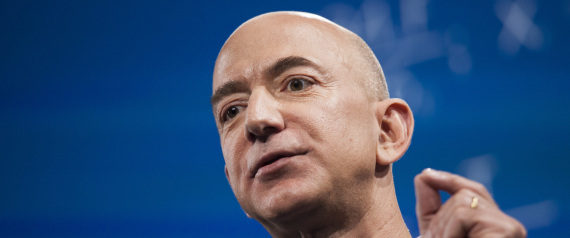
Bezos kept up a dubious practice of refusing comment to the journalists he pays when it was announced on Tuesday that he had replaced the Post's publisher, Katharine Weymouth, with former Politico executive and Reagan administration official Fred Ryan. Given that Bezos has owned the Post for little over a year, and that he was severing the paper's last ties with the storied Graham family by ousting Weymouth, the news was not insignificant.
Anybody expecting openness and transparency from Bezos, however, would be disappointed, as the Post's own story made clear:
"The announcement did not give reasons for the change or its timing. Bezos declined to comment through a spokesman."
Uh, OK then! Thanks for the help, boss.
Bezos, of course, has form in this area. Amazon, the other company he leads, is notorious for its almost complete refusal to comment on any story. It has continued to do this even with stories written in the Post.
Original Article
Source: huffingtonpost.com/
Author: The Huffington Post | By Jack Mirkinson
Thursday, August 08, 2013
How The Washington Post’s New Owner Aided the CIA, Blocked WikiLeaks & Decimated the Book Industry
 The Washington Post announced on Monday the paper had been sold to Amazon.com founder and CEO
Jeff Bezos for $250 million. Bezos, one of the world’s wealthiest men,
now controls one of the most powerful newspapers in the country. Some
critics of the sale have cited Bezos’ close ties to the U.S. government.
In 2010, Amazon pulled the plug on hosting the WikiLeaks website under
heavy political pressure. Earlier this year, Amazon inked a $600 million
cloud-computing deal with the CIA.
Independent booksellers and publishers have also long complained about
Amazon’s business practices. We host a roundtable on the history of
Amazon and the future of the newspaper industry. "Monopoly newspapers,
especially The Washington Post in the nation’s capital, while it might
not be a commercially viable undertaking, it still has tremendous
political power," says Robert McChesney, co-founder of Free Press. "What
we have is a plaything for these billionaires that they can then use
aggressively to promote their own politics." Media critic Jeff Cohen
notes that while The Washington Post notably published reports on
Watergate and the Pentagon Papers decades ago, he thinks concerns that
Bezos will ruin its journalistic tradition is unfounded, saying that in
recent years, "The Washington Post has really been the newspaper of the
bipartisan consensus." We also speak to Dennis Johnson, publisher of
Melville Books. "Amazon is a company that feels no pain. They’ve, as far
as I can tell, never made money. … So, when you see him taking over The
Washington Post and you wonder is he going to be able to monetize it,
is he going to make it profitable, he probably doesn’t care," Johnson
says.
The Washington Post announced on Monday the paper had been sold to Amazon.com founder and CEO
Jeff Bezos for $250 million. Bezos, one of the world’s wealthiest men,
now controls one of the most powerful newspapers in the country. Some
critics of the sale have cited Bezos’ close ties to the U.S. government.
In 2010, Amazon pulled the plug on hosting the WikiLeaks website under
heavy political pressure. Earlier this year, Amazon inked a $600 million
cloud-computing deal with the CIA.
Independent booksellers and publishers have also long complained about
Amazon’s business practices. We host a roundtable on the history of
Amazon and the future of the newspaper industry. "Monopoly newspapers,
especially The Washington Post in the nation’s capital, while it might
not be a commercially viable undertaking, it still has tremendous
political power," says Robert McChesney, co-founder of Free Press. "What
we have is a plaything for these billionaires that they can then use
aggressively to promote their own politics." Media critic Jeff Cohen
notes that while The Washington Post notably published reports on
Watergate and the Pentagon Papers decades ago, he thinks concerns that
Bezos will ruin its journalistic tradition is unfounded, saying that in
recent years, "The Washington Post has really been the newspaper of the
bipartisan consensus." We also speak to Dennis Johnson, publisher of
Melville Books. "Amazon is a company that feels no pain. They’ve, as far
as I can tell, never made money. … So, when you see him taking over The
Washington Post and you wonder is he going to be able to monetize it,
is he going to make it profitable, he probably doesn’t care," Johnson
says.Video
Source: democracynow.org
Author: --
Tuesday, July 02, 2013
Washington Post's Edward Snowden Editorial Draws Incredulous Reaction

The editorial board, which is run independently of the news division, allowed that the scoops published by the Post and other outlets had "shed useful light on some NSA programs and raised questions that deserve debate." But, the board said, "The first U.S. priority should be to prevent Mr. Snowden from leaking information that harms efforts to fight terrorism and conduct legitimate intelligence operations ... The best solution for both Mr. Snowden and the Obama administration would be his surrender to U.S. authorities, followed by a plea negotiation."
Subscribe to:
Posts (Atom)