Democracy Gone Astray

Democracy, being a human construct, needs to be thought of as directionality rather than an object. As such, to understand it requires not so much a description of existing structures and/or other related phenomena but a declaration of intentionality.
This blog aims at creating labeled lists of published infringements of such intentionality, of points in time where democracy strays from its intended directionality. In addition to outright infringements, this blog also collects important contemporary information and/or discussions that impact our socio-political landscape.

All the posts here were published in the electronic media – main-stream as well as fringe, and maintain links to the original texts.

[NOTE: Due to changes I haven't caught on time in the blogging software, all of the 'Original Article' links were nullified between September 11, 2012 and December 11, 2012. My apologies.]

Showing posts with label Wireless. Show all posts

Wednesday, December 28, 2016

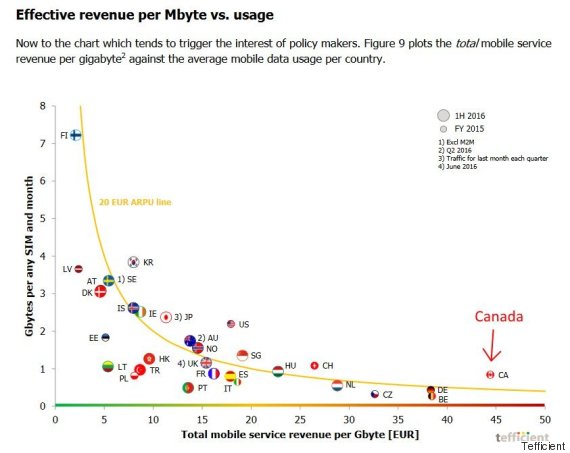
Chart: Canadians Get Worst Deal Of Anyone On Wireless

Wireless providers make more revenue off of Canadians than people anywhere else, a new survey has found.

The predictable result? Canadians have among the lowest rates of mobile data usage, among 32 countries surveyed by Swedish telecom consultancy Tefficient.

“The most expensive mobile data countries are Canada, Belgium, Germany, Czech Republic and the Netherlands and — as a consequence — mobile users in these countries are using very little mobile data,” Tefficient said in its report.

Friday, May 06, 2016

Harper's Wireless Policy Created 'Phoney' Competition, Study Says

OTTAWA — Consumers were on the losing end of a gamble by the former Conservative government when it sought to create more competition in the wireless market by interfering in it, says a new report released Thursday.

And researchers at the Montreal Economic Institute say the country's telecom regulator can learn from that failed policy by backing away from calls to interfere in the broadband Internet marketplace.

Tuesday, February 23, 2016

CRTC rejects plea from small internet providers seeking wireless access

Do you think your cellphone bill is too high? Tough. It's going to stay that way thanks to a CRTC decision that nixes the possibility of dozens of new wireless carriers springing up, consumer advocates say.

The regulator on Thursday denied an appeal from a group of small internet providers to mandate what are called Mobile Virtual Network Operators.

Thursday, October 09, 2014

How Much Do You Trust Canada's Wireless Giants?

Fresh off the contentious hearing on the future of television regulation, the Canadian Radio-television and Telecommunications Commission (CRTC) jumped back into the fire last week with a hearing on the wireless market that focused on whether changes are needed to the wholesale market to improve competition.

The Big Three -- Bell, Telus and Rogers -- unsurprisingly oppose new measures, arguing that the commission should reject the Competition Bureau's independent finding that there are competition concerns along with the smaller players and consumer groups that support new regulations. Instead, they argue that Canadians can trust that the market is already competitive and that reforms would reduce investment and harm the quality of the networks.

Wednesday, September 24, 2014

Wireless Costs In Canada Among Highest, Identical Among Carriers: PC Mag

Six years after the federal government began attempting to create a fourth national wireless carrier in Canada, the big three telcos are still almost identical on wireless prices and remain among the most expensive in the world.

That’s the findings of a PC Mag review of Canadian wireless service, its second annual look at the state of telecom in Canada.

Sunday, May 11, 2014

Wireless competition ad campaign leaves Canadians angry

Months after the federal government launched a $9-million advertising campaign announcing it wanted more competition and lower prices in the wireless market for consumers, there are fewer competitors and prices have, on average, gone up.

“They had all the trumpet and fanfare. But when it comes time to actually implementing these policies, nothing happens,” NDP MP Glenn Thibeault said.

Friday, May 02, 2014

CRTC Defenseless After Tories Walk Away From Wireless Code Challenge

OTTAWA - After spending millions of dollars in ads critical of the big wireless companies, the Harper government appears to have walked away from a legal battle over its touted wireless code of conduct.

The Federal Court of Appeal ruled this week that the country's telecom regulator could not argue on its own behalf in an appeal by Canada's major service providers over the start date for the wireless code, which is set to kick in by June of next year.

Monday, March 24, 2014

Wireless Price Hikes: Tories Failing To Live Up To Promises, Analysts Say

MONTREAL - Canada's big three wireless carriers have put up prices on some of their voice and data plans since January, showing Ottawa is unable to live up to its promises of overall lower prices and increased competition, according to analysts.

Rogers, Bell and Telus have been able to increase prices because of their market dominance with smaller, new players like Wind Mobile and financially struggling Mobilicity up for sale, analysts said Wednesday.

Wednesday, February 05, 2014

Debate Over: Canada's Wireless Market Is Uncompetitive

The longstanding debate over the state of wireless services in Canada has veered across many issues -- pricing, roaming fees, locked devices, new entrants, and foreign investment to name a few. At the heart of all of these questions is a single issue: is the current Canadian wireless market competitive?

The competitiveness of the Canadian market is a foundational question, since the answer has huge implications for legislative and regulatory policy. If the market is competitive, regulators (namely the CRTC) can reasonably adopt a "hands-off" approach, confident that competitive forces will result in fair prices and consumer choice. If it is not competitive, standing on the sidelines is not option, thereby pressuring government and the CRTC to promote more competition and to implement measures to prevent the established players from abusing their advantageous position.

Friday, November 22, 2013

Wireless Carriers Block Simple Solution To Phone Theft To Protect Profits, Prosecutor Says

As cell phone robberies have soared nationwide, phone companies have found a lucrative side business offering insurance to customers who are anxious their devices may be lost or stolen.

The top four wireless carriers will earn more than $7.8 billion this year in insurance premiums from their customers, according to an estimate by Warranty Week, an industry trade publication. Asurion, a phone insurance company that pays the wireless carriers for each policy they sell, made an estimated $98 million in profit in 2010, according to Businessweek.

Tuesday, November 05, 2013

Pricy Wireless Shuts out Poorer Canadians

Statistics Canada released its biennial Internet use survey last week, and while much of the immediate reaction focused on the continuing growth of Internet use (due largely to increased usage by those aged 65 and older), the bigger story is the ongoing Canadian digital divide that confirms the strong link between household income and Internet use.

StatsCan reports that 83 per cent of Canadians use the Internet, yet a closer examination of the data reveals a significant gap that is closely correlated to income. Moreover, the data also shows that Canada's high wireless prices now play a role in the digital divide, with only a quarter of lower-income Canadians using Internet wireless services.

Friday, October 04, 2013

Propaganda Won't Solve Our Cellphone Problems

Who knew the normally rather staid Canadian telecom world could provide such entertainment? This summer we witnessed heated rhetoric, political populism, multi-million dollar ad campaigns and a good dose of patriotic flag waving, all over whether Verizon, a big U.S. telecom company, should be "allowed" to come into the Canadian market. More specifically, whether it should be able to do so through acquisition of one of the new, small entrants who were subsidized in 2008 by the Canadian government (and thus by Canadian taxpayers) by way of spectrum set-asides, only to stand to reap even further advantage over the incumbents in the upcoming spectrum auction.

Now, with the new multi-million dollar government ad campaign attacking the incumbent telcos, it has become downright nasty.

Thursday, September 19, 2013

Canadian economy has turned into a policy-free zone

Remember just a few weeks ago when Verizon was going to march north into the welcoming embrace of the Canadian government and legions of roaming-at-the-mouth consumers? What happened with that? Presumably, the U.S. foreign insurgent wasn’t scared off by our jihadist telecom companies since it was Bell, Rogers and Telus that dispensed millions telling us they were the scared ones.

More likely, the decision to take a pass on Wireless Spring emanated from the fact that business, like life, abhors a vacuum. Verizon had more predictable places in which to forage for profit. In Canada, policy often looks sketchy and ad hoc, hardly a confidence builder even if it may favour your interests at a given moment. Indeed, the failure of this attempted consumer revolution from above is replete with lessons for those who care about growth, innovation and jobs, and the limited but essential role government and policy still play.

Friday, August 30, 2013

Stephen Harper: Wireless Rules Don't Favour Foreign Entrants Like Verizon

Prime Minister Stephen Harper says there are no “special loopholes” in Canada’s wireless rules for large foreign companies like Verizon, wading once again into a contentious war of words between his government and the Big Three telecoms.

But Harper’s latest salvo comes even as the prospect of Verizon coming to Canada seems more remote than it has in months, as Verizon seems to be distracted by much larger negotiations than a possible entry into Canada.

Sunday, August 25, 2013

Consumers will pay more for mobile phones over two years instead of three

MONTREAL - Even though it has yet to confirm it is coming to Canada, Verizon is already having a major influence on the cellphone market here.

Canadians need look no further than new data-sharing plans that made their debut this summer in what is generally seen as a response by Canadian wireless companies to the looming threat of competition from the U.S. telecom giant.

Thursday, August 22, 2013

Competition will lead to lower wireless bills, James Moore says

More competition in the wireless marketplace will mean lower cellphone prices for Canadians, Industry Minister James Moore says.

New competitors in wireless, such as Wind, already have brought down the cost of cellphone plans by 18-20 per cent over the past few years, Moore said in an interview with CBC’s Metro Morning. Nevertheless, he said, Canadians still are spending too much.

Wednesday, June 05, 2013

CRTC made wireless code stronger after consumers spoke

The CTRC’s new wireless code is tougher on Canada’s big telecom firms than the draft code released in January, which focused on disclosure.

In the final version released this week, the telecom regulator orders the firms to stop doing things it feels are unfair to customers.

Starting in December, there will be no more three-year wireless contracts. You will be able to cancel a contract at no cost after two years.

Tuesday, June 04, 2013

Wireless Prices: Canadians Would Pay $419 More Per Year, Industry Group Study Suggests

HuffPost Canada readers got what they most wanted from the CRTC Monday — an effective end to three-year cellphone contracts, in the form of an early escape clause allowing wireless customers to end their contracts after two years.

But they didn’t get something else that wireless customers apparently want: Higher prices for cellphone service.

That’s the implication of a new poll carried out for the main lobby group of Canada’s telecom industry, which shows Canadians willing to pay up to $11.5 billion more for telecom services than they are currently paying.

Monday, June 03, 2013

New CRTC wireless rules ban contract break fees after 2 years

The CRTC has unveiled a new code of conduct that forbids cellphone companies from charging customers fees to break their contracts after two years and makes it easier to unlock cellphones.

Those are two of the biggest takeaways from a new code of conduct that the broadcast regulator unveiled on Monday and will come into effect for contracts signed after Dec. 2, 2013.

Friday, May 10, 2013

Canada Wireless Customer Satisfaction Survey: J.D. Power Says Prices Spiking

Canadians saw their cellphone bills jump by an average of more than 13 per cent in the past year, according to a survey from J.D. Power & Associates.

The survey also found Koodo Mobile has the highest level of customer satisfaction among Canadian wireless carriers, followed by Virgin Mobile in second place.

At the bottom of the list? Rogers Wireless, which has the distinction of having the lowest customer satisfaction ranking.