Democracy Gone Astray

Democracy, being a human construct, needs to be thought of as directionality rather than an object. As such, to understand it requires not so much a description of existing structures and/or other related phenomena but a declaration of intentionality.
This blog aims at creating labeled lists of published infringements of such intentionality, of points in time where democracy strays from its intended directionality. In addition to outright infringements, this blog also collects important contemporary information and/or discussions that impact our socio-political landscape.

All the posts here were published in the electronic media – main-stream as well as fringe, and maintain links to the original texts.

[NOTE: Due to changes I haven't caught on time in the blogging software, all of the 'Original Article' links were nullified between September 11, 2012 and December 11, 2012. My apologies.]

Showing posts with label Verizon. Show all posts

Sunday, April 17, 2016

Verizon CEO Attack on Bernie Sanders Receives Gushing Praise — From Fellow Execs

As 40,000 Verizon workers went on strike Wednesday to protest cuts to health care and pensions, presidential candidate Bernie Sanders rallied with some of them in New York City, blasting the company’s practices.

“This is just another major American corporation trying to destroy the lives of working Americans,” Sanders told the workers, who decided to strike after failing to reach a contract. “Today you are standing up not just for justice for Verizon workers, you’re standing up for millions of Americans who don’t have a union.”

Nearly 40,000 Verizon Wireline Workers To Go On Strike Today

Verizon Communications Inc’s wireline employees will go on strike starting Wednesday after reaching an impasse in talks over a new labor contract, union officials said on Monday.

The Communications Workers of America (CWA) and International Brotherhood of Electrical Workers unions say they jointly represent nearly 40,000 employees of the wireline business, which includes FiOS Internet, telephone and TV services.

Thursday, October 30, 2014

Verizon is launching a tech news site that bans stories on U.S. spying

Verizon is getting into the news business. What could go wrong?

The most-valuable, second-richest telecommunications company in the world is bankrolling a technology news site called SugarString.com. The publication, which is now hiring its first full-time editors and reporters, is meant to rival major tech websites like Wired and the Verge while bringing in a potentially giant mainstream audience to beat those competitors at their own game.

Thursday, June 26, 2014

Verizon Says It Wants to Kill Net Neutrality to Help Blind, Deaf, and Disabled People

Verizon lobbyists are canvassing Capitol Hill with a curious new argument against net neutrality—it hurts disabled people. 
The odd pitch comes as the Obama administration is mulling a plan to scrap net neutrality—the idea that Internet service providers should treat all websites equally—and instead allow ISPs to create Internet "fast lanes" for companies that can afford to pay for speedier service. The proposal, which is under consideration by the Federal Communications Commission, has sparked a massive public outcry, including an "Occupy the FCC" protest and a letter signed by 150 tech companies, including Google, Amazon, and Netflix, opposing the plan. 

Friday, February 28, 2014

Verizon CEO Wants To Charge You More If You Use Too Much Internet

Netflix streamer? File sharer? If Verizon CEO Lowell McAdam gets his way, you may soon start paying more for broadband.

At an investor's meeting on Monday, McAdam used his closing comments to clarify Verizon's position on net neutrality, or the rule that internet service providers (ISPs) should treat all types of web traffic equally.

"I think it is only natural that the heavy users help contribute to the investment to keep the web healthy," McAdam said. Those "users" could be companies that use a lot of bandwidth -- like Netflix -- or even individual consumers -- like people who stream a lot of Netflix. Essentially, McAdam's saying that if you're using too much Internet, you should pay up.

Thursday, September 19, 2013

Canadian economy has turned into a policy-free zone

Remember just a few weeks ago when Verizon was going to march north into the welcoming embrace of the Canadian government and legions of roaming-at-the-mouth consumers? What happened with that? Presumably, the U.S. foreign insurgent wasn’t scared off by our jihadist telecom companies since it was Bell, Rogers and Telus that dispensed millions telling us they were the scared ones.

More likely, the decision to take a pass on Wireless Spring emanated from the fact that business, like life, abhors a vacuum. Verizon had more predictable places in which to forage for profit. In Canada, policy often looks sketchy and ad hoc, hardly a confidence builder even if it may favour your interests at a given moment. Indeed, the failure of this attempted consumer revolution from above is replete with lessons for those who care about growth, innovation and jobs, and the limited but essential role government and policy still play.

Friday, August 30, 2013

Stephen Harper: Wireless Rules Don't Favour Foreign Entrants Like Verizon

Prime Minister Stephen Harper says there are no “special loopholes” in Canada’s wireless rules for large foreign companies like Verizon, wading once again into a contentious war of words between his government and the Big Three telecoms.

But Harper’s latest salvo comes even as the prospect of Verizon coming to Canada seems more remote than it has in months, as Verizon seems to be distracted by much larger negotiations than a possible entry into Canada.

Friday, August 23, 2013

Telecom policy would put ‘Canada last’

I am frankly quite puzzled and astounded by the federal government’s current attempt to increase competition in the mobile phone market by courting massive U.S. companies such as Verizon. I am confused as to how this can be viewed as consistent and appropriate public policy that will benefit Canadians.

Providing Verizon with unique advantages in the Canadian market which are not equally available to Canadian companies goes against everything we, as a country, believe in. For decades, Canadian governments have been champions of our industry, our companies and our fellow Canadians who work so hard to support, clothe, feed and educate their families for a better future by ensuring that a level and competitive playing field exists. Welcoming foreign competitors to our markets is one thing, but we absolutely must not undercut our Canadian companies while subsidizing foreign corporations whose interests in Canada are superficial at best, and who undoubtedly see us as a source of profit to be reinvested elsewhere or shared with their U.S. shareholders.

Thursday, August 22, 2013

Ralph Nader to Canada: Don’t open door to Verizon

This is the text of a letter sent on Wednesday to Prime Minister Stephen Harper by U.S. consumer advocate Ralph Nader concerning the possibility of U.S. telecom giant Verizon entering the Canadian market:

Dear Prime Minister Stephen Harper:

I read with interest that you are considering allowing Verizon Communications to operate in Canada with unique acquisition rights.

Bad idea.

Tuesday, July 09, 2013

A North America with No Roaming Charges?

Reports that U.S. telecom giant Verizon may be preparing to enter the Canadian market has sparked considerable speculation on the likely impact of a company with a market cap greater than Bell, Rogers, and Telus combined. While much of the discussion has centred on wireless pricing, the more significant development may be the shift toward a single North American communications market.

Canada and the U.S. share much of the same communications infrastructure -- the same North American numbering plan (calling codes), closely aligned spectrum policies, and easy access to broadcast signals along the border -- yet for decades the two systems have been separated through regulation. Foreign ownership restrictions, Canadian content requirements, and simultaneous substitution policies (which lead to the annual complaints about missing U.S. commercials during the Super Bowl) have all ensured that the two markets remain distinct.

Wednesday, June 26, 2013

Comcast, Verizon Editorials Distort True Picture of U.S. Internet Service, Experts Say

Recent editorials authored by top Internet executives paint a rosy picture of America's broadband services, but experts say they distort reality and don't offer a full picture about problems with the market.

Verizon CEO Lowell McAdam argued last week in The New York Times that the U.S. has "gained a global leadership position" in delivering high-speed Internet. Last month, Comcast chief executive David Cohen wrote in the Philadelphia Inquirer that America has become "a world leader" in broadband access and speed.

Monday, January 14, 2013

Verizon Copyright Alert System Would Throttle Internet Speeds Of Repeat Online Pirates

Guilty of online piracy? Verizon may slow your high-speed Internet service to a crawl.

The company is considering punishing subscribers who illegally share movies or songs on the Internet by temporarily throttling their Web service to dial-up speeds.

Saturday, December 31, 2011

Verizon Fee: Mobile Network Operator Scraps Convenience Fee After Customer Uproar

Well, isn't that convenient! After public outcry, Verizon has decided that it will not instate a $2 "convenience fee" for customers paying monthly bills with a credit or debit card via the Internet or telephone.

A press release on the Verizon website announced the carrier's change of heart and credited "customer feedback about the plan" for its decision:
Verizon Wireless has decided it will not institute the fee for online or telephone single payments that was announced earlier this week. The company made the decision in response to customer feedback about the plan, which was designed to improve the efficiency of those transactions. The company continues to encourage customers to take advantage of the numerous simple and convenient payment methods it provides.

Verizon Convenience Fee: Customers To Be Charged $2 For Paying Bill Online Via Credit Card

In a move that is sure to upset some customers, Verizon has announced on its website that it will start charging a $2 convenience fee "for customers who make single bill payments online or by telephone."

The $2 fee will apply to those who pay with credit or debit cards on a per-statement basis, either through the company's website or by telephone, and the company says that the fee is designed to offset the cost that credit card companies charge Verizon for processing payments.

On its website, Verizon is encouraging its customers to choose one of seven alternative payment options to avoid incurring the fee -- those options include enrolling in an Auto-Pay system on the company's website, paying via check or cash via mail, paying at a Verizon kiosk, or paying with a Verizon gift card.

The new fee goes into effect on January 15.

Sunday, August 21, 2011

Unions End the Biggest Strike in Years—but the Battle for Verizon Workers Continues

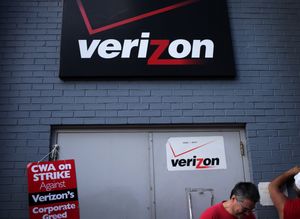
The nation’s longest and largest strike in the age of austerity ended this weekend. But the labor standoff continues as 45,000 Verizon landline technicians and customer service employees on the East Coast will return to work on Tuesday without a new contract.

The Communication Workers of America (CWA) and the International Brotherhood of Electrical Workers (IBEW), representing thousands of workers striking the nation’s largest wireless carrier, announced an end to the biggest walkout in recent labor history and the resumption of contract negotiations. However, at the present time, this is not a victory for the workers by any means.

After two dynamic, energetic weeks of walking picket lines and receiving no paychecks, Verizon workers are returning to work under the previous contract while revived negotiations with an obstinate standard-bearer of corporate greed make the prospect of a prolonged contract battle almost certain. Union leaders say they decided to end the strike after the company agreed to bargain seriously on contentious issues that Verizon had refused to budge on until now.

Larry Cohen, president of CWA, said the unions and the company had reached a deal “to restructure bargaining in a way that represents progress for everyone.” But the details of that agreement remain vague.

Friday, August 19, 2011

The Verizon Labor Battle: As Strike Continues, Customers Report Delays and Disruptions To Service

As a strike by 45,000 Verizon workers approaches the two-week mark, the company’s customers are beginning to feel the impact on its services. Consumers are reporting significant delays in booking Verizon technicians to fix and install landline telephone, Internet and cable television services. The strike was called after Verizon pushed for the workers to accept far-reaching concessions, including a pension freeze and fewer sick days. The company also asked workers to contribute far more toward their health coverage. Meanwhile, Verizon made $22.5 billion in profits over the past four and a half years and has paid its top five CEOs $258 million in the past four years. We’re joined by Steven Greenhouse, the labor reporter for the New York Times.

Video
Source: Democracy Now! 

Thursday, August 18, 2011

Juan Gonzalez: Verizon Workers’ Strike "Most Important Labor Battle Going on Today"

Telecom giant Verizon has threatened to suspend benefits to 45,000 striking workers if they do not return to work at the end of the month. The strike was called after negotiations after Verizon sought to cut health and pension benefits and obtain more leeway to fire workers. The strike is "the most important labor battle going on today," says Democracy Now! co-host and New York Daily News columnist Juan Gonzalez. "We’re not talking here about a General Motors or a company that’s in financial trouble. But Verizon is literally swimming in cash. [...] And yet, even with such a profitable company, you have a situation where it is demanding unprecedented givebacks from its workers. If Verizon, such a profitable company, can insist that its workforce has to do all of these cuts in their living standards, what does it mean about any other company in America? [...] The workers are vowing to keep this up as long as possible, because a company that is so profitable right now should not be insisting that its workers give up even more of the hard-fought gains they’ve had over the years."

Video
Source: Democracy Now! 

Wednesday, August 17, 2011

Striking Verizon Workers Are an Example to Us All

The Verizon Corporation is asking its workforce to accept wage and benefit reductions—despite being a very profitable company. Morgan Stanley’s recent analysis shows Verizon’s net income from ongoing operations was $13.9 billion in 2010, up more than 16 percent from 2007. No wonder Verizon’s stock has outpaced that of the S & P index and other telecommunication’s firms, something Verizon itself brags about in its last annual report. How, then, can Verizon freeze current workers’ pensions and eliminate pensions for new workers? Ask their workers to accept reductions in holidays (to seven), reduced sick pay and the substitution of the current health plan with one having high deductibles and contributions? The unions involved estimate that benefit and wage reductions would total $20,000 per worker each year.

Understandably, the workers have gone on strike. This labor conflict, however, is a microcosm of a broader trend in our economy, one that is not healthy for overall growth and certainly not conducive to improved living standards for America’s working families.

Thursday, August 11, 2011

Verizon Workers Strike Over "Full-Scale Attack" on Wages, Benefits at Telecom Giant

Some 45,000 workers at Verizon have entered their fifth day on strike after negotiations between Verizon and two unions representing the workers broke down when the company attempted to cut health and pension benefits for workers and make it easier to fire workers. The workers on strike are employed in Verizon’s fixed-line division covering landline phones, DSL Internet, FiOS, cable TV and Internet. Workers at Verizon Wireless are not unionized. Verizon says the benefit cuts are needed because its wireline business has been in decline for more than a decade as more people switch to using cellphones exclusively. But union officials have rejected Verizon’s argument. As the nation’s second-largest U.S. phone carrier, Verizon earned $6.9 billion in net income for the first six months of the year. We speak with Robert Master, spokesperson for Communications Workers of America, one of the unions representing Verizon employees, and with and Pamela Galpern, a striking Verizon worker and union activist. "Verizon [has] launched a full-scale attack,” says Galpern. “Essentially, the company has said, despite the fact we’re hugely profitable, we’re going to take advantage of the economic situation in the country right now to try to roll back the wages, benefits and job security of our workers."

Video
Source: Democracy Now! 

Monday, August 08, 2011

Verizon Labor Strike: Defense Of Middle Class Jobs, Workers Claim

NEW YORK -- Outside Verizon corporate headquarters in downtown Manhattan, a group of more than 40 union employees gathered wearing red shirts and placards proclaiming "CWA on Strike For Middle Class Jobs."

Over 45,000 Verizon workers -- 35,000 represented by the union Communications Workers of America, 10,000 by the International Brotherhood of Electrical Workers -- went on strike early Sunday morning when contract negotiations between the unions and Verizon broke down. The workers are striking, they say, because the company wouldn't budge on the nearly 100 concessions headquarters has asked employees to make on a set of broad-ranging issues. At the top of the list: wide spread wage cuts, increased employee contributions to health care plans and pensions -- which the company has proposed to freeze for current employees and eliminate for new hires.