Democracy Gone Astray

Democracy, being a human construct, needs to be thought of as directionality rather than an object. As such, to understand it requires not so much a description of existing structures and/or other related phenomena but a declaration of intentionality.
This blog aims at creating labeled lists of published infringements of such intentionality, of points in time where democracy strays from its intended directionality. In addition to outright infringements, this blog also collects important contemporary information and/or discussions that impact our socio-political landscape.

All the posts here were published in the electronic media – main-stream as well as fringe, and maintain links to the original texts.

[NOTE: Due to changes I haven't caught on time in the blogging software, all of the 'Original Article' links were nullified between September 11, 2012 and December 11, 2012. My apologies.]

Tuesday, December 06, 2011

The Commons: ‘It is the cover-up that buries one’

The Scene. James Moore, today’s substitute prime minister, had enough to say about the government’s maybe withdrawing from Kyoto that it was not until his third response to NDP leader Nycole Turmel that he needed to start whining about the actions of a Liberal government that last held office nearly six years ago. Conversely, in response to a question from Bob Rae about the travel habits of Peter MacKay, Moore had but three sentences to offer before he had to start ranting about how terrible the Liberals had been.

So it could be worse. To this rallying cry, the government holds steadfast.

The explanation for Mr. MacKay is altogether more straightforward and thus more complicated.

For the record, the three sentences Mr. Moore offered in Mr. MacKay’s defence were as follows: “Mr. Speaker, we have been clear. The Minister of National Defence returned from a private trip in order to go back to work. Government aircraft are used for government work.”

This much was offered in response to a very specific question from Mr. Rae. “The Minister of National Defence has stated in the House that there was a previously planned search and rescue mission that was the reason for his being picked up by a government helicopter. I would like to ask the government if it could answer this simple question,” Mr. Rae begged. “If it was a previously planned mission, why did Lieutenant Colonel Chris Bowles say on July 7, 2010 ‘this mission will be under the guise of fighter group as search and rescue training?’ If it was a previously planned mission, why would you need a guise?”

Attawapiskat tells 3rd-party manager to leave

The third-party manager sent by the federal government to handle the desperate housing situation in Attawapiskat in northern Ontario has been asked by the band to leave, CBC News has confirmed.

Attawapiskat Chief Theresa Spence told CBC News that she had informed the band manager of her decision.

"I advised my band manager I don't want them in my community … doesn't work for our community … we should focus on the crisis, not on other things," she said.

The government said earlier it had chosen Jacques Marion, from the accounting and consulting firm BDO Canada, as its third-party manager for Attawapiskat. Marion was to exercise signing authority for all department spending and would decide which band staff are required to run its program and services.

Spence said the minister responsible for First Nations "didn't listen."

Toonie user fee proposal is ‘war on children’, councillor says

Hold onto your toonies, Toronto. You might need them to visit Riverdale Farm, swim in an outdoor pool or borrow a popular movie from the library.

The City of Toronto is looking to shave costs and raise revenue as part of its 2012 budget and new $2 user fees for services that are now free emerged Monday as a key theme in that plan. The new fees – floated during a day-long budget meeting – will be debated later this week and next and, if approved, will go before council next month.

Talk of the new charges is likely to unleash a new wave of budget-cutting protests and, in the case of Riverdale Farm, comes just a few months after council voted unanimously to let a local group work on a new funding plan for the popular family attraction.

Budget chair Councillor Mike Del Grande has made it clear he thinks Toronto has too many “freebies,” and the proposed $2 charge to cool off in an outdoor pool or wander among the cows and pigs at Riverdale Farm are just the latest on his list.

Snow Revolution leaves Putin on ‘wrong side of history’

For 12 years, Vladimir Putin has ruled Russia in an increasingly authoritarian manner, slowly squeezing the life out of the country’s political opposition and independent media. His many detractors always struggled to get around the awkward truth that he did so with a large measure of popular support.

By voting for the opposition in large numbers in Sunday’s parliamentary election, Russians across the country signalled they were no longer onside with the direction Mr. Putin was taking the country in. The rebuke to Mr. Putin – who recently announced his plan to return to the Kremlin for up to another 12 years as president – was clear.

Thousands of protesters took to the streets of central Moscow on Monday, calling for “Russia without Putin!” and trying to break through a thick police cordon that blocked them from marching toward the Kremlin. It was the biggest demonstration the Russian capital has seen in years, and more may be on the way as anger spreads over Twitter and other social networking sites. A smaller protest broke out Monday on the Nevsky Prospekt in St. Petersburg.

If not for heavy-handed Kremlin manipulation – including the disqualification of the most vocal opposition parties, the harassment of independent monitors and apparent ballot-box stuffing in Chechnya (where United Russia won an improbable 99.5 per cent of the vote) and other regions – the results of Sunday’s Duma election would surely have been far worse for Mr. Putin’s United Russia party.

MacKay should apologize about chopper flight, opposition warns

OTTAWA—Defence Minister Peter MacKay should come clean or he will face calls for his resignation over a decision to hitch a ride on a search-and-rescue helicopter, opposition parties say.

MacKay brushed off attacks with clipped answers in the House of Commons Monday, while New Democrats and Liberals accused him of lying to the Commons over his 25-minute flight in 2010.

The minister was hoisted up to a CH-149 Cormorant helicopter from near a Newfoundland fishing lodge on July 9, 2010, and taken to Gander airport to catch a Challenger flight. From there he travelled to London, Ont., for a government announcement.

The minister has maintained that he was met by the search-and-rescue crew in order to witness a long-delayed demonstration of the aircraft’s abilities. But emails obtained by the Star last week showed an air force official ordered the ride to be carried out “under the guise” of a training mission only after MacKay made his request for the trip.

MacKay did not refer to any pre-planned demonstration Monday, but said “any suggestion that there was a re-tasking or diversion of search-and-rescue aircraft from their actual tasking is simply untrue.”

Liberal interim leader Bob Rae said the minister was “like a kid caught with his hand in the cookie jar.”

‘People are scared and morale is devastated’

City manager Joe Pennachetti is telling his staff “a few” of their ranks have already received layoff notices ahead of a council budget vote that could push almost 1,200 people out the door.

But city staff themselves say the number of workers already let go, or about to go, is higher when you factor in people who have been working on contract for as long as a decade and aren’t seeing that contract renewed.

One Toronto Water worker said staff morale is the lowest he’s seen in 26 years, with longtime colleagues suddenly disappearing and others bursting into tears at their desks.

“People are scared and morale is devastated,” said Mark Cooper, a water information officer who works at 275 Merton St.

“Last week three people were let go, and four people the week before that. It feels like anyone on contract, who they can cut without (their having) union protection, is gone.”

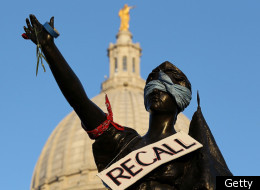
Scott Walker Recall Campaign Gets Ugly As Allegations Fly

WASHINGTON -- Few races next year will carry as much symbolic importance as the campaign to recall Wisconsin Gov. Scott Walker (R). His push to strip state workers of collective bargaining rights set off a nationwide debate over the role of unions and public workers and reenergized progressives who were still recovering from the tough losses they sustained during the 2010 elections.

Both sides recognize the importance of the campaign, which is also targeting the lieutenant governor and three Republican state senators. Progressive activists are working to collect enough petition signatures to force a recall of the governor, and Walker and his allies have already started an ad campaign in response.

Underlying all this is a scattered amount of isolated, underhanded activity that may be illegal. The past weekend even saw two arrests of recall opponents.

On Sunday, a man was arrested on allegations that he defaced recall petitions.

"The suspect stood in line to sign a petition and when given the petition clipboard, he scribbled out some names on the actual form, and the recall worker took the clipboard back, and he left the scene without any incident," West Bend, Wis. police Sgt. Matt Rohlinger told the Milwaukee Journal Sentinel.

Income Inequality Rising In Most Wealthy Countries, OECD Finds

Scales continue to tip in the rich's favor the world around.

Income inequality -- the gap between a society's richest members and its poorest -- is rising not only in the United States but in most of the world's major economies, according to a new report from the Organization for Economic Cooperation and Development.

Since 1985, income inequality has grown more pronounced in 17 of the 22 countries for which the OECD has long-term data, including Mexico, Italy, Japan, Australia, Canada and the United Kingdom.

The OECD's report suggests an explanation for why the Occupy Wall Street movement has grown from a single protest site in New York's Zuccotti Park to a global phenomenon with hundreds of chapters in dozens of countries. Among other things, protesters in the Occupy movement say they oppose the concentration of wealth in the hands of fewer and fewer people.

In the United States, the incomes of the very highest earners have grown by leaps and bounds over the last quarter century, while remaining more or less flat for the vast majority of the population.

Rural Suicides Follow Medicaid Cuts

Suicide is on the increase in rural America--nowhere so much as in western mountain states like Idaho, Wyoming and New Mexico. Mental health professionals attribute it in part to cutbacks in Medicaid funding, to the recession and to the culture of the rural West.

In Idaho, somebody kills himself every 35 hours, according to a 2009 report to Idaho's governor by the state's Council on Suicide Prevention. Their report calls suicide "a major public health issue" having a "devastating effect" on Idaho's families, churches, businesses and even schools: 65 students aged 10 and 18 killed themselves in a recent five-year period.

Recently, a county sheriff in Bonneville told the Idaho Falls Post Register that his department was getting more suicide calls than in 2010—a year in which 290 Idahoans took their own lives. "We're in a spike right now," he says.

Historically the suicide rate in rural states has been higher than in urban ones. According to the most recent national data available, Alaska has the highest rate, at 24.6 suicides per 100,000 people. Next comes Wyoming (23.3), followed by New Mexico (21.1), Montana (21.0) and Nevada (20.2). Idaho ranks 6th, at 16.5. Suicide is the second-leading cause of death for Idahoans aged 15-34. Only accidents rank higher.

First Nations housing in dire need of overhaul

As the Canadian Red Cross prepares to send aid to the northern Ontario Cree community of Attawapiskat this week to help it deal with a housing crisis that has left more than 100 people living in tents and construction trailers, many other First Nations are struggling with housing problems just as grave.

A recent federal evaluation of First Nations housing concluded that the housing shortage on reserves is severe and only getting worse.

According to the February 2011 report, 20,000 to 35,000 new units would need to be built to meet current demand (the Assembly of First Nations puts the figure closer to 85,000).

Housing on reserves falls short by almost any measure and especially when compared with housing off reserve: 41.5 per cent of homes on reserves need major repairs, compared with seven per cent in non-aboriginal households outside reserves.

Rates of overcrowding are six times greater on reserve than off. In many communities, it's not uncommon to have three generations living under one roof – not by choice but by necessity.

"There are people who are living like sardines in some units," says Jonathan Solomon, chief of Kashechewan First Nation, a fly-in Cree community upstream from James Bay in northern Ontario. "Sometimes, there's 18 to 21 people living in small units, and it creates an unfit home environment."