Democracy Gone Astray

Democracy, being a human construct, needs to be thought of as directionality rather than an object. As such, to understand it requires not so much a description of existing structures and/or other related phenomena but a declaration of intentionality.
This blog aims at creating labeled lists of published infringements of such intentionality, of points in time where democracy strays from its intended directionality. In addition to outright infringements, this blog also collects important contemporary information and/or discussions that impact our socio-political landscape.

All the posts here were published in the electronic media – main-stream as well as fringe, and maintain links to the original texts.

[NOTE: Due to changes I haven't caught on time in the blogging software, all of the 'Original Article' links were nullified between September 11, 2012 and December 11, 2012. My apologies.]

Thursday, March 29, 2012

Budget targets environmental critics

OTTAWA — Finance Minister Jim Flaherty's budget takes aim at the federal government's environmental critics, while reducing its own internal resources for promoting sustainable development.

The budget tabled Thursday proposes a few environmental protection measures. In contrast, it contains an $8-million plan to crack down on conservation groups, while maintaining the status quo on substantial tax incentives for the oil and gas sector.

The budget also proposes to eliminate a key federal advisory panel on business and environmental issues — and its $5.2 million annual budget — which is headed by Flaherty's former chief of staff, David McLaughlin.

The National Round Table on the Environment and the Economy, originally established in the 1990s to advise the prime minister, regularly produced reports that challenged the business and environmental policies of the government, particularly regarding climate change.

The proposed crackdown on charities would add new resources to the Canada Revenue Agency to monitor and restrict environmental groups from sending out emails to supporters and other activities that are considered to be political in nature.

Federal budget drags Canada into unnecessary austerity

In contrast to this year’s AFB 2012, today’s federal budget is decidedly not a budget for the rest of us.
In fact, regular Canadians won’t see themselves at all in this budget.
Instead, the country will be dragged into austerity, not only now but in the future.  And none of it is necessary.
The deficit balance date has moved forward one year purely due to economic growth, and with just slightly better growth, it will be two years.  The federal cuts weren’t $4 billion or $8 billion, but more than $5 billion—for this round anyway.

While the budget’s title says growth, it will be hard for the federal government to paddle against the obvious fact that they are cutting back. This is a budget of cuts: 10% for the CBC, for food inspectors and for those who help low-income Canadians access services.  The impact will be felt on services, but it will also be felt on employment.  For the first time since elected in 2006, the federal government is starting to project job losses.  It estimates that the latest wave of cuts will result in 19,000 lost positions.

Total's Elgin Platform Leaking Gas In North Sea Raises Concerns

EDINBURGH, Scotland (AP) — Environmental groups warned Thursday they fear an oil spill could be triggered at a North Sea offshore platform that has been leaking highly pressurized gas since the weekend.

A flame is still burning in the stack above the Elgin platform, which stands about 150 miles (240 kilometers) off the coast of Aberdeen, eastern Scotland, after a leak of flammable gas Sunday— prompting all 238 staff to be evacuated on Monday.

Platform operator Total S.A. insists there is no threat of any explosion under current weather conditions, but said that surveillance flights have detected a sheen around the platform estimated to extend over 4.8 square kilometers (1.85 square miles).

The sheen is believed to be caused by gas condensate — a petrol-like substance that contains some oil. The condensate is a lighter fuel than oil, but is still dangerous.

"Elgin is sending methane into the atmosphere, which is a greenhouse gas, so there is some environmental impact at the moment. There is also oil in that well, and Total need to move before an oil spill becomes part of this leak," said Richard Dixon, director of WWF Scotland.

Israel’s Secret Staging Ground

In 2009, the deputy chief of mission of the U.S. embassy in Baku, Donald Lu, sent a cable to the State Department's headquarters in Foggy Bottom titled "Azerbaijan's discreet symbiosis with Israel." The memo, later released by WikiLeaks, quotes Azerbaijan's President Ilham Aliyev as describing his country's relationship with the Jewish state as an iceberg: "nine-tenths of it is below the surface."

Why does it matter? Because Azerbaijan is strategically located on Iran's northern border and, according to several high-level sources I've spoken with inside the U.S. government, Obama administration officials now believe that the "submerged" aspect of the Israeli-Azerbaijani alliance -- the security cooperation between the two countries -- is heightening the risks of an Israeli strike on Iran.

In particular, four senior diplomats and military intelligence officers say that the United States has concluded that Israel has recently been granted access to airbases on Iran's northern border. To do what, exactly, is not clear. "The Israelis have bought an airfield," a senior administration official told me in early February, "and the airfield is called Azerbaijan."

Progressive Muslims Launch Gay-Friendly, Women-Led Mosques In Attempt To Reform American Islam

At first, the devout Muslims who gathered in a Washington, D.C., conference center seemed like they could have come from any mosque. There were women in headscarves and bearded men who quoted the Quran.

But something was different. While mingling over hors d'oeuvres, they discussed how to change Islam's future. A woman spoke about fighting terrorism; she had married outside the Islamic faith, which is forbidden for a Muslim woman. A Pakistani man mentioned his plans to meet friends for drinks, despite the faith's ban on alcohol.

In a corner of the room, an imam in a long gray tunic counseled a young Muslim with a vexing spiritual conflict: being gay and Muslim. The imam, also gay and in a relationship, could easily sympathize with the youth's difficulties.

On this brisk Monday night in late October, members of Muslims for Progressive Values, a nascent American reformist organization, had gathered from around the country to celebrate a milestone: In four years, the group had grown from a few friends to a thousand members and spawned a string of small mosques and spiritual groups that stretched from Atlanta to Los Angeles.

The Money Trail Behind Florida's Notorious Gun Law

On April 26, 2005, Florida Gov. Jeb Bush signed into law SB 436, better known as the "Stand Your Ground" law, which gave Floridians the right to use deadly force to defend themselves in public without first trying to flee from a threat. Nearly seven years later, the law has exploded into public view with the killing of 17-year-old Trayvon Martin in Sanford, Florida. Police released the shooter, George Zimmerman, the night of the killing after he claimed self-defense; ever since, there has been a firestorm of debate over the wisdom of Stand Your Ground laws, also known as "shoot first" laws, which now exist in 24 states.

The money trail leading to the watershed law in Florida—the first of the 24 across the nation—traces primarily to one source: the National Rifle Association. When Gov. Bush conducted the 2005 signing ceremony, standing alongside him was Marion Hammer, a leader and familiar face from the pro-gun lobbying powerhouse. But the NRA's support for the Stand Your Ground law was far more than symbolic. An analysis by Mother Jones of election and lobbying records reveals that the NRA was instrumental in creating Stand Your Ground: Over a nine-year period the organization gave more than $73,000 in campaign donations to the 43 Florida legislators who backed the law. That money was buttressed by intense lobbying activity and additional funds spent by the NRA in support of the bill's introduction and passage.

Killed at Home: White Plains, NY Police Called Out on Medical Alert Shoot Dead Black Veteran, 68

As the Trayvon Martin case draws national attention, we look at another fatal shooting of an African-American male that has received far less scrutiny. Kenneth Chamberlain, Sr., a 68-year-old African-American Marine veteran, was fatally shot in November by White Plains, NY, police who responded to a false alarm from his medical alert pendant. The officers broke down Chamberlain’s door, tasered him, and then shot him dead. Audio of the entire incident was recorded by the medical alert device in Chamberlain’s apartment. We’re joined by family attorneys and Chamberlain’s son, Kenneth Chamberlain, Jr., who struggles through tears to recount his father’s final moments, including the way police officers mocked his father’s past as a marine. "For them to look at my father that way, (with) no regard for his life, every morning I think about it," he says.

Video
Source: Democracy Now
Author: ---

Canada Budget 2012: Tories To Lay Down Majority Markers With First Unfettered Budget

OTTAWA - After six years in office, Prime Minister Stephen Harper's Conservatives finally get to flex their majority muscles today with a budget of deep spending cuts and government streamlining.

Everything appears up for a rethink, from the way major resource projects are assessed to how immigrants are selected, research and development is funded and the eligibility age for certain pension benefits.

The first budget since last May's majority victory, Foreign Affairs Minister John Baird boasted Wednesday in the Commons, "will help the middle class by ensuring the long-term prosperity of this great country."

"It will support the priorities of working families, creating an environment for job creation, supporting health care, supporting education. It is going to do great things over the next year on this plan."

The Conservatives have been pushing a "jobs and growth" mantra for months, including some $12 million in pre-budget advertising by Finance and the Canada Revenue Agency.

But a more frank appraisal might frame the budget as short-term pain for longer term gain.

Marc Mayrand Testimony On Robocall Scandal: 800 Election Complaints Cut Across Canada

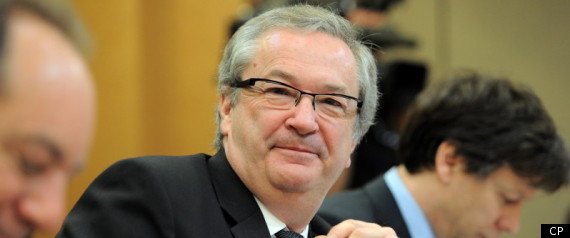
OTTAWA — Canada's elections watchdog called the possibility of voter suppression during the last election "outrageous,'' revealing Thursday that investigators are examining 800 complaints of misleading telephone calls from right across the country.

Chief Electoral Officer Marc Mayrand emphasized how seriously his office was taking the complaints as he testified before a House of Commons committee.

"I think it's absolutely outrageous — whether it was organized, or bigger, or whatever, the fact that electors at least that we know of in Guelph, were misdirected by calls falsely made on behalf of Elections Canada is absolutely outrageous, should not be tolerated,'' Mayrand told MPs in a packed committee room.

"It's totally unacceptable in a modern democracy.''

Canada Gas Prices: 10 Per Cent Jump In One Year Among Highest In Developed World

If it seems like gas prices have been rising particularly quickly in Canada, that’s because they are.

According to a new analysis by The Economist, in the past year the price at the pump increased faster in Canada than in a majority of developed nations. Though gas here remains cheap compared to many countries, the amount Canadians have been forking over at the pump was up 10 per cent in February over the same month the previous year, putting Canada eighth out of 28 countries in terms of the rate of increase.

But while Canadian consumers are no doubt feeling the pinch, Earl Sweet, managing director of economic research at BMO Capital Markets, cautions against reading too much into the international comparison.

As he points out, many of the countries included in The Economist comparison are in Europe, where taxes make up a much greater proportion of the pump price than in Canada. That makes gas prices there less susceptible to swings in the price of oil.