Democracy Gone Astray

Democracy, being a human construct, needs to be thought of as directionality rather than an object. As such, to understand it requires not so much a description of existing structures and/or other related phenomena but a declaration of intentionality.
This blog aims at creating labeled lists of published infringements of such intentionality, of points in time where democracy strays from its intended directionality. In addition to outright infringements, this blog also collects important contemporary information and/or discussions that impact our socio-political landscape.

All the posts here were published in the electronic media – main-stream as well as fringe, and maintain links to the original texts.

[NOTE: Due to changes I haven't caught on time in the blogging software, all of the 'Original Article' links were nullified between September 11, 2012 and December 11, 2012. My apologies.]

Showing posts with label International Relations. Show all posts

Monday, February 01, 2016

Harper wanted to pull out of Europe’s leading security organization: diplomats

OTTAWA — Former prime minister Stephen Harper wanted to pull Canada out of one of Europe's leading security organization four years ago but U.S. President Barack Obama convinced him to stay.

Three European ambassadors are describing what happened in 2012 when Harper suggested Canada would withdraw from the Organization for Security and Cooperation in Europe, a 57-country alliance that includes NATO and European Union countries.

The diplomats say Harper believed the OSCE was no longer relevant because Europe was mainly peaceful then.
Thursday, October 15, 2015

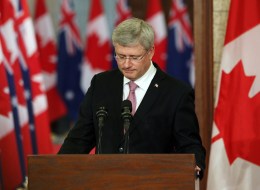
Canada's War on Science Brings Us International Shame

A push to prioritize economic gains over basic research is endangering science and academic freedom in countries around the world, according to a new report published by a leading researchers union, the French National Trade Union of Scientific Researchers (SNCS-FSU).

The group surveyed higher education and research unions in 12 countries including France, Argentina, Canada, Denmark, Italy, Portugal, Russia, Senegal, Serbia, Spain, the U.K. and the U.S.

Wednesday, October 07, 2015

Saudi Arabia Continues Hiring Spree of American Lobbyists, Public Relations Experts

Saudi Arabia is in the market for a better reputation in Washington, D.C.

In September alone, foreign lobbying disclosure documents show the Saudi government signing deals with PR powerhouse Edelman and lobbying leviathan the Podesta Group, according to recent disclosures.

Tuesday, September 29, 2015

Harper doesn’t have the power to eviscerate Canada’s reputation

What do Stephen Harper and Joan Jett have in common besides a burning love for rock and roll?

Neither, apparently, gives a damn about his or her reputation.

Jett said so explicitly in her hit song, “Bad Reputation,” released in 1980. And Harper, according to his foes, has quietly and deliberately diminished Canada’s international standing as the True North Strong and Friendly since he entered the prime minister’s office in 2006.

Sunday, June 28, 2015

Harper Has Made Canada Irrelevant in Global Governance

This week, the United States and China are engaging in high-level Strategic and Economic Dialogues, the P5+1 and Iran bargain the last outline of a nuclear deal that is reshaping the Middle East and, barring any major strategic surprises, Russia is seeking readmission to the G7 group of countries.

Thursday, February 26, 2015

How Harper's disastrous diplomacy crushed Keystone XL

President Obama's veto of the Keystone XL pipeline is nothing less than a devastating indictment of Stephen Harper's foreign policy.

Despite the imperative that Canada diversify our access to foreign markets, no relationship is or ever will be more important to this country's fortunes than the one it has with the US, and most of all, the White House.

But the weight of Harper's ambition and ego brought that historic relationship to its knees, and with it, the prime minister's own defining economic and foreign policy objectives.

Monday, October 13, 2014

Just how seriously is Canada’s voice taken now?

It was a moment made-to-order for Stephen Harper’s dark way of talking about the world. Going back to the 2011 election, the Prime Minister has often portrayed Canada as an island of safety in a global sea of dangers. Sometimes that imagery comes off as alarmist, but the rhetoric works when the topic at hand is the rise of Islamic State extremism in Syria and Iraq. So, when Harper rose in the House of Commons last week to make his case for joining U.S. President Barack Obama’s air campaign against the terrorists, he sounded very much himself in framing the disturbing new threat. He also said that deploying CF-18 fighter jets was necessary to maintain Canada’s international standing. “If Canada wants to keep its voice in the world—and we should, since so many of our challenges are global—being a free rider means you are not taken seriously,” Harper said.

Monday, June 10, 2013

Here we go again

AFTER his historic meeting with Mao Zedong in 1972, Richard Nixon wrote in his diary of what he called “probably the most moving moment” of the hour-long encounter: the chairman clasping the American leader’s hand for about a minute as they sat talking. Such sparks of personal chemistry are what China’s new president, Xi Jinping, and Barack Obama may be hoping to recreate during an informal summit on June 7th and 8th.

Thursday, April 04, 2013

Dropping UN drought convention: The death knell of Canada's international reputation?

According to UNICEF's 2009 Human Development Index, the impoverished North African nation of Niger ranks lowest in nutritional and health indicators. In that country, one child in five dies before their fifth birthday.

Bordering Niger to the southwest is Burkina Faso, a similarly destitute, landlocked republic where there are as few as ten physicians per 100,000 people and a child malnutrition rate of 25 per cent.

Wednesday, March 13, 2013

Conservative government’s approach to rebranding Canada’s foreign policy is failing

At no time since the Conservatives were first elected in 2006 has the political leadership been so disappointed with its international portfolios.

Having only recently shaken off public criticism of its treatment of the nation’s veterans, a government that initially strove to promote a new, more militaristic posture for Canada on the world stage now finds itself mired in controversy over the Department of National Defence’s procurement policies.

Monday, December 17, 2012

What Julian Fantino needs to learn about international development

The learning curve is awesomely steep and must be carried out in the full glare of media and public attention. What's worse, you can be 100 per cent certain there are hordes of people who know the issues better than you ever will. And it's often the international ministries that are most intimidating for new ministers who typically may have little background in their new universe. Some -- many -- never make the grade. That's why a wise new international minister will say little publicly until he/she has really mastered the file, and will then be extremely humble and modest. They must remember how much they don't know.

In July, Prime Minister Stephen Harper appointed Julian Fantino the Minister of International Co-operation. Mr. Fantino's entire adult life had been spent as a police officer in Ontario. He had, literally, a world to discover before he could master the hugely complex and controversial subject of international development and co-operation.

Thursday, October 25, 2012

The Iranians we left behind

When Canada closed its embassy in Tehran last month, it wasn’t just Canadian diplomats who were affected. We left behind a small number of local staff, and their plight deserves attention. Blindsided by Ottawa’s decision, they’re now in danger of becoming collateral damage in the dysfunctional relationship between Canada and Iran.

Canadian embassies are made up of both Canadian and local staff. The Canadians are sent from Canada as diplomats, and locals are recruited to support them. Sometimes local staff are also Canadian citizens – this is the case for some of our former Iranian staff – but they don’t have the same privileges as Canadian staff and are not subject to the same protections.

Wednesday, October 24, 2012

Canada caught in geopolitical energy struggle between China and the U.S.

What is a middle power with an overabundance of natural resource assets to do when the rising rival of its most crucial ally — politically, militarily, economically — comes knocking?

That rival is China; the ally, the United States of America. Canada and the Harper government appear caught in the crosshairs of a geopolitical energy struggle.

Already, U.S. lawmakers have begun to raise the alarm over China’s growing stake in Canadian oilsands development. The pending sale of Canada’s Nexen for $15.1 billion to China National Offshore Oil Corp. (CNOOC) is deeply unpopular with Canadian voters, with a majority unhappy at the prospect of a Chinese state-owned enterprise owning a controlling stake in a Canadian energy gem.

Friday, October 05, 2012

Canada poised to claim ownership of vast underwater territory bigger than Quebec

OTTAWA – Canada is poised to claim ownership of a vast new expanse of undersea territory beyond its Atlantic and Arctic coasts that’s greater in size than Quebec and equal to about 20% of the country’s surface area, Postmedia News has learned.

The huge seabed land grab has been in the works since 1994, when federal scientists first conducted a “desktop study” of Canada’s potential territorial expansion under a new UN treaty allowing nations to extend their offshore jurisdictions well past the current 200-nautical-mile (370-km) limit of so-called “Exclusive Economic Zones” in coastal waters.

Sunday, September 16, 2012

Canada shutters 3 embassies for the day over safety woes

Canadian and U.S. embassies across the Middle East took precautions against continued violent protests over the weekend, while Libya said it has rounded up some 50 people in connection with the deadly attack on the U.S. consulate in Benghazi.

Canada closed three of its embassies for the day on Sunday — in Egypt, Libya and Sudan, where anti-U.S. protests have turned violent — citing continued security concerns.

Sunday, September 09, 2012

China worries probed at Northern Gateway hearing

Lawyers for environmental groups have pressed Northern Gateway pipeline representatives about the hypothetical possibility of Chinese interests buying control of the project.

Barry Robinson, one of the lawyers who represents three different environmental organizations, raised the issue Saturday during federal review hearings into the proposed $6-billion line, which would ship Alberta's crude to the British Columbia coast where it could be loaded aboard tankers.

Tuesday, September 04, 2012

Smiles and Barbs for Clinton in China

BEIJING — Secretary of State Hillary Rodham Clinton arrived here on Tuesday night to a barrage of unusually harsh coverage in China’s official news media over what they called American meddling in territorial disputes in the region — and then a strikingly warm welcome from the country’s foreign minister.

 The contrasting receptions — both official, though in different ways — underscored a complicated and often fraught relationship that both countries nevertheless appear intent to maintain despite serious differences over foreign policy, trade and human rights.

Friday, August 24, 2012

Canada waives Cote d’Ivoire’s $130-million debt

Canada is cancelling $130-million in debt owed by the Cote d’Ivoire, erasing an old tab to help the African country dig itself out from a pile of debt.

The Canadian action is part of a international effort to forgive billions in Ivorian debt as international players judge that President Alassane Ouattara is making headway in turning the country’s finances and governance around.

Wednesday, August 08, 2012

Canada has to master the complexity of the U.S. political system

In three months we will wake up to see who Americans have elected as president, to the House of Representatives and a third of the Senate. We will be deeply affected by the results, whatever the political stripe of those who occupy the White House and take control of the two houses of Congress. Like it or not, Canadians do have a “dog in this hunt.” Geography, history, economics and culture have created a deep integration that goes far beyond a typical foreign relationship.

Sunday, July 15, 2012

Battle for the Pacific: Naval arms race in the China Sea

ABOARD THE USS CARL VINSON—U.S. navy Capt. Rick Labranche streaks across the horizon at 1,000 kilometres an hour in his F-18 Hornet strike fighter.

It has been 12 minutes since a catapult slung Labranche’s plane from the flight deck of the aircraft carrier USS Carl Vinson and Labranche is preparing to drop a pair of 225-kilogram bombs into the Indian Ocean’s two-metre swells.