Democracy Gone Astray

Democracy, being a human construct, needs to be thought of as directionality rather than an object. As such, to understand it requires not so much a description of existing structures and/or other related phenomena but a declaration of intentionality.
This blog aims at creating labeled lists of published infringements of such intentionality, of points in time where democracy strays from its intended directionality. In addition to outright infringements, this blog also collects important contemporary information and/or discussions that impact our socio-political landscape.

All the posts here were published in the electronic media – main-stream as well as fringe, and maintain links to the original texts.

[NOTE: Due to changes I haven't caught on time in the blogging software, all of the 'Original Article' links were nullified between September 11, 2012 and December 11, 2012. My apologies.]

Showing posts with label CFIA. Show all posts

Friday, October 03, 2014

Canada's Agricultural Watchdog Isn't Interested In Your Health

The majority of humans I have met are vastly humane. Comparatively, the majority of Government decisions are seen as exasperatingly profane.

The Canadian Food Inspection Agency (CFIA) has been slowly going the way of the other federal departments in our post-democratic Canada; they have gone from having the occasional nosebleed of odd policy, to having chronic influenza of misguided rulings, to now having a dead soul.

Wednesday, July 31, 2013

CFIA contract flip-flop latest sign of Tories’ ‘hardball’ approach to PS unions

OTTAWA — The chair of a conciliation panel has scolded the federal government after its representative on the panel rejected three recommendations he had earlier endorsed during contract bargaining involving more than 4,000 employees of the Canadian Food Inspection Agency.

“It does not assist the process when one party backtracks from earlier agreements,” Lorne Slotnick, a respected mediator and arbitrator, wrote as the three-member panel released its recommendations, including a dissent from Andrew Tremayne, the member representing the CFIA.

Monday, June 10, 2013

CFIA Anthrax Investigations Stop

EDMONTON - Canada's food regulator has stopped riding herd on anthrax, a disease that can kill cattle, bison, other grazing animals and, in rare cases, people.

The Canadian Food Inspection Agency says it will no longer investigate and quarantine anthrax-infected farms, collect samples for testing, vaccinate livestock or oversee and help pay for the cost of disposing animals that die of the disease.

Friday, February 01, 2013

Infected salmon declared fit for human consumption by Canadian Food Inspection Agency

For the first time, Canada’s food safety regulator is allowing Nova Scotia salmon infected with a flu-like virus to be processed for supermarkets and restaurants.

Last week the Canadian Food Inspection Agency declared fit for human consumption 240,000 Atlantic salmon with infectious salmon anemia — a disease it says poses no risk to human heath. The ruling is the first time the CFIA has opted not to destroy fish carrying the virus since it started regulating the fish farming industry in 2005.

Monday, November 05, 2012

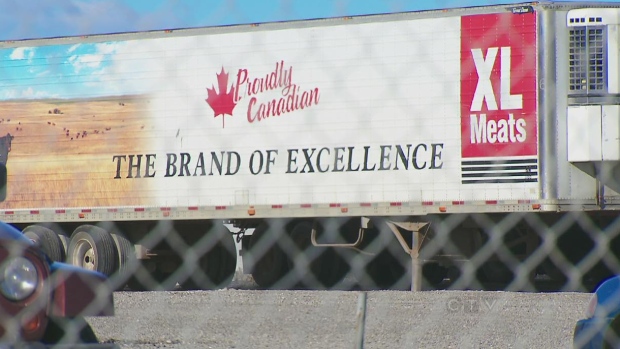
Food inspection agency raises new safety concerns at XL Foods

The Canadian Food Inspection Agency has raised new safety concerns about operations at an Alberta beef processing plant that recently resumed slaughter operations.

CFIA inspectors have been closely monitoring operations at XL Foods, which was shut down after E. coli was discovered by meat inspectors last month.

Thursday, October 18, 2012

U.S. authorities repeatedly warned CFIA over safety problems at XL Foods facilities

OTTAWA —Long before E. coli contamination was discovered in XL Foods Inc. products, U.S. authorities repeatedly warned the Canadian Food Inspection Agency about safety problems at the Alberta meat packer.

Inspectors with the U.S. Department of Agriculture’s Food Safety and Inspection Service (FSIS) sent a series of audit reports to the CFIA between 2003 and 2008 detailing deficiencies they had found at Canadian processing plants, including XL Foods facilities.

Monday, October 15, 2012

CFIA has 1,727 meat inspectors, but unions say it’s not enough, can’t keep up

The Canadian Food Inspection Agency provided some clarity on the number of meat inspectors it employs last week, but the unions representing slaughterhouse workers and inspectors across the country say that staffing numbers have failed to keep up with factory speeds.

The CFIA employed 1,727 meat inspectors as of March, 2012. Some 1,223 meat inspectors were assigned to slaughterhouses; 674 were assigned to meat processing, 495 were assigned to “ready to eat” meat processing, and 483 were assigned to “non-ready” meat inspection. The figures exceed the total because hundreds of inspectors are assigned to more than one task and counted twice.

Wednesday, April 25, 2012

CFIA Budget Cuts: Gerry Ritz Not Telling Truth About Cuts To Food Inspectors, Union Says

The federal government is misleading Canadians about the changes it’s making to Canada’s food safety measures and bowing to industry pressure in its cuts to the food inspection agency’s budget, says the union that represents food inspectors.

The Agriculture Union, a component of the Public Service Alliance of Canada, said Tuesday the changes the government is planning to the Canadian Food Inspection Agency will create a system “reminiscent of the conditions in place just prior to the listeriosis outbreak.”

In a statement to the press, the union said the CFIA’s food inspectors will be converted to “systems inspectors,” effectively creating an industry “self-policing” system reminiscent of the one in place prior to the 2008 listeriosis outbreak, in which 22 people died from eating processed meats linked to a Maple Leaf plant in Toronto.

The union also said Tuesday that CFIA executives expect to hand off a “big role” to the food industry when it comes to enforcement of food safety rules. It did not provide details.

Despite assurances by Agriculture Minister Gerry Ritz that there will be no reduction in the front-line staff that inspect food products, executives at the CFIA have been telling staff that cuts are coming, the Agriculture Union said.

Saturday, March 31, 2012

Canada Budget 2012: CFIA Cuts Mean Food Labelling Lies Will Have To Be Policed By Consumers

The federal government’s decision to stop policing nutrition claims on food labels threatens Canadians’ health and leaves consumers with little recourse when food labels are wrong, the head of an agricultural union says.

In the budget released Thursday, the Conservative government announced it would no longer verify nutrition claims on food labels, and will instead set up a website where consumers can take their concerns directly to food producers.

“The Government will change how the Canadian Food Inspection Agency (CFIA) monitors and enforces non-health and non-safety food labelling regulations,” the budget document states. “The CFIA will introduce a web-based label verification tool that encourages consumers to bring validated concerns directly to companies and associations for resolution.”

Bob Kingston, president of the Agriculture Union, which represents food inspectors at the CFIA, said the new policy amounts to “a total farce.”

Consumers don’t have the capacity to determine whether nutrition information, such as the level of sodium or cholesterol in a food product, is accurate, he argued, adding that he disagreed with the government's assertion that nutrition labels are a "non-health and non-safety" issue.

Monday, January 09, 2012

Maple Lodge Farms faces 60 criminal charges as thousands of chickens perish

The Canadian Food Inspection Agency has laid 60 criminal charges against Brampton-based Maple Lodge Farms, Canada’s largest independent chicken processor, alleging violations of federal animal health regulations.

The CFIA alleges that between December 2008 and February 2009, and then December 2009 and April 2010, thousands of chickens died from exposure to cold conditions during transportation from farm to slaughterhouse, often because of proximity to a truck trailer’s floor or walls.

Two of the counts have been heard in a series of six hearings at the Ontario Court of Justice, in Brampton, which began in September. The hearings continue on Monday.

In one count, dated “on or about” Dec. 30 and Dec.31, 2008, the Crown alleges that 711 chickens, of nearly 10,000 in shipment, were “found dead on arrival” at Maple Lodge’s slaughterhouse. In the other, “on or about” Feb. 23, 2009, 1,181 chickens, of nearly 11,000, were discovered dead upon unloading at the slaughterhouse.

The first count concerns a haul of broiler chickens, which are raised solely for meat production; their breasts and thighs appear on grocery store shelves. The second refers to a load of spent hens, a term for poultry no longer capable of laying eggs, whose meat is often used in ground chicken products.