
Showing posts with label Mortgage Fraud. Show all posts
Showing posts with label Mortgage Fraud. Show all posts
Saturday, May 28, 2016
“It is happening again”: David Dayen on the epidemic of mortgage fraud and the rigged economy that sets it in motion
Friday, April 24, 2015
Did Insurance Giant Defraud Thousands of Mortgage Holders?

The province last year fined three companies -- including Manulife Financial Corp., the Manufacturers Life Insurance Co., and Benesure Canada Inc. -- for breaking laws that govern British Columbia's insurance industry.
Thursday, August 08, 2013
JPMorgan: We're Being Investigated By DOJ Over Mortgages

Friday, March 01, 2013
New York AG investigating BofA for mortgages: filing

The second-largest U.S. bank said it was cooperating with the investigation and other similar inquiries. A Bank of America spokesman declined to comment beyond the filing.
The bank is the third known to be targeted by the New York attorney general's office over how banks bundled mortgage loans into securities during the housing boom.
In its annual report filing with the U.S. Securities and Exchange Commission, Bank of America also said it could sustain up to $3.1 billion in legal losses beyond the amount it has reserved. That was up from a possible loss above legal reserves of $2.8 billion at the end of the third quarter.
Original Article
Source: reuters.com
Author: Reuters
Monday, January 07, 2013
Bank Of America, Fannie Mae Settlement: Bank To Pay $3.6 Billion To Settle Mortgage Claims
 CHARLOTTE, N.C. — Bank of America says it will spend more than $10 billion to settle mortgage claims resulting from the housing meltdown.
Under the deal announced Monday, the bank will pay $3.6 billion to Fannie Mae and buy back $6.75 billion in loans that the North Carolina-based bank and its Countrywide banking unit sold to the government agency from Jan. 1, 2000 through Dec. 31, 2008. That includes about 30,000 loans.
Wednesday, October 24, 2012
Bank Of America Mortgage Fraud: Feds Sue For Over $1 Billion Alleging Multi-Year Scheme

"In order to increase the speed at which it originated and sold loans ... Countrywide eliminated every single checkpoint on loan quality and compensated its employees solely based on the volume of loans originated," the lawsuit, filed in Manhattan federal district court, alleges.
Friday, October 19, 2012
Mortgage Settlement: Half Of Money Siphoned Off By Cash-Hungry States

But in the months after that deal was reached, many found themselves confronted by a new challenge: fighting with lawmakers who want to siphon off money earmarked for homeowner aid for other uses.
Wednesday, October 10, 2012
Wells Fargo Lawsuit: U.S. Sues Bank Alleging Civil Mortgage Fraud

From Jan. 1, 2002 through Dec. 31, 2010, Wells Fargo intentionally concealed the problems with 6,320 loans it had determined were "seriously deficient" from the Federal Housing Administration, which insured the loans, according to the complaint filed in Manhattan federal district court. The bank didn't report the problems with the loans even after its own risk department conducted reviews that according to one bank employee, unearthed "a dirty underbelly of bad loan officers," the lawsuit claims.
Wednesday, July 18, 2012
Bank Of America Settles With Bond Insurer Syncora For $375 Million Over Mortgage Fraud Claims

Syncora sued Bank of America in 2009 to recover losses on securities transactions based on home loans made by Countrywide Financial, which was bought by Bank of America in 2008. Syncora said it was duped into insuring the mortgage-backed securities and that Countrywide misrepresented the quality of the underlying mortgages.
Wednesday, June 06, 2012
Mortgage Fraud Investigation Pushes Forward, Hires Criminal Prosecutor
The investigation into widespread fraud on Wall Street leading up to the financial crisis will now have a proseucting attorney to help the effort. Virginia Chavez Romano,a former assistant US attorney in New York, was hired by Eric Schneiderman, the New York attorney general and co-chair of the task force. She is not an official hire of the working group, but rather will assist Schneiderman in his efforts as co-chair.
Romano participated in the criminal indictments of Credit Suisse employees earlier this year for falsifying prices tied to collateralized debt obligations. This is just the sort of fraud the working group wants to go after, though you can look at Romano’s case history in two different ways.
Romano participated in the criminal indictments of Credit Suisse employees earlier this year for falsifying prices tied to collateralized debt obligations. This is just the sort of fraud the working group wants to go after, though you can look at Romano’s case history in two different ways.
Monday, March 26, 2012
Fannie Mae, Freddie Mac Resistance To Principal Reduction Costs Taxpayers

They could no longer afford their mortgage payments and had slipped into delinquency. They could not refinance to take advantage of low-interest rates because they were among the nearly 11 million American homeowners who are "underwater," meaning that they owed the bank more than their house was worth. Bank of America had already initiated foreclosure proceedings.
Then in the spring of 2011, a nonprofit lender, Boston Community Capital, presented a potential fix, one it has used to aid some 200 underwater borrowers in Massachusetts over the last two years. The bank would buy the DeCaros' home at market value -- about $87,000, which was barely half of their mortgage balance -- and then sell it back to them for a little more, providing a manageable loan. Bank of America affirmed the sale price as fair value.
Thursday, March 22, 2012
"Too Crooked to Fail": Matt Taibbi Says Bailouts, Fraud are the Secrets to Bank of America’s Success
 In his new article, "Bank of America: Too Crooked to Fail," Rolling
Stone reporter Matt Taibbi chronicles the remarkable history of the rise
of Bank of America, an institution he says has defrauded "everyone from
investors and insurers to homeowners and the unemployed." Taibbi
describes how the Bush and Obama administrations have repeatedly propped
up the financial institution, which received a $45 billion taxpayer
bailout in 2008. Bank of America has also received billions in what
could be described as shadow bailouts. The bank now owns more than 12
percent of the nation’s bank deposits and 17 percent of all home
mortgages. Taibbi also recounts how fraudulent practices by Bank of
America and other companies ravaged pension funds. "Most people think of
[the mortgage crisis] as some airy abstraction — you know, bankers
ripping off bankers," Taibbi says. "That’s not what it is. It’s bankers
stealing from old ladies and retirees."
In his new article, "Bank of America: Too Crooked to Fail," Rolling
Stone reporter Matt Taibbi chronicles the remarkable history of the rise
of Bank of America, an institution he says has defrauded "everyone from
investors and insurers to homeowners and the unemployed." Taibbi
describes how the Bush and Obama administrations have repeatedly propped
up the financial institution, which received a $45 billion taxpayer
bailout in 2008. Bank of America has also received billions in what
could be described as shadow bailouts. The bank now owns more than 12
percent of the nation’s bank deposits and 17 percent of all home
mortgages. Taibbi also recounts how fraudulent practices by Bank of
America and other companies ravaged pension funds. "Most people think of
[the mortgage crisis] as some airy abstraction — you know, bankers
ripping off bankers," Taibbi says. "That’s not what it is. It’s bankers
stealing from old ladies and retirees." Video
Source: Democracy Now!
Author: ---
Tuesday, March 13, 2012
Mortgage Investigation Consistently Hindered By Major U.S. Banks

The findings, based on a review of foreclosure practices at Bank of America, JPMorgan Chase, Wells Fargo, Citigroup and Ally Financial over a two-year span from October 1, 2008 to September 30, 2010, essentially confirm what has been reported extensively for nearly two years. Bank employees, in order to speed foreclosures, signed hundreds of legal documents a day without reviewing the accuracy of the foreclosure information, notarized signatures on documents that purported to verify a bank's legal right to foreclose without ever checking whether that was true, and hired law firms that forged signatures en masse -- all with the encouragement of management.
The report was issued by the HUD's Office of Inspector General a day after the government finally filed in federal court documents that set the terms of the banks' settlement to resolve a 16-month foreclosure investigation. The Department of Justice used the HUD review in negotiating the settlement.
Thursday, February 23, 2012
FDIC Lawsuits Yielded Big Penalties, But Bankers Haven't Paid Up

WASHINGTON, Feb 23 - Like many banks engulfed by the mortgage crisis, First National Bank of Nevada specialized in risky home loans that didn't require borrowers to prove their incomes. When the housing bubble burst, First National got crushed in 2008 under the weight of bad loans that it could no longer resell to investors.
Last year, the Federal Deposit Insurance Corporation sued two former senior executives of the defunct bank for alleged negligence and breach of fiduciary duty, hoping to recover nearly $200 million in losses that it tied directly to those executives' decisions. The two men denied wrongdoing and settled for $40 million.
But they didn't pay a dime.
Instead, the federal agency - which is better known as a regulator that seizes control of failing banks and provides deposit insurance for consumers than for its prosecutorial endeavors - is still fighting in court to collect that money from Catlin Group Ltd., a Lloyd's insurance syndicate. Catlin provided an equivalent of malpractice insurance to First National's executives, but the insurer denied liability for the executives' alleged mistakes.
Tuesday, February 21, 2012
Mortgage fraud up 150 per cent in the last year
Mortgage fraud has become big business in Canada, with a 150 per cent rise in criminal transactions detected just in the last year, according to the credit reporting agency Equifax.
“The schemes are getting so increasingly complex, there is no doubt that organized crime is involved,” says John Russo, chief legal counsel and privacy officer for Equifax Canada.
“They are working with individuals, even from jail, to come up with schemes that are bigger and better than the last.”
The levels of fraud have been escalating so wildly since 2008, Equifax has started working hand-in-hand with major lending institutions trying to flag fraudulent loans before money is handed over, Russo said in an interview Tuesday.
Largely as a result of those efforts, Equifax helped detect a $2.8 million escalation in attempted mortgage fraud just in the last year, he noted.
Thursday, February 16, 2012
Audit Uncovers Extensive Flaws in Foreclosures
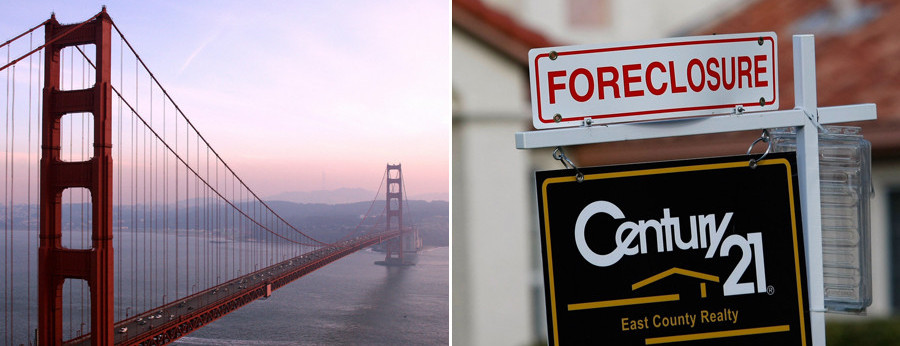
Anecdotal evidence indicating foreclosure abuse has been plentiful since the mortgage boom turned to bust in 2008. But the detailed and comprehensive nature of the San Francisco findings suggest how pervasive foreclosure irregularities may be across the nation.
The improprieties range from the basic — a failure to warn borrowers that they were in default on their loans as required by law — to the arcane. For example, transfers of many loans in the foreclosure files were made by entities that had no right to assign them and institutions took back properties in auctions even though they had not proved ownership.
Commissioned by Phil Ting, the San Francisco assessor-recorder, the report examined files of properties subject to foreclosure sales in the county from January 2009 to November 2011. About 84 percent of the files contained what appear to be clear violations of law, it said, and fully two-thirds had at least four violations or irregularities.
Tuesday, February 14, 2012
After Mortgage Settlement, Fannie Mae, Freddie Mac Face Renewed Pressure On Principal Reduction
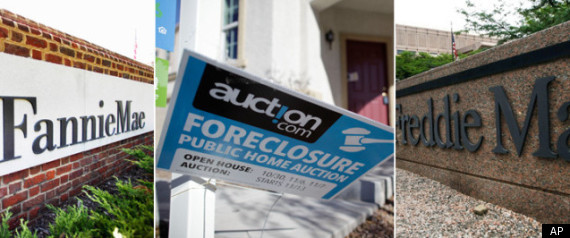
Borrowers whose loans are backed by the government-controlled mortgage giants -- nearly half of all outstanding mortgages in the United States -- are not eligible for payouts under the deal. State officials who negotiated the deal say they could not convince Fannie Mae and Freddie Mac, or the Federal Housing Finance Agency, which oversees the loan giants, to join onto the settlement because they are steadfastly opposed to principal reductions -- loan write-downs for borrowers whose homes are at risk of foreclosure.
"This is a glaring weakness of the overall settlement," said one state official who spoke on condition of anonymity. "Fannie and Freddie were absolutely opposed to principal reduction. You'd ask why, and they'd say 'moral hazard to the taxpayer.'"
So far, the mortgage giants and the FHFA have only said that they're avoiding principal reduction because of the cost to taxpayers.
Principal reductions are hailed by many economists and housing experts as the most effective way to help homeowners who are underwater on their mortgages, owing more than the home is worth. About 1 in 5 homes in the U.S. are currently underwater.
Thursday, February 09, 2012
Mortgage Settlement Leaves Some Foreclosure Victims Wanting

Instead, the couple packed and left their dream house behind. After two failed attempts at a mortgage modification and what the Zapatas describe as a suspiciously timed foreclosure sale, the bank managing their loan ordered the couple and their two children out. That day, the Zapatas lost more than $100,000 in mortgage payments. In the months that led up to the foreclosure and those that followed, they also racked up thousands of dollars in stress-related medical bills and family loans. Ally Financial, whose predecessor, GMAC, handled the Zapatas' mortgage, declined to comment on the details of the Zapatas' claims.
Now, under the terms of a government settlement with Ally and four other companies that allegedly mismanaged millions of loans and introduced fraud to the foreclosure process, nearly 2 million homeowners are slated to receive a negotiated measure of justice. About 1 million homeowners who owe their banks more than their homes are worth will be eligible for a principle balance or interest rate reduction, making it less likely that these people will default. Another 775,000 borrowers who lost their homes between 2008 and 2011 will be eligible for a one-time payment of up to $2,000.
Borrowers will not release any claims in exchange for a payment. And $3.5 billion will go to state and federal governments to be used to repay public funds lost as a result of mortgage servicer misconduct and to fund housing counselors, legal aid and other similar public programs determined by the state attorneys general.
Friday, February 03, 2012
Goldman Sachs Faces Mortgage Debt Class-Action Lawsuit Over Misleading Investors

U.S. District Judge Harold Baer in Manhattan certified a class-action lawsuit by investors in the GSAMP Trust 2006-S2, a $698 million offering of certificates based on a pool of second-lien home mortgages.
The underlying loans were made by New Century Financial Corp, a subprime mortgage specialist that went bankrupt in 2007.
Plaintiffs in the lawsuit said New Century ignored its own underwriting standards and used improper appraisals when making the loans, and Goldman failed to conduct adequate due diligence when it bought the loans and packaged them into securities.
Baer's decision is dated Feb. 2. (Reporting By Jonathan Stempel; Editing by Phil Berlowitz)
Original Article
Source: Huff
Author: Reuters
Eric Schneiderman Sues BofA, Wells Fargo, JPMorgan Chase Over Electronic Mortgage Fraud
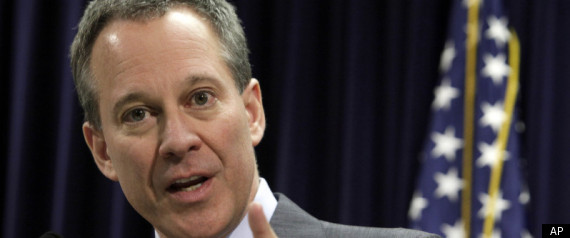
Schneiderman has been outspoken in urging the Obama administration to hold the nation's largest financial institutions accountable for their role in the foreclosure crisis, notably hesitating to join a larger nationwide case against the country's five largest banks for mortgage fraud. States now have until Monday, according to the Iowa attorney general's office, to decide to join that deal.
The New York attorney general has yet to announce whether New York will participate in the deal because of concerns that joining the settlement would make it impossible for him to file his own, state-based lawsuits against the banks, said sources close to the negotiations who spoke on the condition of anonymity. The decision to bring this lawsuit on Friday indicates that the larger nationwide settlement is now more to Schneiderman's pleasing, said a source familiar with the discussions.
"If the deal terms had been decided six months ago, a state couldn't have pursued this kind of lawsuit," said the source. "The fact that Schneiderman has filed this case suggests that the terms of the deal have changed since then."
Subscribe to:
Posts (Atom)