Democracy Gone Astray

Democracy, being a human construct, needs to be thought of as directionality rather than an object. As such, to understand it requires not so much a description of existing structures and/or other related phenomena but a declaration of intentionality.
This blog aims at creating labeled lists of published infringements of such intentionality, of points in time where democracy strays from its intended directionality. In addition to outright infringements, this blog also collects important contemporary information and/or discussions that impact our socio-political landscape.

All the posts here were published in the electronic media – main-stream as well as fringe, and maintain links to the original texts.

[NOTE: Due to changes I haven't caught on time in the blogging software, all of the 'Original Article' links were nullified between September 11, 2012 and December 11, 2012. My apologies.]

Showing posts with label Wheat Board. Show all posts

Tuesday, February 16, 2016

Sask. farmers call for return of Canadian Wheat Board

A meeting of Prairie farmers has called for the return of a single-desk system for grain marketing.

The Canadian Wheat Board Alliance says more than 50 farmers from the Swan River and Pelly areas of Manitoba and Saskatchewan met last week and unanimously passed a resolution calling for the re-establishment of the Canadian Wheat Board.

The group says the loss of the single-desk system has resulted in an increasingly dysfunctional rail system, reduced grain quality guarantees to other nations and an overall loss of $6.5 billion in income to farmers over the last two years.

Former agriculture Minister Ritz passed legislation ending the Canadian Wheat Board, and last year half of its assets were sold to Saudi-owned G-3 Global Grain Group.

Original Article
Source: CBC
Author: The Canadian Press
Tuesday, August 04, 2015

Canadian Wheat Board Sold To G3 Global Grain Group, Becomes G3 Canada

EDMONTON — The federal government has closed the book on the agency that once marketed almost all the grain produced by western Canadian farmers.

Agriculture Minister Gerry Ritz says Ottawa has finalized the sale of the Canadian Wheat Board to G3 Global Grain Group.

Monday, May 18, 2015

CWB deal raises doubts

When announcing the saleof the former Canadian Wheat Board to a U.S.-Saudi joint venture, Agriculture Minister Gerry Ritz couldn't resist getting one parting shot in at supporters of orderly marketing.

No longer would Canadian farmers go to jail for selling their own grain, Ritz said. The only problem is, like many of the other statements Ritz made on Wednesday in Winnipeg, it's not entirely true. In fact, Canadian farmers (a few of them anyway) went to jail for refusing to pay fines for breaking the Canadian Wheat Board Act. So their crime was not only flouting the law of the land, but also the judicial system that enforces the law.

Friday, April 24, 2015

Investor ​G3 Global Grain Group to take over wheat board

G3 Global Grain Group will invest $250 million to become the new majority owner of the CWB, formerly known as the Canadian Wheat Board.

The new Winnipeg-based partnership was selected to take over CWB's operations after a process set in motion when the Conservative government ended its marketing monopoly.

Farmers who sell their grain through the CWB can receive free units in an independently managed trust, which will hold the remaining 49.9 per cent interest in the CWB.

Tuesday, December 16, 2014

Harper Government Destroys Farmer Control Over Seed

(November 25, 2014 - Saskatoon, SK) – The National Farmers Union (NFU) is sounding the alarm with the passing of Bill C-18, the Agriculture Growth Act omnibus bill yesterday in the House of Commons. “Farmers must now contend with UPOV ’91. UPOV ’91 is one of the most farmer-unfriendly mechanisms we have ever seen,” exclaimed Jan Slomp, NFU President.

“Bill C-18 gives seed breeders-- increasingly large multinational companies -- massive new rights over seed along with the power to extract vast amounts of money from farmers,” added Ann Slater, NFU Vice President (Policy).

Tuesday, December 09, 2014

Giving away Wheat Board assets and Pat Martin's outburst in the House

If you believe that government monopoly agencies are not the best way to get Canadian agricultural products to market you probably applauded when the Harper government eliminated the Canadian Wheat Board's control of the prairie grain business.
That move "liberated" Western farmers, freed them from the bondage of "big government," Prime Minister Harper boasts, and allowed them to take part fully in the free market economy.
But even if you are an enthusiastic cheerleader for open markets in agriculture, you've got to be a bit worried about the Conservatives' current plans for the no-longer-single-desk Canadian Wheat Board.
The Harper government legislation that got rid of the Wheat Board's monopoly also stipulated that the agency should be fully privatized by 2017.

Monday, December 08, 2014

Pat Martin Asks Agriculture Minister: Have You Lost Your Freaking Mind?

Winnipeg NDP MP Pat Martin returned to his raucous ways during question period on Tuesday, asking Conservative minister Gerry Ritz if he had “lost his freaking mind.”


The colourful outburst was related to an exchange about the government’s rejection of an ownership bid back in October by Saskatoon-based Farmers of North America (FNA) to acquire the Canadian Wheat Board (CWB).

Friday, November 28, 2014

Canadian Wheat now cheapest in the world

This just in from the Reuters news agency out of Hamburg, Germany: Canadian wheat is now the cheapest in the world. How times change! With the single-desk Canadian Wheat Board farmers sold directly to overseas markets and got premium prices because of reliability of supply, honesty, and guaranteeing the highest quality grain in the world.

Wednesday, January 29, 2014

Friends of the Canadian Wheat Board: $17 Billion Lawsuit Against Feds Will Move Ahead

SWIFT CURRENT, Sask. - The group Friends of the Canadian Wheat Board says it is moving ahead with a multibillion-dollar lawsuit against the federal government despite a court ruling in the fall.

The lawsuit is over legislation that removed the wheat board's marketing monopoly on western wheat and barley sales.

Board supporters are seeking $17 billion in damages.

Friday, July 05, 2013

Why Canada's Wheat Board will be missed

In 2012, the Conservatives ended the 70-year monopoly seller status of the Canadian Wheat Board, one of the world's largest and most successful "state trading enterprises."

The government decision came without a vote among prairie grain farmers, required by the Canadian Wheat Board Act, and despite a 2011 plebiscite in which a majority of farmers voted to maintain the Board's status. The matter is now before the courts, but the Board cannot simply be revived after having been dismantled. Instead, a coalition of farmer groups has launched a class action suit against the government seeking billions of dollars in compensation.

Wednesday, February 13, 2013

Board of Sex: Pining for pin-ups at the CWB

The Canadian Wheat Board (CWB) has been at the intersection of political controversy. The Harper Government's Bill C-18 (which came into effect on August 1, 2012) legislated an end to its monopsony (a single buyer facing many sellers) as purchaser of Canadian wheat and barley. Given the importance of the CWB in protecting individual grain farmers from the immense marketing force of multi-national corporations on the one hand, and the determination of the Harper Conservatives to splinter the collective muscle of the CWB on the other, this is hardly surprising. What is surprising is the normally staid CWB being at the center of a controversy in a clumsy attempt to foster participation with a sexually charged advertising campaign.

Wednesday, September 26, 2012

Revamped Canadian Wheat Board faces 1st test

The Canadian Wheat Board is facing its first test in the open market, competing with other grain companies to get farmers' business this fall.

The federal Conservative government stripped the agency of its monopoly on wheat and barley sales in August, meaning Prairie producers can sell their grain to the board or to other companies.

Staff at the Winnipeg-based CWB are now trying to convince farmers to sign up for its early delivery wheat pool by a Friday deadline, as it seeks a high buy-in rate to prove it is still relevant in the open market.

Wednesday, September 19, 2012

OECD praises the end of Wheat Board monopoly

The federal government has won praise from the Organization of Economic Co-operation and Development for dismantling the Canadian Wheat Board’s monopoly over the sale of wheat and barley grown in Western Canada.

The controversial decision to effectively eliminate the Wheat Board “is a positive step to enhance proactive risk management by farmers,” the OECD said in a report on global agriculture policy released Wednesday.

Friday, August 17, 2012

U.S. grain and seed ports will kill a few more Canadian jobs -- with a little help from Stephen Harper

Back in 2009, when the destruction of the Canadian Wheat Board was still just a twinkle in Prime Minister Stephen Harper's eye, work started on a $200-million US grain-handling terminal in the port of Longview, Wash., just south of the Canadian border.

The companies behind the project -- which, significantly, will be capable of loading about 200 grain ships a year -- are Bunge Ltd. (the giant "Bermudian" agricultural and food products corporation with its real headquarters in White Plains, N.Y.), Japan's Itochu Corp. and South Korea's STX Pan Ocean Co.

Saturday, August 11, 2012

Pardons another slap in the face

As the new marketing era dawned Aug. 1, Canada's prime minister took his revisionist view of history and his ideological vendetta against the Canadian Wheat Board to a new level.

He retroactively pardoned farmers convicted of running the border with their grain trucks in the early 1990s as a protest, and who defied customs officers by stealing their compounded vehicles back. Some were later convicted of contempt of court.

Saturday, August 04, 2012

Rights are relative in Stephen Harper's world

Wouldn't it be nice if we lived in a world where we only had to obey the laws we liked and disregard or flagrantly flout those we didn't? And wouldn't it be nice if, having broken those laws, someone came along afterward and wiped away our criminal record?

Welcome to Prime Minister Stephen Harper's world.

Harper was in Kindersley this week exercising the Royal Prerogative of Mercy to pardon 13 Alberta farmers who defied the Canadian Wheat Board and illegally transported grain across the Canada-U.S. border in the 1990s and early 2000s. "These people were not criminals, they were our fellow citizens, citizens who protested injustice.''

Friday, August 03, 2012

Wheat farmers lose a tool in the winds of change

The winds of change are sweeping through the Prairies this summer, the federal government having stripped the Canadian Wheat Board of its marketing monopoly on wheat and barley. Since 1943, the wheat board has had the exclusive authority to sell these grains on behalf of farmers, returning to them all of the proceeds minus the costs of administration. This week, the “single desk” system ceased to exist, ushering in the biggest change in Prairie farming in at least two generations.

It’s worth pausing to take stock of the long and storied history of this institution. Will the change bring a breath of fresh air or the hot, withering gales of a Prairie scorcher?

Wheat board pardons from Harper could open the door to abuse of power, critics charge

Normally, when someone wants to be pardoned for a past crime they have to apply to the Parole Board of Canada.

But on rare occasions, the government can exercise what Prime Minister Harper referred to this week as an “ancient power”: the Royal Prerogative of Mercy.

That’s exactly what it did in suspending the records of a group of farmers convicted years ago of taking their grain across the border to sell in the U.S. against the law.

Thursday, August 02, 2012

Wheat Pardons: Harper Gives Amnesty To Farmers Convicted Under Old Law

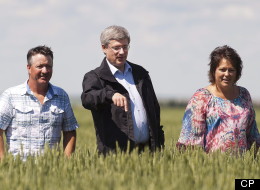
KINDERSLEY, Sask. -- Prime Minister Stephen Harper has granted pardons to farmers who were convicted in the 1990s for taking their grain across the border to sell in the U.S.

The farmers were trying to get around a law at the time that said they had to sell their wheat and barley through the Canadian Wheat Board or get export permits from the agency.

New federal legislation effective Wednesday strips the wheat board of its monopoly so that western farmers can sell their grain to whomever they choose.

Harper pardons farmers arrested under old wheat board law

The Conservative government is pardoning a group of farmers who were arrested for trying to sell their wheat under the old law governing the Canadian Wheat Board's monopoly as they mark the first day on which prairie producers can sell outside the board.

Prime Minister Stephen Harper made the announcement this afternoon at a farm outside Kindersely, Sask.

"Never, never again" will western farmers alone be punished for trying to sell the wheat they grew on their land, Harper said to a round of applause.