Democracy Gone Astray

Democracy, being a human construct, needs to be thought of as directionality rather than an object. As such, to understand it requires not so much a description of existing structures and/or other related phenomena but a declaration of intentionality.
This blog aims at creating labeled lists of published infringements of such intentionality, of points in time where democracy strays from its intended directionality. In addition to outright infringements, this blog also collects important contemporary information and/or discussions that impact our socio-political landscape.

All the posts here were published in the electronic media – main-stream as well as fringe, and maintain links to the original texts.

[NOTE: Due to changes I haven't caught on time in the blogging software, all of the 'Original Article' links were nullified between September 11, 2012 and December 11, 2012. My apologies.]

Showing posts with label Yellowstone. Show all posts

Thursday, April 24, 2014

Yellowknife Mine Sits Atop A Lethal Store Of Arsenic

A mine in the Northwest Territories sits atop a lethal store of arsenic that would be enough to kill every man, woman and child in the world, Vice reports.

And a northern regulator wants to know precisely what will be done to keep it it from seeping out.

Proponents of the Giant Mine Remediation Project aim to freeze 237,000 tonnes of arsenic trioxide dust stored in chambers under the mine in Yellowknife, N.W.T. in order to keep it from contaminating nearby water, says Aboriginal Affairs and Northern Development Canada (AANDC).

Friday, January 20, 2012

Exxon: Yellowstone Oil Spill Involved More Barrels Than Estimated

BILLINGS, Mont. -- Exxon Mobil says 1,509 barrels of oil spilled into the Yellowstone River during a pipeline break in Montana last summer – an increase of more than 500 barrels over the company's earlier estimates.

Spokesman Alan Jeffers said Thursday the company recalculated the volume after discovering the pipeline was completely severed during the July 1 accident near Laurel.

Jeffers says pipeline breaches typically involve a crack or fissure. That was the assumption used to craft the initial estimate.

The company has estimated costs related to the spill of $135 million.

More than 1,000 Exxon Mobil contractors were involved in the cleanup effort. Only about 10 barrels of crude were recovered – less than 1 percent of the total spilled.

Original Article
Source: Huff 

Wednesday, July 06, 2011

Yellowstone Oil Spill: Exxon Mobil Took Longer To Seal Pipeline Than Publicy Disclosed

LAUREL, Mont. -- Federal documents show it took Exxon Mobil nearly twice as long as it publicly disclosed to fully seal a pipeline that spilled roughly 1,000 barrels of crude oil into the Yellowstone River.

Details about the company's response to the Montana pipeline burst emerged late Tuesday as the Department of Transportation ordered the company bury the duct deeper beneath the riverbed, where it is buried 5 to 8 feet underground to deliver 40,000 barrels of oil a day to a refinery in Billings.

The federal agency's records indicate the pipeline was not fully shut down for 56 minutes after the break occurred Friday near Laurel. That's longer than the 30 minutes that company officials claimed Tuesday in a briefing with federal officials and Gov. Brian Schweitzer.

An Exxon Mobil spokesman said the longer time span was based on information provided to the agency by the company and the discrepancy might have come about because Exxon Mobil Pipeline Co. President Gary Pruessing was speaking without any notes in front of him when he addressed Schweitzer.

"Clearly our communication with the regulator (DOT) is the one that we've got precision on," spokesman Alan Jeffers said.

It was not the first time the company offered clarification of its response and assessment of the spill. A day earlier, the company acknowledged under political pressure that the leak's impact could extend far beyond a 10-mile stretch of the river it initially said was the most affected area. The company had earlier downplayed government officials' assertions that damage was spread over dozens of miles.

Full Article
Source: Huffington 

Sunday, July 03, 2011

Yellowstone Oil Spill Prompts Evacuations

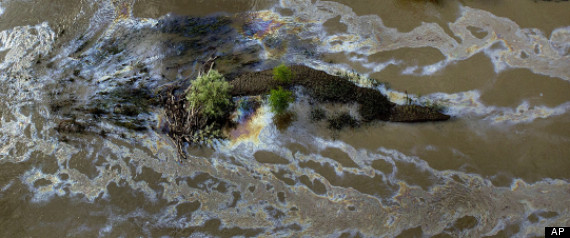
LAUREL, Mont. — Hundreds of barrels of crude oil spilled into Montana's Yellowstone River after an ExxonMobil pipeline beneath the riverbed ruptured, sending a plume 25 miles downstream and forcing temporary evacuations, officials said.

The break near Billings in south-central Montana fouled the riverbank and forced municipalities and irrigation districts Saturday to close intakes.

The river has no dams on its way to its confluence with the Missouri River just across the Montana border in North Dakota. It was unclear how far the plume might travel.

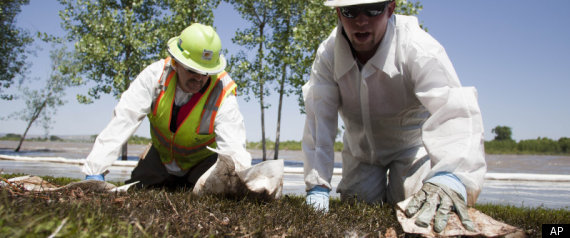
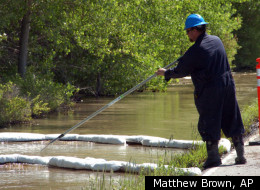
Cleanup crews deployed booms and absorbent material as the plume moved downstream at an estimated 5 to 7 mph.

"The parties responsible will restore the Yellowstone River," Mont. Gov. Brian Schweitzer said.

A 600-foot-long black smear of oil coated Jim Swanson's riverfront property just downstream from where the pipe broke.

"Whosever pipeline it is better be knocking on my door soon and explaining how they're going to clean it up," Swanson said as globules of oil bubbled to the surface. "They say they've got it capped off. I'm not so sure."

ExxonMobil spokeswoman Pam Malek said the pipe leaked an estimated 750 to 1,000 barrels of oil for about a half-hour before it was shut down. Other Exxon officials had estimated up to 42,000 gallons of crude oil escaped.

Duane Winslow, Yellowstone County director of disaster and emergency services, said the plume was dissipating as it moved downstream. "We're just kind of waiting for it to move on down while Exxon is trying to figure out how to corral this monster," Winslow said.

"The timing couldn't be worse," said Steve Knecht, chief of operations for Montana Disaster and Emergency Services, who added that the plume was measured at 25 miles near Pompeys Pillar National Monument. "With the Yellowstone running at flood stage and all the debris, it makes it dang tough to get out there to do anything."

Brent Peters, the fire chief for the city of Laurel about 12 miles west of Billings, said the rupture in the 12-inch diameter pipe occurred late Friday about a mile south of Laurel.

He said about 140 people in the Laurel area were evacuated early Saturday due to concerns about possible explosions and the overpowering fumes. He said they were allowed to return at about 4 a.m. after fumes had decreased.

Winslow said hundreds of residents downstream were told to evacuate in the early morning hours as authorities knocked on doors, but it's unclear how many did.

In a statement, ExxonMobil said it was sending a team to help with cleanup, and that state and federal authorities had been alerted to the spill. The ExxonMobil Pipeline Company "deeply regrets this release," it said.

Crews were putting out absorbent material along stretches of the river in Billings and near Laurel, but there were no attempts at capturing oil farther out in the river. In some areas oil flowed underneath booms and continued downstream.

The smell of oil permeated the air for miles downstream and through the city of Billings.

"Nobody's been able to lay their eyes on the pipe," Peters said. "Right now, the Yellowstone River is at flood stage. The bank isn't stable enough for anybody to get close."

The cause of the rupture in the pipe carrying crude oil from Belfry, Mont., to the company's refinery in Billings wasn't known. Peters and Malek said speculation involves high water that might have gouged out the river bed and exposed the pipe, which was possibly hit by debris.

"I haven't seen it this high for at least 15 years," Peters said.

Jeb Montgomery of ExxonMobil said the pipe was buried six feet below the riverbed.

The state has received record rainfall in the last month and also has a huge snowpack in the mountains that is melting, which has resulted in widespread flooding in recent weeks.

Three oil refineries are in the Billings area, and Peters said he asked all three to turn off the flow of oil in their pipelines under the river once the leak was reported. He said ExxonMobil and Cenex Harvest Refinery did so, and that Conoco Phillips said its pipe was already shut down.

He said the river where the leak occurred is about 250 yards wide, and that an oil slick appeared to be about 20 feet wide.

Full Article
Source: Huffington