Democracy Gone Astray

Democracy, being a human construct, needs to be thought of as directionality rather than an object. As such, to understand it requires not so much a description of existing structures and/or other related phenomena but a declaration of intentionality.
This blog aims at creating labeled lists of published infringements of such intentionality, of points in time where democracy strays from its intended directionality. In addition to outright infringements, this blog also collects important contemporary information and/or discussions that impact our socio-political landscape.

All the posts here were published in the electronic media – main-stream as well as fringe, and maintain links to the original texts.

[NOTE: Due to changes I haven't caught on time in the blogging software, all of the 'Original Article' links were nullified between September 11, 2012 and December 11, 2012. My apologies.]

Tuesday, August 09, 2011

What Happened to Obama?

IT was a blustery day in Washington on Jan. 20, 2009, as it often seems to be on the day of a presidential inauguration. As I stood with my 8-year-old daughter, watching the president deliver his inaugural address, I had a feeling of unease. It wasn’t just that the man who could be so eloquent had seemingly chosen not to be on this auspicious occasion, although that turned out to be a troubling harbinger of things to come. It was that there was a story the American people were waiting to hear — and needed to hear — but he didn’t tell it. And in the ensuing months he continued not to tell it, no matter how outrageous the slings and arrows his opponents threw at him.

The stories our leaders tell us matter, probably almost as much as the stories our parents tell us as children, because they orient us to what is, what could be, and what should be; to the worldviews they hold and to the values they hold sacred. Our brains evolved to “expect” stories with a particular structure, with protagonists and villains, a hill to be climbed or a battle to be fought. Our species existed for more than 100,000 years before the earliest signs of literacy, and another 5,000 years would pass before the majority of humans would know how to read and write.

Origins of the debt showdown

In mid-January, newly installed as the GOP House majority leader, Virginia’s Eric Cantor rose to the podium inside a spacious hotel ballroom to deliver a message to his troops, including the 87 newcomers who had given the party control of the House.

A vote to increase the nation’s $14.3 trillion debt limit was coming soon, he told the caucus members who had gathered at the Marriott in Baltimore’s Inner Harbor for a closed-door retreat less than 10 days after taking power. Think of it as a “hidden” opportunity, he implored them, a chance to achieve their goal of reining in the federal government and its spending habits.

“I’m asking you to look at a potential increase in the debt limit as a leverage moment when the White House and President Obama will have to deal with us,” said Cantor, one of several new House leaders who detailed the game plan for the coming months. “Either we stick together and demonstrate that we’re a team that will fight for and stand by our principles, or we will lose that leverage.”

Turning Poverty Into an American Crime

I completed the manuscript for Nickel and Dimed in a time of seemingly boundless prosperity. Technology innovators and venture capitalists were acquiring sudden fortunes, buying up McMansions like the ones I had cleaned in Maine and much larger. Even secretaries in some high-tech firms were striking it rich with their stock options. There was loose talk about a permanent conquest of the business cycle, and a sassy new spirit infecting American capitalism. In San Francisco, a billboard for an e-trading firm proclaimed, “Make love not war,” and then—down at the bottom—“Screw it, just make money.”

When Nickel and Dimed was published in May 2001, cracks were appearing in the dot-com bubble and the stock market had begun to falter, but the book still evidently came as a surprise, even a revelation, to many. Again and again, in that first year or two after publication, people came up to me and opened with the words, “I never thought...” or “I hadn’t realized...”

Government paper discovery sparks internment test case

The discovery of government papers from the early years of the North's Troubles has sparked a court action by former prisoners held without trial under the controversial policy of internment.

Six former internees who have reported being tortured by British troops are suing the British Ministry of Defence, the Secretary of State, the police, as well as the estate of the late Brain Faulkner, former Northern Ireland Prime Minister.

The group, who see their action as a test case for the 2,000 people interned in the early 1970s during some of the worst years of violence, said the confidential documents confirmed their long-standing belief that the policy was directed against the Catholic community and included indiscriminate arrests.

"A Declaration of War on the Poor": Cornel West and Tavis Smiley on the Debt Ceiling Agreement

The veteran broadcaster Tavis Smiley and the author and Princeton University Professor Cornel West are in the midst of a 15-city, cross-country trek they have dubbed "The Poverty Tour: A Call to Conscience." The tour comes on the heels of last week’s deficit agreement, which has been widely criticized for excluding a tax hike on the wealthy, as well as any measures to tackle high unemployment. "Any legislation that doesn’t extend unemployment benefits, doesn’t close a single corporate loophole, doesn’t not raise one cent in terms of new revenue in terms of taxes on the rich or the lucky, allows corporate America to get away scot-free again—the banks, Wall Street getting away again—and all these cuts ostensibly on the backs of everyday people," says Smiley.

Video
Source: Democracy Now! 

Atomic Cover-Up: The Hidden Story Behind the U.S. Bombing of Hiroshima and Nagasaki

As radiation readings in Japan reach their highest levels since the Fukushima Daiichi nuclear power plant meltdowns, we look at the beginning of the atomic age. Today is the 66th anniversary of the U.S. atomic bombing of Nagasaki, which killed some 75,000 people and left another 75,000 seriously wounded. It came just three days after the United States dropped an atomic bomb on Hiroshima, killing around 80,000 people and injuring some 70,000. By official Japanese estimates, nearly 300,000 people died from the bombings, including those who lost their lives in the ensuing months and years from related injuries and illnesses. Other researchers estimate a much higher death toll. We play an account of the 1945 atomic bombing of Nagasaki by the pilots who flew the B-29 bomber that dropped that bomb, and feature an interview with the son of Pulitzer Prize-winning journalist George Weller, who was the first reporter to enter Nagasaki. He later summarized his experience with military censors who ordered his story killed, saying, "They won." Our guest is Greg Mitchell, co-author of "Hiroshima in America: A Half Century of Denial," with Robert Jay Lifton. His latest book is "Atomic Cover-Up: Two U.S. Soldiers, Hiroshima & Nagasaki and The Greatest Movie Never Made."

Video
Source: Democracy Now! 

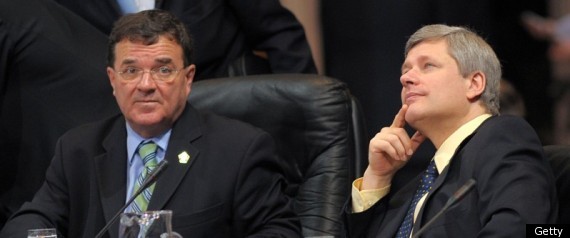
Jim Flaherty's Budget Cuts: Are They Too Much, Too Soon?

With debt crises in the United States and Europe threatening to send a still-shaky world economy teetering over the edge, Canada’s finances have rarely looked so good.

Despite racking up a hefty federal budget deficit of $36.2 billion last year, or about 3 per cent of GDP, Finance Minister Jim Flaherty's plan to get back to balance by 2015 — which includes an estimated $4 billion in annual spending cuts — has made Canada the poster child for fiscal responsibility.

But as global economic uncertainty once again reaches a fever pitch, how much austerity is too much?

According to Andrew Jackson, chief economist for the Canadian Labour Congress, the belt-tightening underway in Canada is more extreme than in most other industrialized nations.

Would the PM please shut up: Senior Conservative cabinet minister was BQ member for 7-plus years

Senior federal Conservative cabinet minister was member of Bloc Quebecois for seven-plus years!

Well, it's not April 1, and it's in the Globe and Mail just now, so presumably the fact Prime Minister Stephen Harper's transport minister, Denis Lebel, was a member of the theoretically separatist Bloc Quebecois for more than seven years during the 1990s means the federal Conservatives are either breathtaking hypocrites or they’re incompetent buffoons who didn't do their due diligence.

By the sound of the Globe's report, there wasn't much secret about Lebel's long sovereignist involvement, or his generous personal donations to Quebec's separatist movement. But that was before Prime Minister Harper came along with his great economic plans for Canada, and Lebel saw the light, or so his spokesperson told the Globe yesterday.

Guaranteed, this story wouldn't have rated two inches on page B97 but for the fact the Conservatives have been raging for days about Acting Opposition Leader Nycole Turmel having once been a member of the BQ … just like the prime minister's esteemed cabinet colleague.

Tories on the defence over Lebel’s Bloc ties

The NDP is accusing the Harper Conservatives of hypocrisy as the Tories try to defend against revelations that one of their own was also once a member of the separatist Bloc Québécois.

Reports Tuesday noted that Denis Lebel, the Transport Minister and a senior member of the Conservative team in Quebec, had been a member of the Bloc from July 1993 to April 2001. Some Tories, however, are arguing this is much different than the situation of NDP MP Nycole Turmel, who was a member of the Bloc for four years before she turned to federal politics.

A senior Conservative source said Tuesday morning that as Mr. Lebel is not head of the party a different argument would be applied.

Ms. Turmel has taken over as the Interim NDP leader and official opposition leader while Jack Layton battles a new cancer diagnosis.

NATO rejects growing criticism of airstrike against Libyan TV

BRUSSELS—NATO is rejecting growing international criticism of its airstrike on Libyan television transmitters, saying it has no evidence the attack caused any casualties.

Spokeswoman Carmen Romero said Tuesday that the alliance had not deliberately targeted journalists. She says the alliance “targeted equipment that had been used to incite attacks against civilians.”

Libyan officials say the July 31 airstrike on the state television’s satellite transmitters killed three journalists and injured 15 others.

International journalists’ groups condemned the strikes, saying they violated a U.N. resolution banning attacks on the media. On Monday, the U.N. cultural and educational body also denounced the strike, saying it violated the Geneva Conventions.

Origin
Source: Toronto Star