Democracy Gone Astray

Democracy, being a human construct, needs to be thought of as directionality rather than an object. As such, to understand it requires not so much a description of existing structures and/or other related phenomena but a declaration of intentionality.
This blog aims at creating labeled lists of published infringements of such intentionality, of points in time where democracy strays from its intended directionality. In addition to outright infringements, this blog also collects important contemporary information and/or discussions that impact our socio-political landscape.

All the posts here were published in the electronic media – main-stream as well as fringe, and maintain links to the original texts.

[NOTE: Due to changes I haven't caught on time in the blogging software, all of the 'Original Article' links were nullified between September 11, 2012 and December 11, 2012. My apologies.]

Showing posts with label Ireland. Show all posts

Monday, September 09, 2024

Israeli foreign minister accuses Irish taoiseach of legitimising terror over hostage statement

The Israeli government has accused Ireland’s taoiseach, Leo Varadkar, of legitimising terror and losing his moral compass by saying a freed Irish-Israeli hostage had been “lost” as opposed to kidnapped.

Eli Cohen, Israel’s foreign minister, on Sunday summoned the Irish ambassador to the foreign ministry in Jerusalem for a formal reprimand over Varadkar’s response to the release of nine-year-old Emily Hand, who was reunited with her family after 50 days as a hostage in Gaza.

Friday, August 10, 2018

An Irish bill on Israeli settlement goods could make history

On July 11, the upper house of the Irish parliament, the Seanad, will vote on a landmark bill that, if passed, would ban the purchase of goods and services from illegal Israeli settlements. The "Control of Economic Activity (Occupied Territories) Bill 2018" was put forward by  Irish independent Senator Frances Black and co-signed by Senators Alice-Mary Higgins, Lynn Ruane, Colette Kelleher, John G Dolan, Grace O'Sullivan and David Norrison on January 24 this year.

Monday, July 31, 2017

Brexit burns Ireland’s British bridge to EU markets

Brexit threatens to sever the logistical lifeline that connects Irish food producers to the rest of the EU.

For many Irish farmers and food producers, Britain is a time-saving flyover from their rainswept island on the periphery of Europe to millions of hungry consumers on the Continent. The cross-U.K. route allows Irish traders to reach EU markets in a little over 10 hours door-to-door, a swift timeframe vital for transporting perishable goods.

Wednesday, July 12, 2017

Ireland Set to Have Its First Openly Gay Prime Minister, Leo Varadkar

Leo Varadkar, a gay lawmaker, was elected the leader of Ireland’s ruling Fine Gael party on Friday, making him the country’s prime minister-elect, set to take power after the Irish parliament reconvenes in 10 days.

Varadkar, a doctor who served as health minister, came out about his sexuality during a live radio interview in 2015. Born in 1979 to an Indian doctor from Mumbai and an Irish Catholic nurse from County Waterford, he will also become Ireland’s youngest-ever taoiseach — the Irish word for “leader” — and the first son of an immigrant to lead the nation.

Wednesday, July 05, 2017

Man arrested over vandalism of The George

A man in his 20s has been arrested for criminal damage following the vandalism of Dublin’s best-known gay bar, The George.

The man is being held at Pearse Street Garda station.

On Saturday, the manager of the establishment said the man responsible for the vandalism had been caught on CCTV footage.

Tuesday, April 07, 2015

Ireland’s Abortion Law Reveals a Complete Contempt for Women

Last week in Dublin I was part of an event, “Too Loud a Silence: Abortion and Censorship in Irish Media,” organized by an Irish activist group, the Abortion Rights Campaign, at the Teachers’ Club in Parnell Square. The room was packed with women, young and not-so-young, which is something you don’t always see at an American pro-choice event. I read from my no-longer-quite-so-new book, Pro: Reclaiming Abortion Rights, and a splendid panel—social policy researcher Goretti Horgan, journalist Carol Hunt and activist Angela Coraccio—dissected the sorry state of reproductive rights in Ireland now, where abortion is banned except, theoretically, when the woman would die or commit suicide (we have the horrific death of Savita Halappanavar in 2013 to thank for the Protection of Life During Pregnancy Act, which provides that extremely narrow exemption). Penalty for taking an abortion pill like those bought on the Internet by women all over the world? Up to fourteen years in prison.

Tuesday, December 16, 2014

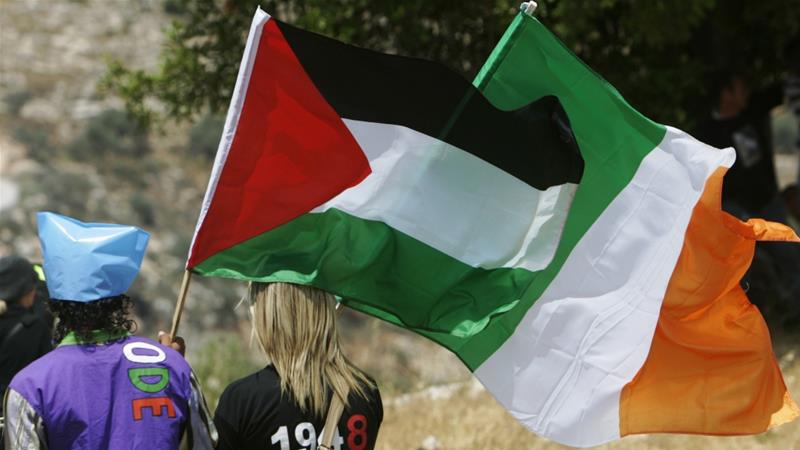
Israel Slams Irish Decision Recognizing Palestine

JERUSALEM (AP) — Israel has slammed the decision of the Irish parliament to adopt a non-binding resolution supporting an independent Palestinian state.

Foreign Ministry spokesman Emmanuel Nahshon expressed disappointment Thursday at the decision, accusing the Irish parliament of giving voice to "statements of hatred and anti-Semitism directed at Israel in a way which we have not heard before."

Wednesday, June 26, 2013

‘Arrogant’ bankers caught on tape spark outrage in Ireland

DUBLIN- Ireland’s deputy prime minister on Tuesday laid in to “arrogant” executives at a failed bank who mocked government efforts to tackle an economic crisis, amid growing public outrage at the latest revelations in tapes of bank executive phone calls.

The revelations were seen as potentially damaging to Ireland’s efforts to obtain concessions from the European Union on the terms of a bank rescue that pushed it to an 85-billion-euro ($111 billion) bailout.

Wednesday, May 29, 2013

Northern Ireland town turns into virtual Potemkin village ahead of G8

Enniskillen may not have a $2 million Muskoka-inspired fake lake exhibit, but it does have giant stickers plastered on abandoned storefronts to make it look like business is booming and shelves are fully stocked.

The Northern Irish town and surrounding area is getting a $460,000 fluff-up in advance of next month’s G8 summit. Gum is being scraped off sidewalks. Roads will be freshly paved to ensure a smooth ride for convoys of world leaders. Virtual Potemkin villages are springing up on the road to the Lough Erne Resort, where heads of state will gather to discuss tax evasion and reforms, food security, trade deals and the crisis in Syria.

Wednesday, December 12, 2012

Sean FitzPatrick is third ex-Anglo Irish Bank executive to be arrested in 24 hours

The former head of Anglo Irish Bank, Sean FitzPatrick, has been arrested by Irish police in connection with alleged financial irregularities at the bank.

Mr FitzPatrick has been appearing in court in Dublin.

He is the third former senior executive from Anglo Irish Bank to appear in court within the past 24 hours.

Thursday, November 29, 2012

Ireland Abortion Rights Protests: Thousands March In Dublin

DUBLIN — About 10,000 people marched through Dublin and observed a minute's silence Saturday in memory of the Indian dentist who died of blood poisoning in an Irish hospital after being denied an abortion.

Marchers, many of them mothers and daughters walking side by side, chanted "Never again!" and held pictures of Savita Halappanavar as they paraded across the city to stage a nighttime candlelit vigil outside the office of Prime Minister Enda Kenny.

Wednesday, November 28, 2012

Justice for Savita

This week, the first American study ever to look at what happens to women when they’re denied abortions was released. It’s a fascinating, but not all that surprising, read. The research shows women who seek out abortions and are unable to obtain them fare significantly worse over time than women who are able to procure the procedure. Women who are denied abortions are more likely to end up on welfare, more likely to stay in abusive relationships, and more likely to be emotionally distressed over their pregnancy outcome.

Tuesday, November 27, 2012

Savita Halappanavar Dead: Irish Woman Denied Abortion Dies From Blood Poisoning

DUBLIN -- The debate over legalizing abortion in Ireland flared Wednesday after the government confirmed that a woman in the midst of a miscarriage was refused an abortion and died in an Irish hospital after suffering from blood poisoning.

Prime Minister Enda Kenny said he was awaiting findings from three investigations into the death of Savita Halappanavar, a 31-year-old Indian woman who was 17 weeks pregnant. Her case highlighted the legal limbo in which pregnant women facing severe health problems can find themselves in predominantly Catholic Ireland.

Monday, October 08, 2012

Canada woos Irish immigrants in search of jobs

Irish immigrants helped build Canada since its early days. They are now being asked to pitch in again.

A job fair over the weekend in Dublin, at which Canada and Canadian companies were well represented, drew nearly 8,000 job-hungry Irish hoping to escape hard times on the Emerald Isle.

Wednesday, August 01, 2012

One third of adults 'plan to rely on state pension'

A warning has been issued today about the number of Irish adults hoping to live solely on the state pension when they retire.

A study by Amárach research questioned 1,000 people and found a third of them plan to use the state pension as their only source of income in later years.

Nearly 40% will use a combination of state and private pensions, while a fifth do not know how they will fund their retirement.

SmartQuotes.ie, which commissioned the research, warned of the potential for "huge strain" on the exchequer in the future.

The number of active members in occupational pension schemes is 771,878 - a drop of 38,083 members over 2010 levels, according to recent figures published by the Pensions Board.

Original Article
Source: eircom.net
Author: 

Thursday, May 31, 2012

Ireland polls point to ‘yes’ in Europe’s only austerity treaty vote

DUBLIN- Ireland began casting ballots in the only popular vote on Europe’s new fiscal treaty on Thursday, with opinion polls pointing to a “yes” vote that could ease concerns about its funding prospects and save Europe a headache it can do without.

The referendum, Ireland’s third on Europe in four years, puts it back in the spotlight after it avoided much of the recent heat from the euro-zone’s debt crisis by dutifully implementing its 85 billion euro ($106 billion) EU/IMF bailout.

While the German-led plan for stricter budget rules needs the approval of only 12 of the 17 euro-zone countries to be ratified, an Irish rejection would undermine one of Europe’s key initiatives just as problems mount in Spain and Greece.

Monday, May 28, 2012

Ireland referendum: Will Irish ‘ayes’ be smiling after austerity vote?

Michael Byrne’s grandmother opened the butcher shop he now runs north of Dublin city centre in 1925. But just days before Ireland votes on an EU fiscal treaty, he has another generation on his mind.

“I don’t want my grandchildren to have to go through this, so I’ll be voting yes” on May 31, he says, standing amid pigs’ trotters and sausages.

What Ireland has gone through is unprecedented in the country’s history. In 2008, the Irish economy took a nosedive as real-estate prices crashed. In November 2010, it received an €85-billion ($110-billion) bailout from the International Monetary Fund and the European Union.

The fiscal treaty — which aims to bind nations into tighter debt and deficit limits under the threat of EU fines — is being introduced by most member states. It needs to be ratified by at least 12 nations, but Ireland is the only country holding a referendum; the Irish constitution dictates that any transfer of sovereignty must get the approval of the electorate.

Sunday, May 06, 2012

The ghost houses of Ireland: Foreclosure and eviction

DUBLIN—In Mairead Harold’s Irish childhood, there were no rugged mountains, stone-built cottages or seaside cliffs.

Harold grew up poor in Dublin’s derelict Finglas neighbourhood, where rows of gritty semi-detached houses and parks have long been regarded as a haven for drug dealers and their clients.

A 1987 marriage to Stan Harold hardly improved her fortunes. Within weeks of their wedding, he was laid off and she had to use a modest family inheritance to pay down most of the $24,000 mortgage on their new three-bedroom home.

It wasn’t long before Stan left.

Almost 20 years later, he came back, announcing in 2005 that he wanted roughly $130,000 to surrender his claim to the house. Mairead Harold couldn’t raise the cash on her own. She earned $13 an hour working for a bookmaker, her unemployed adult son lived with her and her heroin-addicted daughter was constantly asking for money.

Monday, January 30, 2012

Sinn Fein wants referendum on united Ireland

DUBLIN - Northern Ireland should hold a referendum as early as 2016 on whether to remain British or join a united Ireland, Sinn Fein, the main pro-Irish nationalist party in the province, said on Monday.

The British government in London, which is already facing calls for a referendum in 2014 on ending Scotland’s 300-year union with England, has the final say on whether a referendum on the future of Northern Ireland can be held.

Sinn Fein’s leader in Northern Ireland, Martin McGuinness, said he favoured a referendum after the next election to Northern Ireland’s assembly, which is likely to happen in 2015 or 2016.

“It could take place anytime between 2016 and 2020/21,” McGuinness, a former commander with the Irish Republican Army (IRA) guerrilla group, told the Irish Examiner newspaper. “I don’t see any reason whatsoever why that should not be considered.”

Just as 2014 is a key year for Scottish nationalists, marking the 700th anniversary of a historic victory over the English, so 2016 is important for Irish nationalists, as it marks the centenary of a popular uprising against British rule.

One political analyst dismissed the referendum idea as being outside “the realm of pratical politics”.

Tuesday, August 09, 2011

Government paper discovery sparks internment test case

The discovery of government papers from the early years of the North's Troubles has sparked a court action by former prisoners held without trial under the controversial policy of internment.

Six former internees who have reported being tortured by British troops are suing the British Ministry of Defence, the Secretary of State, the police, as well as the estate of the late Brain Faulkner, former Northern Ireland Prime Minister.

The group, who see their action as a test case for the 2,000 people interned in the early 1970s during some of the worst years of violence, said the confidential documents confirmed their long-standing belief that the policy was directed against the Catholic community and included indiscriminate arrests.