Democracy Gone Astray

Democracy, being a human construct, needs to be thought of as directionality rather than an object. As such, to understand it requires not so much a description of existing structures and/or other related phenomena but a declaration of intentionality.
This blog aims at creating labeled lists of published infringements of such intentionality, of points in time where democracy strays from its intended directionality. In addition to outright infringements, this blog also collects important contemporary information and/or discussions that impact our socio-political landscape.

All the posts here were published in the electronic media – main-stream as well as fringe, and maintain links to the original texts.

[NOTE: Due to changes I haven't caught on time in the blogging software, all of the 'Original Article' links were nullified between September 11, 2012 and December 11, 2012. My apologies.]

Showing posts with label Research. Show all posts

Monday, September 25, 2023

Coronavirus: Was US money used to fund risky research in China?

As the debate continues over the origins of the coronavirus, a heated political battle is taking place over virus research carried out in China using US funds.

It's linked to the unproven theory that the virus could have leaked from a lab in Wuhan, the Chinese city where it was first detected.

A report released by Republican lawmakers cites "ample evidence" that the lab was working to modify coronaviruses to infect humans and calls for a bipartisan investigation into its origins.

Thursday, October 15, 2015

Basic Gun Violence Research Is Seriously Underfunded

NEW YORK (AP) — Amid the bloodbaths of 21st-century America, you might think that there would be a lot of research into the causes of gun violence, and which policies work best against it.

You would be wrong.

Gun interests, wary of any possible limits on weaponry, have successfully lobbied for limitations on government research and funding, and private sources have not filled the breach. So funding for basic gun violence research and data collection remains minuscule — the annual sum total for all gun violence research projects appears to be well under $5 million. A grant for a single study in areas like autism, cancer or HIV can be more than twice that much.

Friday, October 02, 2015

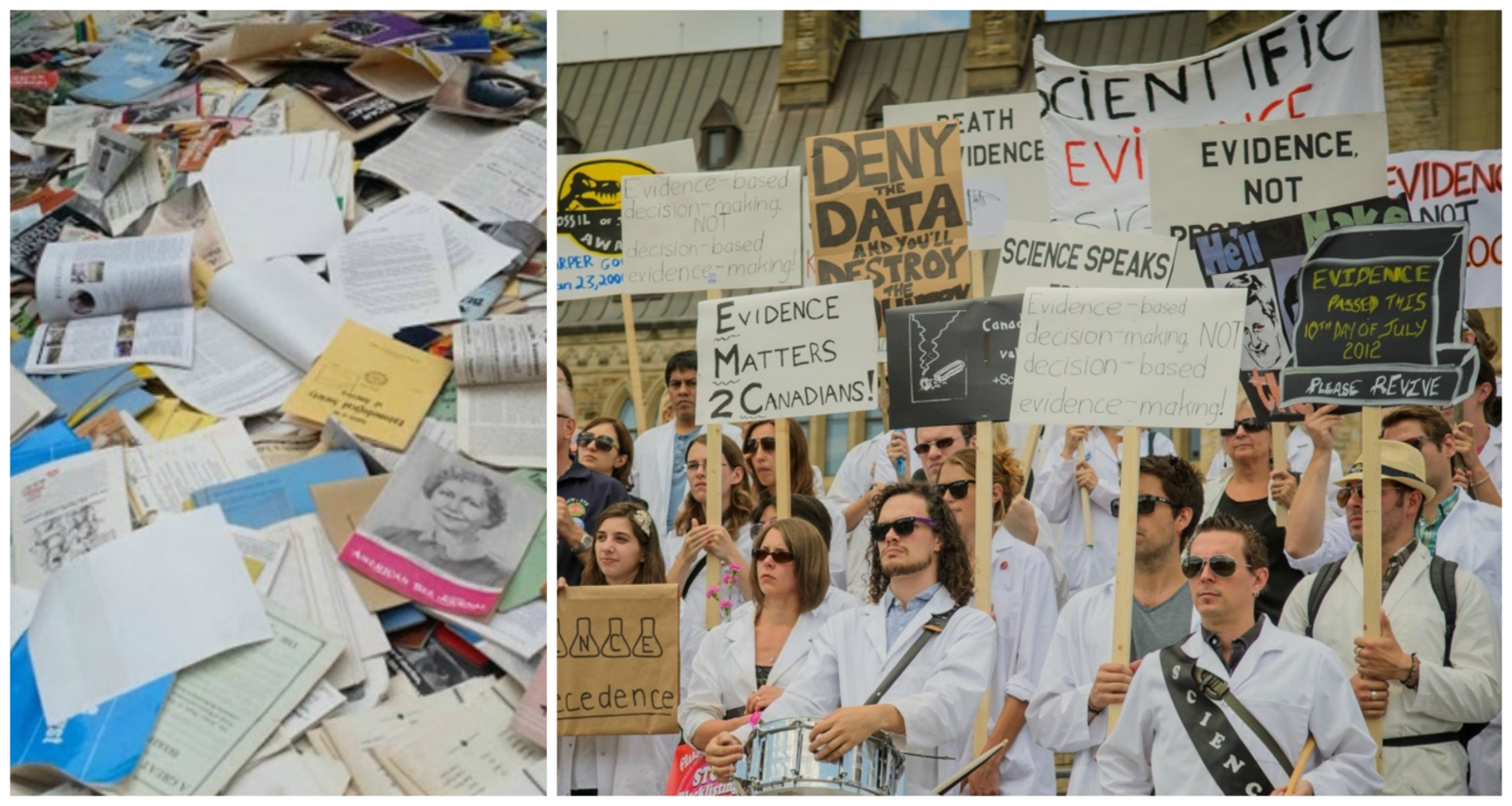
Inside the Harper government's trashing of a research library

At first, the closing of the library at the Lethbridge Agricultural Centre looked methodical. Staff were informed of the closure in July. Then in early August they were told they could help themselves to items from the collection.

And then it all went south from there: in mid-August summer students began filling an extra-large dumpster with journals and reports. Reportedly, one scientist jumped into the dumpster to rescue a set of journals. Distressed staff began to select more and more books from the collection in order to rescue them.

Tuesday, June 30, 2015

Is big pharma behind Clark's health firings?

They’re twisting in the wind.

B.C. Premier Christy Clark and her senior ministers are using every tactic in the book to avoid any sort of public disclosure of what happened behind the scenes when eight health researchers were illegitimately fired, one after the other, in the fall of 2012.

As a family physician for nearly 40 years, I have watched the pharmaceutical industry infiltrate into political and regulatory structures, as part of the general corporatization of society. What the Liberal government is now doing is simply one more example of how bought-and-sold officials sustain this pernicious process.

Thursday, January 29, 2015

Research into controversial topics hurt by Conservative grant priorities

Canadian universities are shying away from research into such controversial topics as immigration and assisted suicide because of the federal Conservative government’s continued focus on matching research grants to corporate interests, experts and advocates say.

Overall funding has dipped about 6 per cent in the past eight years for all three federal granting councils – the Canadian Institutes of Health Research, the Natural Sciences and Engineering Research Council and the Social Sciences and Humanities Research Council (SSHRC) – according to federal budget data provided by the Canadian Association of University Teachers (CAUT).

Tuesday, April 29, 2014

Republicans Say No to CDC Gun Violence Research

After the Sandy Hook school shooting, Rep. Jack Kingston (R-GA) was one of a few congressional Republicans who expressed a willingness to reconsider the need for gun control laws.

“Put guns on the table, also put video games on the table, put mental health on the table,” he said less than a week after the Newtown shootings. He told a local TV station that he wanted to see more research done to understand mass shootings. “Let’s let the data lead rather than our political opinions.”

Wednesday, January 29, 2014

Research cutbacks by government alarm scientists

Scientists across the country are expressing growing alarm that federal cutbacks to research programs monitoring areas that range from climate change and ocean habitats to public health will deprive Canadians of crucial information.

“What’s important is the scale of the assault on knowledge, and on our ability to know about ourselves and to advance our understanding of our world,” said James Turk, executive director of the Canadian Association of University Teachers.

Wednesday, December 04, 2013

Why Some Meteorologists Still Deny Global Warming

Just before Thanksgiving, many conservatives seized on a new study examining the climate views of members of the American Meteorological Society. It's no secret that there's a schism between climate scientists and weather forecasters over climate change, and the study captured this, to skeptics' delight. The fact that a sizeable percentage of AMS members disagree with mainstream climate science represented "the latest in a long line of evidence indicating the often asserted global warming consensus does not exist," according to Forbes blogger and Heartland Institute fellow James Taylor.

Friday, July 26, 2013

New study on Arctic methane is more evidence of looming climate catastrophe

Warning that a dramatic "burp" or "pulse" of methane from beneath the fragile permafrost of the Arctic caused by continued global warming would set off a "climate catastrophe," a new study says that the continued melting is also an economic "time bomb" that could cost the global economy $60 trillion.

Billions upon billions of tons of methane remain stored in the permafrost throughout the Arctic regions, but specific concern has been placed on the enormous reserves that sit locked beneath the East Siberian Arctic Shelf. Scientists have repeatedly warned that if these deposits -- many frozen in the form of methane hydrates -- were released, they would trigger massive feedback loops and dramatically increase the rate of global warming.

Friday, May 10, 2013

Fisheries Department reaches deal with think tank to save freshwater research facility

OTTAWA — Some federal scientists working at the Department of Fisheries and Oceans may soon gain new freedom to control their research and speak in public, under a tentative deal announced Thursday to transfer management of a world-renowned freshwater research facility that opened in 1968.

The arrangement would transfer the management of the Experimental Lakes Area (ELA), a research site made up of dozens of lakes near Kenora in northwestern Ontario, to a Manitoba-based think tank, the International Institute for Sustainable Development.

Thursday, May 02, 2013

Reinhart, Rogoff Backing Furiously Away From Austerity Movement

Under steady attack after their seminal research was found to be riddled with errors, Harvard economists Carmen Reinhart and Kenneth Rogoff are making a show of backing away from the austerity that their research encouraged.

They claim that their views on austerity have never changed, but the record tells a different story. They're still trying to have it both ways -- advocating for government belt-tightening while trying to avoid being seen as political.

Tuesday, April 30, 2013

The Reinhart and Rogoff Controversy: A Summing Up

In one of life’s little ironies, last Friday’s disappointing G.D.P. figures, which reflected a sharp fall in government spending, appeared on the same day that the economists Carmen Reinhart and Kenneth Rogoff published an Op-Ed in the Times defending their famous (now infamous) research that conservative politicians around the world had seized upon to justify penny-pinching policies. Addressing a new paper by three lesser lights of their profession from the University of Massachusetts, Amherst, which uncovered data omissions, questionable methods of weighting, and elementary coding errors in Reinhart and Rogoff’s original work, and which went around the world like a viral video, the Harvard duo dismissed the entire brouhaha as “academic kerfuffle” that hadn’t vitiated their main points.

Friday, April 26, 2013

Reinhart And Rogoff In NYT Op-Ed Aggressively Defend Error-Plagued Research

While a barrage of searing political criticism is certainly making them feel terrible, Kenneth S. Rogoff and Carmen M. Reinhart are not backing away from austerity.

The controversial Harvard economists and champions of austerity took to the pages of the New York Times on Friday in two essays again defending their highly influential work on the relationship between public debt and economic growth.

Tuesday, April 09, 2013

Sequestration Forces Cancer Clinic Patients To Travel Thousands Of Miles For Treatment

WASHINGTON -- Some cancer patients enrolled in clinical trials in rural areas will have to travel thousands of miles to continue their treatments as a byproduct of spending cuts brought on by the sequester.

Last week, The Washington Post reported that cancer clinics were starting to turn away Medicare patients because the cost of administering chemotherapy drugs had risen significantly under sequestration. Those patients were left seeking treatments at local hospitals that still had the capacity to provide care.

Monday, April 08, 2013

Results from Toronto marijuana study in 1972 still not public

In the winter of 1972, 20 young women took part in one of the weirdest scientific experiments in this country’s history.

For 98 days in a downtown Toronto hospital, their brains, hearts, kidneys, livers, blood and urine were rigorously tested and analyzed. A team of nurses kept around-the-clock records of their behaviour, which was logged at half-hour intervals. Were they sullen? Arguing? Laughing? Playing table tennis?

Tuesday, March 12, 2013

Arctic scientists see Canada slipping on world stage

In Germany, in New Zealand, in the Canary Islands and at 21 other observatories around the world, instruments called infrared spectrometers are teasing apart sunlight to measure greenhouse gas levels in the Earth’s atmosphere.

Two dozen spectrometers make up the Total Carbon Column Observing Network (TCCON). The one in Eureka, Nunavut, is the most northerly of them all — a sentry in the Arctic, where extreme effects of climate change are rapidly altering the environment.

Defense Department Spends Billions on Weird Research

Have you ever wondered what fish can teach us about democracy? Or how well babies interact with robots? Or contemplated the color of the feathers of the very first birds? The Department of Defense spends billions of dollars in research each year attempting to answer these and other arcane questions.

To be sure, many of the Pentagon’s research projects address much weightier and consequential questions and issues. But at a time when defense officials are warning of dire consequences to national security from the sequester, some of the military’s surprisingly costly research appears – dare we say -- frivolous or non-essential.

Monday, December 03, 2012

Climate Change Study Indicates Amount Of Heat-Trapping Pollution Rose By 3 Percent Worldwide Last Year

WASHINGTON -- The amount of heat-trapping pollution the world spewed rose again last year by 3 percent. So scientists say it's now unlikely that global warming can be limited to a couple of degrees, which is an international goal.

The overwhelming majority of the increase was from China, the world's biggest carbon dioxide polluter. Of the planet's top 10 polluters, the United States and Germany were the only countries that reduced their carbon dioxide emissions.

Tuesday, November 27, 2012

Federal scientists uncover evidence that oilsands contaminants travel further than expected

Federal scientists have uncovered evidence that contaminants wafting out Alberta's oilsands operations are collecting on the bottom of remote lakes up to 100 kilometres away.

The chemical "legacy" in the lake sediments indicates that oilsands pollution is travelling further than expected and has been for decades.

"The footprint of the deposition is potentially larger than we might have anticipated," says Derek Muir, a senior Environment Canada scientist, who will present the findings Wednesday at an international toxicology conference in the U.S. where the oilsands are a hot topic.

Thursday, August 23, 2012

Harper commits $188M for new Arctic research centre

The federal government is spending $188 million to build and operate a new Arctic research centre that will be vital to protecting Canada's sovereignty, Prime Minister Stephen Harper said today in Nunavut.

He also announced the companies picked to design the new Canadian High Arctic Research Station (CHARS), which will be located in Cambridge Bay. They are two Montreal-based architect firms: Fournier Gersovitz Moss Drolet et associés architects and NFOE et associés architectes.