Democracy Gone Astray

Democracy, being a human construct, needs to be thought of as directionality rather than an object. As such, to understand it requires not so much a description of existing structures and/or other related phenomena but a declaration of intentionality.
This blog aims at creating labeled lists of published infringements of such intentionality, of points in time where democracy strays from its intended directionality. In addition to outright infringements, this blog also collects important contemporary information and/or discussions that impact our socio-political landscape.

All the posts here were published in the electronic media – main-stream as well as fringe, and maintain links to the original texts.

[NOTE: Due to changes I haven't caught on time in the blogging software, all of the 'Original Article' links were nullified between September 11, 2012 and December 11, 2012. My apologies.]

Thursday, July 14, 2011

What It Means to be Black in Canada

If you are a Black Canadian, studies continue to show that you are less likely than a member of any other ethnic group to get a job or a promotion. You are more likely to get pulled over for "driving while Black," or to be discriminated against in the courts. What is more, you know that there are very few Blacks occupying the corner offices of Canadian companies, or in key roles in the academic world. And, over the past two decades, you have seen the representation of Blacks in federal, provincial, and municipal governments drop significantly. Why does this systemic racism persist? What is holding Blacks back? I believe there are three things that continue to impede our progress.

First, there's the fact that, unlike that of Blacks in the United States, the black experience in Canada has been largely ignored. For example, in Canadian history books, there is little mention of the fact that slavery once existed in the territory that is now Canada. Most Canadians don’t know that segregation was accepted in many parts of this country well into the 1960s. They believe the myth of a Canadian tradition of tolerance because most history books gloss over the overt racism that has afflicted Blacks in Canada throughout our country’s existence.

Equally significant is the fact that few Canadians are aware of the many contributions that Blacks have made to Canadian history, beginning with Mathieu da Costa, a Portuguese navigator and explorer, who arrived here in 1605 in the company of Samuel de Champlain. They have never heard of William Hall, who became the first Canadian, and the first person of African ancestry, to receive the Victoria Cross.

They don't know that the "The Real McCoy" was a Black Canadian engineer named Elijah McCoy, whose inventions for lubricating the engines of ships, trains, and factories were patented worldwide. And they're unaware of the achievements of Portia White, who broke the colour barrier in Canadian classical music, performing in more than 100 concerts around the globe. These Afro-Canadians, and many more, made their mark on Canada, all during times characterized by pervasive racism. And these great Canadians not only endured, they succeeded.

The second factor holding Blacks back is the existence of old and tired stereotypes stemming from our legacy of slavery and segregation. For instance, segregation meant there were white schools and Black schools; white churches and Black churches; barbers for white people and barbers for Blacks. In other words, segregation forced people to look at our differences, not the things we shared in common. It led some people to conclude that Black was not as good, as worthy, or as able as white – that Black was inferior to white.

Still today, we watch television and see Blacks portrayed as poor, with no chance for success, or as criminals or inmates in prison. What is the impact of this constant stream of demeaning images on young Black people? It's not pretty. I have seen the lack of self-esteem, the shame in our culture, and the humiliation at the place we have been assigned in our own country.

The third thing that holds Blacks back is ourselves. As human beings, we are defined by our circumstances. I was born of a poor Black family in Nova Scotia shortly before the Second World War. My father was a janitor at a university. He swept floors and cleaned washrooms to make a mere $25 a week. He had a wife and five children to support. My poverty has helped to define me. Ours was also the only Afro-Canadian family in an all-white university town. That defined me too. It gave me a powerful drive to achieve. And, combined with my family tradition, it underscored the importance of books, learning, and education – all of which saved me from the monotony of poverty.

In the same way that circumstances shape individuals, I believe that circumstances have a tremendous influence on a group of people. Our history of slavery and segregation continues to erect barriers that stand in our way of being accepted as equals. To break down those barriers once and for all, Blacks must become more powerful agents for change. We must come together to leverage the power of our collective voice.

I remember a time, not so long ago, when Afro-Canadians did just that. In fact, we felt compelled to make change happen. As the acclaimed Canadian author Lawrence Hill wrote:

For people like me, being Black and having access to a good education carried certain obligations. It wasn't good enough to get A's in school – you also had to ball up your fists and charge into battle if anybody used the word "nigger." In the workplace, it wasn't good enough to merely succeed professionally. You had to change the world, too.

I have witnessed this powerful force for social change first hand. All the members of my family, on both my father’s and my mother’s side, have devoted more than three generations to working for the uplifting of mankind, and, in particular, Blacks. I have seen what hope can do, most recently, with the election of U.S. President Barack Obama. I believe we urgently need to renew that sense of hope for Afro-Canadians today.

That's because Blacks in Canada still have a long way to go. We must embrace our proud heritage, our true potential, and our hope for the future. We must work together to put an end to racism now. It's clear to me that no one else is going to do it for us.

Origin
Source: The Mark 

GAO Report On Proprietary Trading Slammed By Senate Democrats As 'Misleading'

A new government report on banks' controversial practice of trading and investing for their own profit was condemned Wednesday by congressional Democrats who called the practice "woefully incomplete" and "misleading," adding that it failed to reckon with the risks to the broader financial system.

The Volcker Rule, which required banks to sell off their operations that engaged in this so-called proprietary trading, was one of the most contentious elements of financial regulatory reform last year. Proponents argued that the rule was necessary to prevent banks from profiting at the expense of their customers and, ultimately, American taxpayers who stepped in when their complex bets on mortgages went bad. Banks complained that the rule would hurt their profits, while at the same time arguing that the extent of such speculation was not big enough to pose a risk to the financial system. The Government Accountability Office was brought in as something of a referee, commissioned to conduct a study to assess the true extent of such trading practices and whether losses in that area can contribute to the instability of financial institutions.

The GAO report released Wednesday appeared to give ammunition to Wall Street by concluding that such trading only constitutes a small share of its revenue and, thus, does not present much of a risk to the financial system. Critics, including the primary authors of the provisions that limit such activity, countered that the study was flawed because it failed to grapple with the full extent of banks' trading. The report could lead to momentum against enforcing the Volcker rule.

Sens. Jeff Merkley (D-Ore.) and Carl Levin (D-Mich.) sent a strongly worded letter to the GAO, criticizing the auditor for not looking at the full scope of proprietary trading operations. The report was "woefully incomplete," said the pair because it only collected data from the six largest banks' stand-alone units, where only a fraction of such trading occurs, rather than from across all bank divisions.

Full Article
Source: Huffington 

Default risk widens rift within GOP


Federal Reserve Chairman Ben S. Bernanke warned in congressional testimony that failure to raise the government's debt limit by Aug. 2 would be a "huge financial calamity."

And Senate Minority Leader Mitch McConnell (R-Ky.) issued a political warning that the party risked losing the next election if Republicans persisted on their current path.

So far, such warnings have had little impact in the House of Representatives, where many members of the Republican majority, particularly newly elected "tea party" conservatives, have vowed to let the government default on its bills rather than vote for any debt ceiling increase. House GOP leaders have said they will vote for an increase only if it is accompanied by a balanced budget amendment to the Constitution, deep cuts to Medicare, or other spending restrictions that President Obama has rejected.

"Currently, there is not a single debt limit proposal that can pass the House," Majority Leader Eric Cantor (R-Va.) said in a statement Wednesday morning. Cantor has been at odds with McConnell and House Speaker John A. Boehner (R-Ohio) in the last several days.

In a radio interview with conservative commentator Laura Ingraham, McConnell said the economic impact of a default would give Obama an opening to blame the GOP for the country's bad economy.

"Look, he owns the economy," McConnell said. "We refuse to let him entice us into co-ownership of a bad economy."

McConnell had offered his own "backup plan" Tuesday to end the stalemate — a proposal under which Congress would essentially surrender power to raise the debt ceiling and hand responsibility solely to Obama. He was excoriated by many conservatives in his party.

"Wow. Stupid idea," was the tweet from Rep. Jason Chaffetz of Utah.

McConnell fired back Wednesday, saying Republicans who think that the public will support them in the event of a government default were disastrously wrong. Default "destroys your brand," he said.

Full Article
Source: Los Angeles Times 

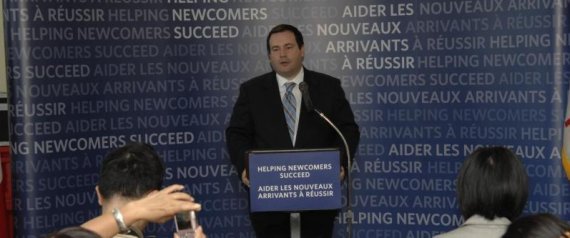
Jason Kenney on the Human Smuggling Ship: Lots of Noise, Little Substance

Several media outlets ran with a story about a ship (the MV Alicia) with an estimated 84 Tamils on board that was detained while supposedly en route to Canada. Most featured comments from Jason Kenney, the Minister of Citizenship and Immigration.

What is interesting is the full-court press the minister gave to this issue without really having much to say and certainly not saying much that seemingly provided solid proof that Canada was the ships destination. He gave several interviews for both print and TV and he even went on Twitter to highlight a CP story that pushed his point of view.

However, at no time did Kenney actually say the MV Alicia was on route to Canada. Instead, he threw out the suggestion that the MV Alicia might have been heading our way and then sat back and watched the media not only ramp up his comments, but then go into much detail about previous boats that had arrived here, the numbers on board, the processing time, etc. Of course the real point of his media push was to get solid quotes into each article on why we need his legislation to prevent similar human smuggling operations from bringing more people to our shores.

Look at some of his quotes and they are pretty vague.

"This vessel is believed to be have been destined for Canada."

"There are indications that it may have been destined for Canada."

"There was some reasons to believe that this particular vessel may have been destined for Canada."

The bottom line is was it or was it not, coming to Canada? There are numerous reports saying the vessel was en route to New Zealand and at least in the public domain no solid proof that its destination was Canada. If it was, why not be clear and say so. If it wasn't or if there is no solid proof that it was heading our way, then the minister was simply piggy-backing on a media story to press his political agenda while doing a bit of fear-mongering to remind Canadians of what we can expect if his legislation isn't passed.

Clearly Kenney was quick of the mark as he saw the detention of a ship in Indonesian waters as an opportunity to promote the need to pass his "The Preventing Human Smugglers from Abusing Canada's Immigration System Act."

This quote backs up that assumption:

"This incident in Indonesian waters of a vessel believed to contain illegal migrants destined for Canada in a human smuggling operation underscores the need for Parliament to act in passing our anti-human smuggling legislation."
Kenney side-stepped questions about what proof he had by saying that he couldn't discuss intelligence reports. Fair enough and I agree completely with him on that point. The intelligence reports either said nothing about the MV Alicia, said it was coming here, said it was going elsewhere or were inconclusive. Whatever the reports said, the minister was out there chasing the media. Kenney is in a win-win situation. If it's proven that the ship was not coming to Canada, he can say he never said it was. If it's proven it was en route to our shores he can say I told you so. Not a bad day's work for the minister as he received substantial media coverage based on what on the surface appears to be pretty flimsy evidence.

Origin
Source: Huffington 

Intercepted Human Smuggling Ship MV Alicia Bound For Canada: Jason Kenney

THE CANADIAN PRESS -- CALGARY - Federal Immigration Minister Jason Kenney said a human smuggling ship intercepted Monday appeared to have been "destined for Canada" and reinforces the need to pass the Tory government's anti-smuggling legislation.

"We are not going to be a doormat for the dangerous crime of human smuggling," Kenney told reporters at a news conference Tuesday in Calgary.

Human smuggling is already a crime in this country, but there has been few successful prosecutions and the government says the act would strengthen Canada's ability to prosecute such crimes and deter queue-jumping in the immigration system.

"The Preventing Human Smugglers from Abusing Canada's Immigration System Act" is supposed to make it easier to prosecute smugglers and impose mandatory prison sentences.

It will also hold ship owners and operators responsible if their vessels are used in smuggling operations.

Two ships of Tamil migrants have arrived off the coast of British Columbia since October 2009, with nearly 800 people authorities believe were the human cargo of smugglers.

The latest ship seized, the MV Alicia, was carrying close to 90 Sri Lankan Tamils and was intercepted by Indonesian authorities.

"This vessel is believed to be have been destined for Canada," Kenney said.

"This incident in Indonesian waters of a vessel believed to contain illegal migrants destined for Canada in a human smuggling operation underscores the need for Parliament to act in passing our anti-human smuggling legislation," he added.

"That would send a clear signal to those that want to treat Canada like a doormat that they should no longer target Canada for the odious business of human smuggling."

Whether or not the ship was actually headed for Canada is up for debate. There have been numerous media reports suggesting the final destination was actually New Zealand. However, the Sydney Morning Herald reported that "charts indicating the boat was prepared to travel to Canada" were found aboard the vessel, which was stopped on Monday.

Kenney conceded the reports are inconclusive.

"I read a report from the prime minister of New Zealand indicating that apparently the captain of this vessel indicated they might be headed for New Zealand...there is some evidence apparently that they were destined for Canada. We can't be absolutely certain what their destination was."

He said many smugglers have "open-ended" contracts with passengers that don't guarantee the destination.

The immigration minister credits a bolstered law enforcement and intelligence presence in southeast Asia at known transit points for human smuggling for preventing "several vessels destined for Canada from leaving port."

Kenney said Canada needs to reduce the number of "pull factors" that allow smuggling syndicates from targeting Canada.

"We have very generous policies, one of which is family reunification," he said.

"If someone comes here in a smuggling operation, succeeds in getting a positive asylum claim, they become a permanent resident and pretty quickly can turn around and sponsor family members that can help them pay off the debt to the smuggling syndicate."

Origin
Source: Huffington 

Gold Soars To Record On Debt Fears

CBC -- The price of gold hit a record high Wednesday as investors continued to flock to the precious metal as a perceived safe haven amid global financial turmoil.

In early New York trading, August gold futures contracts soared $17.70 to $1,580 US an ounce. Spot gold prices also hit a record.

Gold has risen for eight straight trading sessions as European debt worries gained new traction. Tuesday's downgrade of Ireland's credit rating to junk status also rattled financial markets.

"With European sovereign debt fears intensifying again, [and] little clarity on what Eurozone officials intend to do next ..., gold has been a beneficiary," said UBS analyst Edel Tully in a report. "This should, in theory, be gold's time to shine as a safe haven and as an alternative currency."

The inability of the White House and Republican leaders to reach a deal on the U.S. debt ceiling added to gold's appeal, analysts said.

Bullion prices also got a boost from the release Tuesday of minutes from the U.S. Federal Reserve that seemed to hint that some members of its key Open Market Committee were open to the possiblity of further quantitative easing measures to stimulate the economy.

Gold prices are up 11 per cent so far this year and have more than doubled in the last four years.

Origin
Source: Huffington 

East Africa Famine Threatens Regional Stability, USAID Chief Says

The long-suffering nations in the Horn of East Africa are enduring the worst drought conditions in more than half a century, and are at risk of "massive famine," Rajiv Shah, the administrator of the US Agency for International Development (USAID), told The Huffington Post Wednesday.

The top American aid official said in an interview that the food crisis in countries like Ethiopia, Kenya and Somalia is putting millions of lives at risk, and threatens to further destabilize a troubled region of the world.

"It’s very severe," Shah said. "We know from the data that we’ve been collecting that this is the worst drought in 60 years and it’s going to have severe consequences. Eleven and a half million people are at real risk of malnutrition and famine already."

In its most recent update on the crisis, USAID declared the food and water shortage in East Africa "the most severe food security emergency in the world today."

"The current humanitarian response is inadequate to prevent further deterioration," the report warned.

Aid workers in East Africa have spent months gearing up for the looming crisis, thanks in part to an early-warning system operated by USAID that first predicted a round of devastating crop failures and food shortages late last year.

But the high number of malnourished children and families so early in the dry season has nonetheless taken them by surprise, and the growing figures suggest the scope of a problem that is only beginning to emerge.

"It’s going to get worse because the next rains aren’t until October, and we’re already seeing people completely reliant on relief," says Anna Ridout, a Nairobi, Kenya-based spokeswoman for Oxfam.

Aid workers say the severity of the famine conditions has been exacerbated by spiking food prices and the increasing regularity of major African droughts over the past decade, which has made local communities less able to cope with new challenges.

In the Horn of Africa alone, drought conditions have affected crop levels three of the past four years.

"There’s no question that hotter and drier growing conditions in sub-Saharan Africa have reduced the resiliency of these communities," Shah said. "Absolutely the change in climate has contributed to this problem, without question."

Last week, the UN's top humanitarian relief official Valerie Amos also pointed to environmental change during a tour of a refugee camp in Somalia. "We have to take the impact of climate change more seriously," she said. "Everything I've heard has said that we used to have drought every ten years, then it became every five years and now it's every two years."

This year, aid workers say they are seeing new levels of starvation and suffering.

On a recent visit to the refugee camps in the Ethiopian town of Dollo Ado, along the Somali border, World Food Program official Judith Schuler said she found the area flooded with refugees seeking food and water.

"They are in a desperate state," Schuler said. "I was there there a bit more than a year ago in the same refugee camp, and back then everybody that arrived told me that they came because of violence and conflict. This is not the case anymore. It’s regular people who are coming because they have nothing left to eat."

Some 2,000 hungry refugees arrive at Dollo Ado from Somalia every day, according to the UN, and two of the camps there are already at twice their maximum capacity.

The vast majority of those arriving at Dollo Ado are children, and Schuler says many of them die at the camp despite finally receiving aid.

"They’ve had nothing to eat during their journey, which often last several days or a week," she said. "The only time they get food is if they can beg for it from villagers along the way. There are people here dying every day."

Save the Children has reported that malnutrition rates among children in Kenya and Somalia have reached 30 percent in some areas -- well above the official rate to classify a famine.

So far this year, USAID has facilitated the distribution of more than $350 million in aid to the Horn of Africa, but Shah says that emergency response efforts are not sufficient to curb a growing -- and seemingly chronic -- problem in the region.

"To me, the reason this is so glaring is it simply doesn’t have to be this way," Shah told HuffPost. "We know how to help countries and work in partnership with countries to build real modern agricultural systems. We know that every few years the lack of rainfall creates a huge depletion of assets that causes kids to be pulled out of schools to work on the farm. And we know that this cycle of agrarian fall-off results in chronic malnutrition for kids, and holds these countries back."

"This is happening precisely in a part of the world that our Defense Secretary Leon Panetta just said is a critical part of our fight against terrorism and our overall international security," he added. "It just underscores the deep link between food security and national security."

Shah continued, "It’s so important to be promoting security and stability in these parts of the world, as opposed to be dealing with these devastating and difficult consequences of failure."

Origin
Source: Huffington 

Ottawa To Release Champlain Bridge Report

THE CANADIAN PRESS -- MONTREAL - Canada's new transport minister was forced to perform an abrupt about-face Wednesday after declaring that he did not want to release a structural report on a major Montreal bridge because people might worry.

The remarks by Denis Lebel were, of course, noticed in Montreal where 60 million vehicles cross the Champlain Bridge annually and make it one of the country's busiest spans.

His remarks became a top news story in Quebec. The bridge has been a source of public concern since the release this spring of another report that warned it's at risk of collapse.

With 24 hours the Prime Minister's Office made it clear that the rookie transport minister would have more to say on the matter.

Prime Minister Stephen Harper's office announced Wednesday morning that the bridge report would be released, after all.

By early afternoon Lebel had issued a statement stressing his personal commitment to transparency in the matter: "We want to ensure that Canadians have access to information about the Champlain bridge, and that is why the pre-feasibility technical report has been publicly released."

As it turned out, the report was not actually that alarming.

Full Article
Source: Huffington 

Canada: The gift that keeps on giving to Israel

As Israel faces growing isolation and repercussions from an effective global Boycott Divestment and Sanctions Campaign, over the past month Canada has continued to deepen its economic, political, and ideological relationship with Israel.

Least discussed of late has been the merging economic ties between the two countries. This week, the Canada-Israel Technology Innovation Summit in Tel Aviv concluded with a renewal of the Canada-Israel Industrial Research and Development Foundation. Canada's Minister of International Trade Ed Fast described Canada's $5 billion towards this "treaty" -- which will be tabled in Parliament prior to final ratification -- as a collaborative project between Canada's private-sector and Canada's "key trading partner."

One of the projects funded by this Foundation has been the Guardium Autonomous Security Vehicle for the purposes of, as described by Kole Kilibarda, militarizing the border. This is one of many initiatives within the Canada-Israel Free Trade Agreement and the Canada-Israel Public Security Partnership. Under the former agreement, bilateral trade has more than tripled, making Canada increasingly complicit in the economic normalization of the Israeli occupation as well as a critical stake-holder in Israel's defense complex. Under the Declaration of Intent for Cooperation on Public Security Issues, Canada and Israel supposedly face "common threats to border security, illegal immigration, and terrorist financing." In a post 9/11 climate and the never-ending War on Terror, this legitimizes both states' practices of torture, extraordinary rendition, racial and religious profiling, incarcerations, deportations, and surveillance.

The most discussed issue lately has been the Freedom Flotilla II. The Canadian Boat to Gaza Tahrir was one of 10 Gaza-bound vessels carrying humanitarian aid and challenging Israel's illegal blockade. Since 2007, Israel has imposed a tight siege on the 1.5 million residents of Gaza: maintaining control of airspace, waters, and land crossings; disallowing residents to leave without permits; and prohibition on imports and exports including food, fuel, and medical supplies. Aboard the Tahrir, Ardoch Algonquin Robert Lovelace described this collective punishment as follows:

"We recognize that the people of Palestine have been subjected to colonization in the same way that Indigenous people here have lost their relationship with the land. Gaza has become an open-air prison for 1.4 million people. It is the largest ‘Reserve' in the world."

Predictably, the Tahrir never reached Gaza, as Israel outsourced its siege to Greece, and the Greek government banned any ship from leaving its ports towards Gaza. Instead of demanding that the boat be allowed to sail, Canada's Foreign Affairs Minister John Baird had proclaimed in advance that "Canada recognizes Israel's legitimate security concerns and its right to protect itself and its residents from attacks by Hamas and other terrorist groups, including by preventing the smuggling of weapons." This was congruous with the Canadian government parroting of the outlandish Israeli line last year, which alleged self-defence after the murder of nine activists aboard the Mavi Marmara flotilla.

Making no mention of the 11,000 Palestinian political prisoners in Israeli jails, Baird continued, "Canada continues to call for the immediate return of Israeli soldier Gilad Shalit, held by Hamas." Following the election of Hamas in 2006, Canada was the first country, even ahead of Israel, to boycott and vilify the Hamas government. Canada began funding and training Palestinian security forces loyal to appointed President Mahmoud Abbas and Prime Minister Salam Fayyad of the Palestinian Authority (P.A.) as part of U.S. General Keith Dayton's training project and Operation Proteus.

Though focused on the dirty war against Hamas, this past week Canada reiterated hostility towards the P.A.'s bid for statehood at the UN General Assembly in Sept. 2011. While there has been much criticism of the process by Palestinians -- such as Ali Abunimah arguing that "the only thing that could be gained from UN recognition is for Abbas and his entourage to obtain international recognition for themselves as leaders of an imaginary state while nothing changes for Palestinians" as well as Raja Khalidi opposing the neoliberal economic foundation of the proposed state - Canada and the US have succumbed to Israel's (now leaked) global diplomatic campaign to persuade countries to vote against recognition.

Given the Conservative government's consistent support for the unilateral military actions of Israel -- who possesses nuclear capabilities and has occupied Palestinians since 1948 through one of the world's largest militaries -- the Department of Foreign Affairs statement "The Palestinian state is to be a non-militarized one" reflects the hypocrisy of imperial dictates. Furthermore, demanding that those being military occupied must engage in "bilateral peace negotiations" in fact perpetuates the very oppression being resisted. As Malcolm X said "You can`t separate peace from freedom because no one can be at peace unless he has his freedom." This week, the Palestinian BDS National Committee called for an immediate and comprehensive military embargo against Israel.

Not limited solely to the political or economic realm, Canada continues to be a primary ally in Israel's attempts to brand itself as a victim in our collective social conscience. This week the Canadian Parliamentary Coalition to Combat Anti-Semitism, co-founded by Immigration Minister Jason Kenney, released its report noting a rise in "hateful discourse" against Israel, and unsurprisingly yet dangerously characterizes criticism of the state of Israel, particularly Israeli Apartheid Week campus organizing, as anti-Semitic. Meanwhile, Canada has been noticeably silent on the Knesset's passing of the widely condemned boycott law which criminalizes and penalizes support for the BDS campaign against Israel. Yet as Hind Awwad with the Palestinian BDS National Committee notes "This new legislation is testament to the success of the rapidly growing global BDS movement and a realisation within political elites inside Israel that the state is becoming a world pariah..."

And of course an accounting of Canada's generosity towards Israel would be incomplete without hockey. Israel already boasts a Canada-Israel Hockey School, and yesterday the Canadian Friends of Hebrew University announced a scholarship program for Israeli hockey players. Maybe the best gift from Canada that one can hope for will be a good old Canadian-style hockey riot in Israel and instead of a few broken windows, there will be a torn-down apartheid wall.

Origin
Source: Rabble.ca 

Corporate sponsorship for energy meeting slammed

A coalition of environment groups says the large corporate sponsorship at next week's meeting of energy ministers "sends the wrong message to Canadians."

Eleven energy companies and associations are spending $180,000 to sponsor the annual conference that will be held July 16 to 19 in Kananaskis, Alberta. The sponsorship is just under a third of the approximately $600,000 price tag for the conference.

Federal, provincial and territorial ministers and their deputy ministers are holding their annual meeting to discuss, among other issues, a national energy strategy. But environment groups say the sponsorship is a clear attempt by the petroleum industry to influence people who will be making crucial decisions about Canada's energy future.

"We have the big oil picking up the tab," said Sierrra Club Executive Director John Bennett. "Is the Alberta government so broke that it has to do this? It smells bad and sends the wrong message to Canadians."

The sponsors are given a high profile on the website for the conference.

Bob McManus, a spokesman for Alberta's department of energy, said the sponsorship money will be used to fly the ministers and their deputies to visit the oil sands operations in Fort McMurray. It will also pay for a reception there and go towards a charity reception and silent auction for Alberta's helicopter air rescue unit.

McManus said the money gives the companies access to the sessions at the conference that are also open to environmental groups and think tanks, but not to the closed door political meetings.

"The sponsorship has no influence on the conference, no one gets special treatment for their sponsorship," he said.

But Graham Saul from the Climate Action Network disagrees.

"When was the last time they let environmental NGO's give them a tour of the tar sands? This money gives them huge access. It looks like the government ministers are in the pockets of the oil industry," he said.

Previous energy ministers' conferences have had some levels of sponsorship but never as high as $180,000. Last year's meeting was in Montreal, and while it received money from the Quebec provincial government's investment arm, it decided not to accept any private corporate funding.

The last conference in western Canada held in Saskatoon in 2008, received $3,000 in sponsorship from a regional airline, Transwest Air. Several of the province’s mining and oil companies paid for tours of their facilities for delegates attending the conference.


Origin
Source: CBC news