Democracy Gone Astray

Democracy, being a human construct, needs to be thought of as directionality rather than an object. As such, to understand it requires not so much a description of existing structures and/or other related phenomena but a declaration of intentionality.
This blog aims at creating labeled lists of published infringements of such intentionality, of points in time where democracy strays from its intended directionality. In addition to outright infringements, this blog also collects important contemporary information and/or discussions that impact our socio-political landscape.

All the posts here were published in the electronic media – main-stream as well as fringe, and maintain links to the original texts.

[NOTE: Due to changes I haven't caught on time in the blogging software, all of the 'Original Article' links were nullified between September 11, 2012 and December 11, 2012. My apologies.]

Showing posts with label Arctic Oil. Show all posts

Wednesday, October 04, 2023

The Last Of The Trump-Era Arctic Refuge Oil Leases Have Been Canceled

President Joe Biden’s administration on Wednesday canceled all remaining Donald Trump-era oil and gas leases in Alaska’s fragile Arctic National Wildlife Refuge and moved to protect an additional 13 million acres in the nearby National Petroleum Reserve from drilling and other development.

This comes as Biden finds himself under mounting pressure to move more aggressively to curb fossil fuel development on federal lands, as planet-warming greenhouse gas emissions help drive increasingly extreme weather disasters around the globe. And it looks to fulfill the president’s campaign promise to “reverse the Trump administration’s assaults on America’s natural treasures, including by reversing Trump’s attacks on the Arctic National Wildlife Refuge.”

Sunday, December 25, 2016

Obama Administration Blocks Arctic Oil Drilling Through 2022

Further cementing President Barack Obama’s climate legacy, the Department of the Interior announced on Friday its intent to ban oil drilling in the U.S. section of the Arctic Ocean for the next five years, citing environmental risks.

The plan blocks the sale of new offshore oil and gas leases in the Beaufort and Chukchi seas, north of Alaska, between 2017 and 2022.

Thursday, January 21, 2016

Despite petition with a quarter-million names, Shell drilling set to begin

A handful of protesters from Sum of Us, Greenpeace, the Ecology Action Centre and the Clean Ocean Action Committee delivered a massive, 233,000-signature petition to the Canada-Nova Scotia Offshore Petroleum Board (CNSOPB) on Wednesday, opposing what they say are extremely lax safety standards around Shell's drilling program. Currently, if a subsea oil well blowout were to occur, the company would be allowed to take 12 to 13 days to contain it. Shell's original proposal suggested it could take 21 days to get a capping stack to the site.

Tuesday, September 29, 2015

Shell To Cease Costly Alaska Arctic Exploration

ANCHORAGE, Alaska (AP) — Royal Dutch Shell will cease exploration in Arctic waters off Alaska's coast following disappointing results from an exploratory well it just completed.

Shell found indications of oil and gas in the well in the Chukchi Sea about 80 miles off Alaska's northwest coast, the company said Monday in a release from The Hague, Netherlands. However, the petroleum was not in quantities sufficient to warrant additional exploration in that portion of the basin, the company said.

Monday, September 28, 2015

Harper’s research station a ‘cloak' for Arctic oil push, says climate expert

An expensive remote Arctic facility, personally promoted by Prime Minister Stephen Harper as a "world-class” research station, is less about pure science, and almost entirely about pushing oil, gas and mining development in the rapidly melting north, says one of Canada’s top polar climate scientists.

"You couldn’t call this the ‘High Arctic Oil and Gas Development Centre’ because that of course would provoke national and international outrage," said professor Tom Duck, an atmospheric expert with Dalhousie University in Halifax, in an interview with the National Observer.

Saturday, August 22, 2015

Watchdog Group Sues US for Access to Shell Oil's Safety Plan for Arctic Drilling

Shell Oil's recently approved exploration in the Arctic Chukchi Sea is one of the most highly scrutinized drilling operations in the world, but, a watchdog group claims, the company has nevertheless managed to keep many of its plans hidden from view.

The watchdog group, Public Employees for Environmental Responsibility (PEER), claims that Shell and its government regulators have failed to share much of the information on the safety and reliability of the operation with the public.

Tuesday, August 04, 2015

It's Time for Shell to Abandon Its Irresponsible Arctic Drilling Plans

At this moment, the damaged Fennica icebreaker is entering the water in my home of Portland, OR, in what could be a make-or-break moment for our environment and our future climate.

Here's the background: In 2008, President George W. Bush not only lifted the executive ban on Outer Continental Shelf drilling, but also leased parts of the Arctic's Chukchi Sea to Shell for oil and gas exploration.

Friday, July 31, 2015

 People Will Remember Shell Oil As a Symbol of Planet-Destroying Greed

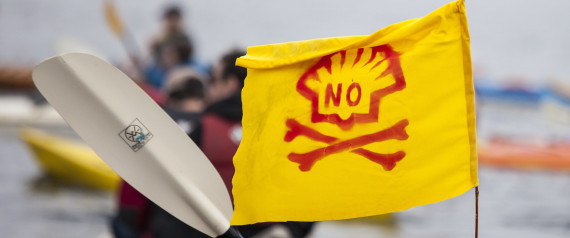
Shell Oil’s icebreaker Fennica is apparently on its way to the Arctic from the Pacific Northwest, ending a dramatic week-long siege that saw activists dangle from bridges and blockade the Portland harbor with kayaks, and a federal court threaten environmentalists with heavy fines.

Amidst the drama of the action, and the drama of the courtroom, and amidst the outpouring of thanks for activists from Greenpeace, Rising Tide, 350PDX, and others, one more thing is worth remembering: there is no more contemptible company on earth than Shell Oil.

Thursday, May 28, 2015

Obama Administration Approves Shell's Drilling Plan For The Arctic

WASHINGTON -- The Obama administration on Monday granted conditional approval to Shell to begin exploratory drilling in the Arctic, which the Department of the Interior's Bureau of Ocean Energy Management said would be "subject to rigorous safety standards.”

The approval will allow Shell Gulf of Mexico, Inc. to begin drilling this summer in the Chukchi Sea, off the northwest coast of Alaska. Shell's drilling plan proposes up to six wells in an area about 70 miles offshore.

Monday, March 23, 2015

Despite Known Risk of Spill, U.S. to Let Shell Drill in Arctic

In spite of estimates of a 75 percent or greater chance of an ecologically disastrous spill, the U.S. government is expected this week to give the green light to Shell Oil’s plan to restart drilling for petroleum in the Arctic.

Environmentalists who have campaigned against the proposed exploration by the Anglo-Dutch group in the Chukchi and Beaufort seas off Alaska are likely to protest the decision, which was made by Interior Secretary Sally Jewell.

Saturday, August 30, 2014

Shell Submits a Plan for New Exploration of Alaskan Arctic Oil

Royal Dutch Shell submitted a plan to the federal government on Thursday to try once again to explore for oil in the Alaskan Arctic, following years of legal and logistical setbacks as well as dogged opposition from environmentalists.

While the plan is just a first step in the process, it reflects the energy potential in the Arctic. Shell’s proposed programs consist of two drilling rigs working simultaneously in the Chukchi Sea, which could produce more than 400,000 barrels of oil a day.

Friday, December 13, 2013

Race to claim High Arctic's oil resources may be a fool's mission -- High Arctic is 'probably the most expensive place in the entire world to drill for oil'

When asked earlier this week about extending Canada's territorial claims in the Arctic, Foreign Affairs Minister John Baird was clear about the rationale.

"We are determined to ensure that all Canadians benefit from the tremendous resources that are to be found in Canada's Far North," he said.

But while the federal government is eager to establish its claims to the polar seabed, some Arctic experts believe that Ottawa is putting too much stock in trying to reap the potential riches of such a harsh domain.

Wednesday, May 15, 2013

Aboriginal groups call for Arctic energy moratorium

Aboriginal groups from every Arctic country have signed a statement that calls for an end to offshore drilling and a pause in northern energy projects unless local aboriginals consent.

The statement was released Monday in Kiruna, Sweden, two days before leaders from the eight circumpolar nations meet and hand over chairmanship of the Arctic Council to Canada.

Wednesday, January 02, 2013

Arctic energy rush runs into a reality check

Mark 2012 as the year the Arctic rush for oil and gas was put on ice.

The harsh reality of finding – and the even more cumbersome process of extracting – petroleum from beneath a frozen ocean with little or no infrastructure nearby, coupled by the expensive price tag, have dented industry’s plans to exploit the polar region.

Beefed-up technology designed for Arctic work has crumbled during testing. Exploration programs have been cancelled. Other seismic testing missions have come up empty. And some companies even swore off ever drilling for oil in the Arctic.

Monday, October 01, 2012

Shell's Arctic Oil Exploration Plans Remain, Despite 2012 Setback

ANCHORAGE, Alaska (AP) — The stars lined up — almost — for Shell Oil to drill exploratory wells this year in waters off Alaska's north coast.

The Arctic Ocean was on record pace for low sea ice. The Obama administration gave a qualified green light to drilling. Two drill ships and a flotilla of support vessels were staged off prospects.

But as the roughly four-month open water season wound down, Shell announced last week it would limit drilling to "top-hole" work, the shallow but time-consuming preparation for an offshore well. The final straw for the decision: damage during testing Sept. 15 to an undersea containment dome, part of a spill response system that Shell put in place to reassure federal regulators that Arctic offshore drilling could be done safely.

Friday, July 20, 2012

Subhankar Banerjee: Looming Deadline Creates Window for Protests to Stop Shell’s Arctic Drilling

As the oil giant Shell prepares to begin exploratory drilling in the Arctic, activists across the world have begun holding protests. The Obama administration has set a deadline for next month to decide on whether to grant the final drilling permits. Over the last decade, Arctic Alaska has become the most contested land in recent U.S. history. But in addition to oil, natural gas and coal, the Arctic is rich in biodiversity and has been home to generations of indigenous people for thousands of years. We’re joined by Subhankar Banerjee, a renowned photographer, writer and activist who has spent the past decade working to conserve the Arctic and raise awareness about human rights and climate change. Banerjee is editor of the newly published book, "Arctic Voices: Resistance at the Tipping Point," and has just won the 2012 Lannan Foundation Cultural Freedom Award.

Video
Source: Democracy Now!
Author: ---

Thursday, May 17, 2012

Reviving Arctic oil rush, Ottawa to auction rights in massive area

Ottawa has placed 905,000 hectares of the northern offshore up for bids, clearing the way for energy companies to snap up exploration rights for an area half the size of Lake Ontario. The scale of the offer indicates eagerness in the oil patch to drill for new finds in Canada’s northern waters less than two years after such plans were put on hold following the BP spill in the Gulf of Mexico and a major Arctic drilling safety review.

The Arctic exploration auction resumes as the Harper government is promoting greater development of the country’s resources. It has taken steps to speed regulatory approvals for major energy projects such as the proposed Northern Gateway pipeline, promising to limit the ability of environmental groups and other opponents to block or delay new developments.

Monday, April 16, 2012

Exxon-Rosneft Deal To Develop Oil, Natural Gas Fields Gives Russia Foothold In Canadian Arctic

NEW YORK -- Exxon is teaming up with Russian oil giant Rosneft to develop oil and natural gas fields in Russia and North America.

The deal is a major score for Exxon, granting the Irving, Texas company access to some of the world's richest sources of crude oil and other hydrocarbons in the Black Sea and the Russian Arctic. In turn, Rosneft subsidiaries will take ownership stakes in three Exxon projects in the U.S. and Canada.

The companies agreed in August to form a partnership. They announced new details Monday in conjunction with a signing ceremony in Russia that was held at Russian Prime Minister Vladimir Putin's suburban residence.

As part of the agreement, Exxon will work with Rosneft to develop oil Russia's prized offshore reserves in the Black and Kara seas. Rosneft does not have its own technology for deep sea drilling, so it needed a partner to develop the offshore projects. Exxon already has experience drilling in the Arctic regions of Canada.

Exploration already has started in the region, and the companies said that the first test wells could be drilled in 2014. Exxon and Rosneft said initial work in the region will cost about $3.2 billion.

Monday, March 26, 2012

Exxon Valdez Oil Spill a Cautionary Tale for Arctic Ocean Drilling

As the Obama administration prepares to issue final permits for exploratory oil drilling on the outer continental shelf off Alaska's Arctic coast this summer, the public is hearing some familiar promises from industry and government -- the risk of a catastrophic oil spill is small, best available technology will be used to prevent spills, any oil spill will be effectively contained and cleaned up, the government will keep a vigilant eye on industry and so on. We heard the same empty promises 40 years ago.

Seeking approval to build the Trans Alaska Pipeline back in the 1970s, government and industry promised the people of America that oil would be shipped safely from Alaska, and "not one drop" would be spilled. There were to be double-hulled tankers, a fail-safe tanker monitoring system, state-of-the-art spill response capability, and of course, the government would keep a vigilant eye on industry. But after getting approval to build the pipeline, the big money began to flow and all such promises were promptly forgotten.

And at four minutes past midnight on March 24, 1989 -- 23 years ago on Saturday -- the single-hulled supertanker "Exxon Valdez," loaded with 1.3 million barrels of toxic Alaska North Slope oil, ran hard aground on a well-marked reef in Alaska's Prince William Sound, rupturing eight of its 11 oil cargo holds, and causing at the time the nation's largest oil spill. So much for "not one drop."

Friday, September 02, 2011

What Exxon's Deal With Russia Really Means

This week ExxonMobil scored a deal to explore for oil in the Russian Arctic Ocean, and in exchange, the Russian state-owned Rosneft apparently got the right to become a part-owner of deepwater drilling operations in the Gulf of Mexico.

But what is a win-win agreement for Exxon and Rosneft is a lose-lose for the rest of us.

First of all, this deal will not lower gas prices. Do the Russians, or ExxonMobil for that matter, care about how much Americans are paying at the gas pump? I don't think so.

The oil that Americans find in Russia -- or that the Russians find in America -- will be sold on an international market -- and the price will be set based on global supply and demand. As a publicly traded company, Exxon is loyal to its shareholders and profits -- not to American consumers.

It doesn't matter if it's American oil or Russian oil -- or some combination of both. It's a perfect example of why increased domestic drilling has not and will never lower gas prices at the pump. In fact, if you look at charts of our gas prices guess what they track? If you said domestic oil production you would be wrong. If you said the international price of oil, you would be correct. The price you pay at the pump is set by commodities traders on international markets not by politicians chanting "drill baby drill."