Democracy Gone Astray

Democracy, being a human construct, needs to be thought of as directionality rather than an object. As such, to understand it requires not so much a description of existing structures and/or other related phenomena but a declaration of intentionality.
This blog aims at creating labeled lists of published infringements of such intentionality, of points in time where democracy strays from its intended directionality. In addition to outright infringements, this blog also collects important contemporary information and/or discussions that impact our socio-political landscape.

All the posts here were published in the electronic media – main-stream as well as fringe, and maintain links to the original texts.

[NOTE: Due to changes I haven't caught on time in the blogging software, all of the 'Original Article' links were nullified between September 11, 2012 and December 11, 2012. My apologies.]

Friday, January 06, 2012

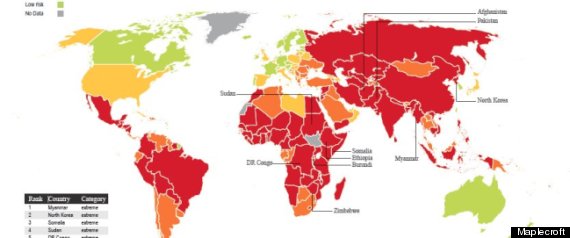
Child Labor By Country: Maplecroft 2012 Index Ranks Risk Of Violations

Where in the world are children forced to work in dangerous conditions, often toiling at the expense of receiving education and basic freedoms?

The risk analysis firm Maplecroft released a report showing that worsening global security and the economic crisis have increased the risk of child labor violations in several countries. Maplecroft studied child labor conditions in 197 countries and concluded that nearly 40% of those countries showed "extreme risk" of violations.

The International Labor Organization (ILO) defines child labor as "work that deprives children of their childhood, their potential and their dignity, and that is harmful to physical and mental development." The ILO argues that not all work carried out by children is harmful or detrimental, but the organization condemns forms of labor that are physically, socially or morally dangerous and harmful to children or interfere with their education and development.

UNICEF, the United Nations Children's Fund, estimates that 158 million children between the ages of 5 and 14 are engaged in child labor, particularly in Sub-Saharan Africa. According to the organization, more than one third of children in Sub-Saharan Africa work, most of them in the agricultural sector.

Maplecroft notes a strong link between household poverty and child labor. When the poor's children are kept out of school to work, they have limited prospects for upward social mobility. This creates a cycle of poverty for generations.

6 countries out of Maplecroft's list of worst child labor offenders are located in Africa. Tens of thousands of children in Congo are employed in the mining sector in often "hazardous conditions," the report shows. In countries hit by conflict such as Sudan, Chad and Ethiopia, the abduction of children and forced labor continue to pose extreme risks.

Original Article
Source: Huff 

Harder for Americans to Rise From Lower Rungs

WASHINGTON — Benjamin Franklin did it. Henry Ford did it. And American life is built on the faith that others can do it, too: rise from humble origins to economic heights. “Movin’ on up,” George Jefferson-style, is not only a sitcom song but a civil religion.       

But many researchers have reached a conclusion that turns conventional wisdom on its head: Americans enjoy less economic mobility than their peers in Canada and much of Western Europe. The mobility gap has been widely discussed in academic circles, but a sour season of mass unemployment and street protests has moved the discussion toward center stage.

Former Senator Rick Santorum of Pennsylvania, a Republican candidate for president, warned this fall that movement “up into the middle income is actually greater, the mobility in Europe, than it is in America.” National Review, a conservative thought leader, wrote that “most Western European and English-speaking nations have higher rates of mobility.” Even Representative Paul D. Ryan, a Wisconsin Republican who argues that overall mobility remains high, recently wrote that “mobility from the very bottom up” is “where the United States lags behind.”

Liberal commentators have long emphasized class, but the attention on the right is largely new.

“It’s becoming conventional wisdom that the U.S. does not have as much mobility as most other advanced countries,” said Isabel V. Sawhill, an economist at the Brookings Institution. “I don’t think you’ll find too many people who will argue with that.”

One reason for the mobility gap may be the depth of American poverty, which leaves poor children starting especially far behind. Another may be the unusually large premiums that American employers pay for college degrees. Since children generally follow their parents’ educational trajectory, that premium increases the importance of family background and stymies people with less schooling.

Walmart Blacklisted By Major Pension Fund Over Poor Labor Practices

A major pension fund and longtime investor in Walmart has blacklisted the retailing behemoth, citing poor labor practices and the company's anti-union stance as the driving force behind its rejection.

Walmart typically shrugs off criticism of its labor practices as union-driven propaganda and insists that its employees are happy and well-managed, but investing experts say that when one of the largest pension funds in the world divests, the company would be wise to listen to the message. It's the same message the American labor movement has been pushing for decades.

On Tuesday, the Netherlands' biggest pension fund, Algemeen Burgerlijk Pensioenfonds, with more than $300 billion in assets, announced that it was blacklisting the largest retailer in the world for noncompliance with the United Nations' Global Compact principles. The Global Compact presents a set of core values relating to human rights, labor standards, the environment and anti-corruption efforts. Sixteen other companies were blacklisted along with Walmart, nearly all of them excluded for producing chemical or nuclear weapons that violate the Nuclear Non-Proliferation Treaty.

ABP said on Wednesday that the decision to pull its investment from Walmart was not hasty. The fund declined to say how much money is involved, but according to ABP records, it had invested some 95 million euros, worth $121 million today, in U.S. Walmart stores as of June 30, 2011. The fund first sent a letter to Walmart executives in 2008, a year after ABP formalized its responsible-investing policy. Four years later, after many meetings with employees and all levels of management, ABP concluded the retail giant was still falling short.

Super PAC Disclosure Requirements Hot Topic Of Conversation Among GOP Candidates

TILTON, N.H. -- The rapid rise and far-reaching impact of super PACs -- the well-financed non-party groups that helped carry former Massachusetts Gov. Mitt Romney to victory in the Iowa caucuses -- have persuaded some prominent Republicans that restrictions of some sort on the groups' activities may be in order.

In an interview with The Huffington Post on Wednesday evening, former Pennsylvania Gov. Tom Ridge said he saw no legal way in which to limit the amount of money that these groups could spend or raise. But he said that both he and the candidate he supports, former Utah Gov. Jon Huntsman, believed firmly that the names of the donors funding those groups should be subject to near instantaneous disclosure.

"I've talked to Jon about this and he and I are like-minded," said Ridge. "He has a modest super PAC [supporting him]. I have felt for the longest time, it is very unlikely that the Supreme Court of the United States would put financial limits on free speech. But I think it is within the power of the president and the Congress to say: 'Guess what? Any contribution in excess of $500 to $1,000 to you personally or the super PAC, it is on the Internet within 24 hours, so people can know.' Not quarterly. Transparency now, it is the best antiseptic."

Attawapiskat: Reserve Fears Ottawa's Controls Mean It Won't Make January Payroll

OTTAWA - First Nations in the James Bay region of Northern Ontario say their housing crisis is deepening despite the federal government's recent response to Attawapiskat.

In a statement issued Thursday, the troubled Attawapiskat First Nation said it won't be able to make its January payroll unless the federal government shows more flexibility.

Many families are still living in tents and substandard shelters there. And now, essential services such as education are at risk because the $1.5 million earmarked for them has been placed in the hands of a government-appointed third party, according to a statement from the regional Mushkegowuk Council.

Neighboring Cree communities along James Bay are crying out for emergency help as well.

"With temperatures now in the minus 30s and 40s, the chiefs are now calling on the federal and provincial governments to take immediate action on the housing crisis in Fort Albany and Kashechewan as well," the statement said.

Volcker Rule: Canada's Financial Industry Hints At Challenge To U.S. Bank Reform Under NAFTA

In the wake of the U.S. financial collapse in 2008, Canadian banks -- which were largely spared the devastation in the U.S. -- were lauded as an example of a properly regulated banking industry. One of the people praising Canadian finance was Paul Volcker, the former head of the Federal Reserve.

But it seems Canadian financial institutions don’t feel the same way about Volcker -- or at least the financial reform named after him.

The “Volcker Rule,” a core part of the U.S.’s financial reform package passed last year, would limit the ability of U.S. banks to engage in proprietary trading -- buying and selling financial instruments for their own benefit. (Banks would still be allowed to trade on behalf of clients.)

That has many in Canada’s financial industry evidently upset. In a letter to U.S. government officials sent last month, the Investment Industry Association of Canada argued that the Volcker Rule could potentially destabilize Canada’s financial sector by making it harder to trade government debt and to take actions that minimize risk.

New Democrats attack Tories’ ‘Republican-style’ assault on unions

PARLIAMENT HILL—New Democrats are gearing up to take on Prime Minister Stephen Harper over what they’re calling a “Republican style” attack on wages and benefits in 2012, with the latest flashpoint a New Year’s Day lockout of nearly 500 workers at the only remaining locomotive manufacturer in Canada.

The standoff at the London, Ont., Electro-Motive plant, now owned by U.S. machinery giant Caterpillar following a Canadian-government approved takeover, has surfaced as a key issue in the NDP leadership race, with candidate and NDP MP Paul Dewar (Ottawa Centre, Ont.) inviting all seven other candidates in the race to London this Friday in a show of support for the locked-out members of the Canadian Auto Workers union.

Leadership candidate and former party president Brian Topp, Toronto region director for the Association of Canadian Cinema, Television and Radio Artists, also joined the fray Wednesday, sending a letter of support to the locked-out London workers.

"I think the NDP should take on Mr. Harper for his approach on labour relations,” Mr. Topp told The Hill Timesin an email. “Not only will Mr. Harper not help Canadians and their families in this economy, he doesn't want them to help themselves.”

Audits question Ottawa’s oversight of first-nations infrastructure

Two government audits show Ottawa is earmarking about a billion dollars a year to build and repair first-nations infrastructure, but its myriad officials are not keeping proper tabs on how the money is spent.

Even as Prime Minister Stephen Harper accuses the Attawapiskat First Nations of mismanaging federal funds, the internal audits posted recently suggest the criticism could apply to the federal bureaucracy as well.

The audits say there are “significant gaps” in how the on-reserve infrastructure funding is controlled, and that the financial reporting system is riddled with inconsistencies.

The audit of on-reserve community infrastructure says targets, standards and compliance systems are often ignored or inconsistently applied, leaving the government with an unclear picture of how well its money is working.

When it comes to water and waste water, for example, the report notes the Aboriginal Affairs Department has ranked many water systems to be low risk. At the same time, there were no inspections for more than a year on these water systems – at least not until a national assessment of first-nations water systems prompted some regions to undertake testing.

Confounding Fathers - The Tea Party’s Cold War roots

A few months ago, the cable-television and radio host Glenn Beck began his Fox News show with one of his favorite props: a pipe clenched between his teeth. “I’ve got my pipe,” he told his audience, his speech slightly muddled by the stem, “because we’re going to speak about schoolish kind of things.” The theme of the day was “Restoring History,” and Beck, looking professorial in a neat dark blazer and a pink button-down shirt, began the lesson by peering at a stack of history textbooks and pronouncing them full of falsehoods, produced by “malicious progressive intent.” Progressives, he explained—liberals, socialists, Communists, the entire spectrum of the left—“knew they had to separate us from our history to be able to separate us from our Constitution and God.” For the next hour, Beck earnestly explained some of the history that “is being stolen from us”: the depression of 1920, for example, or how conservative economics saved the nation from the “near-depression” of 1946—crises that progressives don’t want you to know about. “You’ve been taught one lie, I think, your whole life,” he said.

For the fractious Tea Party movement, Beck—a former drive-time radio jockey, a recovering alcoholic, and a Mormon convert—has emerged as both a unifying figure and an intellectual guide. One opinion poll, released in July by Democracy Corps, showed that he is “the most highly regarded individual among Tea Party supporters,” seen not merely as an entertainer, like Rush Limbaugh, but as an “educator.” And in the past few months Beck has established his own institute of learning: the online, for-profit Beck University. Enrollees can take courses like Faith 102, which contends with “revisionists and secular progressives” about the separation of church and state; Hope 102, an attack on the activist federal government; and the combined Charity 101/102/103, a highly restrictive interpretation of rights, federalism, and the division of powers.

God and Man in Iowa

When it comes to combining delusion, disaster, and Iowa—three essential elements of this past political week—almost nothing can beat “A Foreign Affair,” a 1948 film by Billy Wilder. It was shot in Berlin, amid the uncleared rubble. In one scene, Marlene Dietrich, as a cabaret singer in an underground bar, persuades an Iowa congresswoman on an inspection tour, played by Jean Arthur, to sing her state’s song, “Iow-ay.” (“That’s where the tall corn grows!”—see video, below.) A crowd of G.I.’s, who had been belting out “Deep in the Heart of Texas,” join in, the congresswoman is lifted onto their shoulders—and then, as M.P.’s come in to raid the place, she finds herself clinging to a steampipe, her legs dangling in the air.

And that, without the music or Marlene, is about where an observer of a blasted political scene was left hanging after the Iowa caucuses on Tuesday night. Mitt Romney and Rick Santorum each got about twenty-five per cent; they were separated by just eight votes, and by the subtly differing reasons most voters didn’t like or trust them, or believe they could win. The Texans in this farce—Ron Paul and Rick Perry, who finished third and fifth with about twenty and ten per cent of the vote, respectively—proved just as useless as the singing soldiers in providing clarity. (Perry, haltingly reading a letter from a real soldier, managed to convey nothing other than his pleasure that the soldier thought highly of him.) Meanwhile, the damage wrought in the campaign so far, to the Republican Party and to the sanity of anyone watching each of the debates, has been profound.

What sort of ideals have been affirmed by the Iowa caucuses? Political reporters expressed something like humble wonder at the sight of people actually voting; an understandable reaction, maybe, given what a long path it’s been. But pulling off a free election in the middle of the United States doesn’t exactly seem like a milestone. And while there was certainly an assertion of popular common sense in Newt Gingrich’s weak fourth-place finish—it had looked, two weeks ago, like he might win—the role that unchecked Super PAC spending played in his defeat has to make one wary of what’s to come. (As John Cassidy wrote recently, Gingrich was among the first victims of the Supreme Court’s Citizens United decision.) Is the reason to cheer for Iowa simply that the music has finally stopped, and we’re done with it?