Democracy Gone Astray

Democracy, being a human construct, needs to be thought of as directionality rather than an object. As such, to understand it requires not so much a description of existing structures and/or other related phenomena but a declaration of intentionality.
This blog aims at creating labeled lists of published infringements of such intentionality, of points in time where democracy strays from its intended directionality. In addition to outright infringements, this blog also collects important contemporary information and/or discussions that impact our socio-political landscape.

All the posts here were published in the electronic media – main-stream as well as fringe, and maintain links to the original texts.

[NOTE: Due to changes I haven't caught on time in the blogging software, all of the 'Original Article' links were nullified between September 11, 2012 and December 11, 2012. My apologies.]

Wednesday, January 04, 2012

Tennessee Anti-Bullying Law Change Could Allow Students To Speak Out Against Gays For Religious Reasons: Report

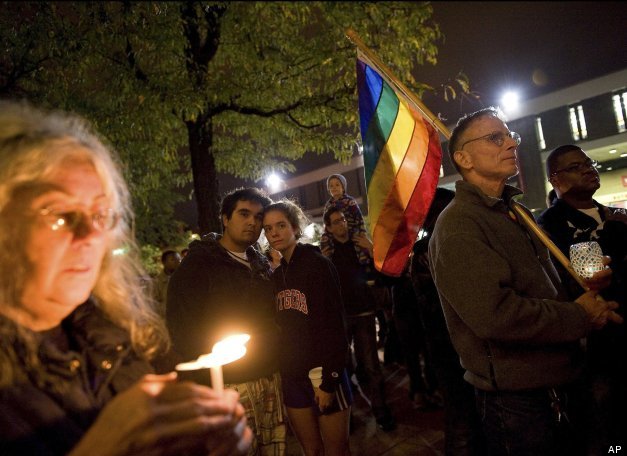
Less than one month after a local gay teen took his own life after allegedly being tormented at his high school, a proposed change in a Tennessee law could protect students who engage in anti-gay bullying if they do so for religious reasons.

As local news channel WSMV is reporting, the proposed law change by state lawmakers would allow students to speak out against homosexuality without punishment if that's what their religious beliefs call for. The bill is reportedly a top priority for the conservative Family Action Council of Tennessee -- as the Chattanooga Times Free Press notes, the group's December newsletter says it hopes "to make sure [the law] protects the religious liberty and free speech rights of students who want to express their views on homosexuality."

Added conservative activist David Fowler, a former Republican state senator who is now Family Action Council president: "The purpose is to stop bullying, not create special classes of people who are more important than others."

Still, many lesbian, gay, bisexual and transgender (LGBT) community activists, as well as local student groups, have cited the recent case of Jacob Rogers, who took his own life in December after friends say he was subjected to anti-gay remarks at his high school, in arguments against the law change. Leaders of the LGBT advocacy group Tennessee Equality Project contend the legislation would allow students to hide their irrational biases behind an extreme religious belief, according to the Associated Press.

"This kind of legislation can send a message that it's ok to hate and we'll even give you religious sanction for it," Tennessee Equality Project official Chris Sanders tells WSMV. "What if one student calls another one a sinner, or a sodomite or says you're perverted or you're unnatural or you are going to hell? That's where it gets really dicey."

Meanwhile, Fowler reportedly blamed Rogers' death on the student's struggles with alcohol and drug abuse, as well as an eating disorder, according to Nashville Scene.

Take a look at some other recent anti-gay bullying cases and other events below:

Original Article
Source: Huff 

Needle Exchange Programs Lose Federal Funding: Local AIDS Programs Brace For Cuts

In a crushing blow to the healthcare community, President Obama is expected to sign new legislation that prohibits federal funding on needle exchange programs both domestically and abroad -- a federally funded program that he himself signed into effect in 2009.

The amendment is part of the 2012 government operations funding legislation and is widely seen as a step backward in the fight against HIV and AIDS, especially considering that injection drug use has accounted for about 36 percent of all infections, according to the Centers for Disease Control and Prevention.

"The reinstatement of the ban is really a dark day in public health policy," said Vice President of Public Affairs for the San Francisco AIDS Foundation James Loduca to the Examiner.

According to the Examiner, the new ban will not have an immediate effect on San Francisco or the Peninsula, where programs are funded by county general grants. However, the ban could significantly derail future local efforts, as the Examiner reported:
But advocates say the move could hinder their agencies' ability to expand existing services by pulling away a funding safety net, deterring agencies that plan to fight the ban from pursuing other initiatives and derailing years of advancement in HIV/AIDS research and treatment. "People are gearing up for this fight, but there are a lot of other things we could be working on," said Laura Thomas, a deputy state director for the Drug Policy Alliance’s San Francisco office. "It’s so frustrating at this point in the epidemic." Money and manpower that will be spent trying to lift the ban again next year could be better spent supporting treatment programs and research, Thomas said.
Though needle exchange programs have seen significant success at curbing infection rates (according to the San Francisco Chronicle, a 1997 study found that HIV infection rates dropped by 5.8 percent in cities with needle exchange programs, and rose 5.9 percent in cities without them) it took AIDS activists 21 years to convince Congress to support federal funding.

With an unbelievably tight economy, healthcare cuts are to be expected. But one can only imagine the long-term costs of a nationwide increase in HIV and AIDS infections.

Original Article
Source: Huff 

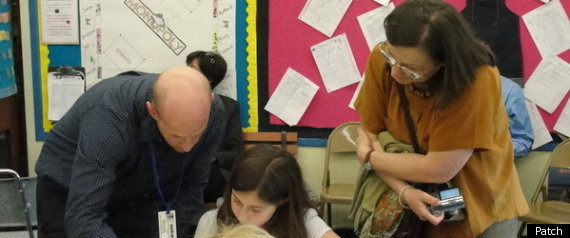
New Hampshire Lawmakers Pass Law Allowing Parental Objections To Curriculum

The Tea Party dominated New Hampshire Legislature on Wednesday overrode the governor's veto to enact a new law allowing parents to object to any part of the school curriculum.

The state House voted 255-112 and Senate 17-5 to enact H.B. 542, which will allow parents to request an alternative school curriculum for any subject to which they register an objection. Gov. John Lynch (D) vetoed the measure in July, saying the bill would harm education quality and give parents control over lesson plans.

"For example, under this bill, parents could object to a teacher's plan to: teach the history of France or the history of the civil or women's rights movements," Lynch wrote in his veto message. "Under this bill, a parent could find 'objectionable' how a teacher instructs on the basics of algebra. In each of those cases, the school district would have to develop an alternative educational plan for the student. Even though the law requires the parents to pay the cost of alternative, the school district will still have to bear the burden of helping develop and approve the alternative. Classrooms will be disrupted by students coming and going, and lacking shared knowledge."

Scott Brown Backs Obama Recess Appointment Of Consumer Finance Watchdog Richard Cordray

WASHINGTON -- Bucking his party's leadership, Sen. Scott Brown (R-Mass.) Wednesday expressed his support for President Obama's decision to name Richard Cordray head of the Consumer Financial Protection Bureau in a recess appointment that evaded a Republican blockade of the nomination.

Senate Republicans had vowed to stop Cordray's appointment until Obama agreed to water down the authority of the new watchdog agency. To stop him from using the constitutional option of a recess appointment while the Senate was adjourned, they've been holding "pro forma" sessions where no business is done, but the chamber is technically working.

GOP leaders bitterly accused the president of arrogance and overreach. But Brown, facing a tough election challenge from the architect of the CFPB, Elizabeth Warren, decided that their actions were the bigger problem.

"I support President Obama's appointment today of Richard Cordray to head the CFPB," Brown said in a statement. "I believe he is the right person to lead the agency and help protect consumers from fraud and scams."

The Iowa Caucus' Real Results: Hardly Anybody Voted, And Nobody Won Anything

So, with the Iowa caucuses in the books, our attention turns to the matter of who "won" last night. Technically, the "winner" is Mitt Romney, who eked out a plurality of the votes cast, by an eight-vote margin. But, as many are noting, Rick Santorum was perhaps the biggest "winner," relatively speaking, because his bare-bones, on-the-cheap retail operation came within a hair of besting the big-spending, Super-PAC enabled Romney. And of course, Ron Paul, who doubled up his 2008 total but only managed a third place finish, was nevertheless acting like a winner last night as well.

And yet, this was an election that was decided by a teensy fraction of the available humans in Iowa who could come around and cast a vote last night. This year's Iowa Caucus is being billed as one of the best ever -- a record turnout, in fact. But if last night was a record turnout, then the Iowa caucuses are some sort of "tallest hobbit" contest.

The numbers tell the story: of the 2,250,423 voters in the state (using the higher voting-eligible population), only 147,255 came out last night. And of those, only 122,255 voted in the Republican contest, for a turnout percentage of 5.4 percent. And if any of the hype about Democrats, Occupiers, Anarchists, interlopers, and stray ACORN activists (those that haven't been secreted off to Bagram Air Force Base for indefinite detention) -- all voting on the GOP side to gum up the works -- is true, it's possible that there was an even smaller percentage of sincere GOP voters.

What's Happening in the Persian Gulf Explained

The basics: Iran and the United States appear to be heading for a showdown in the Persian Gulf. Amid already-high tensions over Iran's advancing nuclear program, the US has imposed harsh new economic sanctions on the regime in Tehran. The sanctions have throttled Iran's economy, and the country has responded by threatening to shut down the Gulf to all shipping traffic. Iranian officials have also threatened military action against the United States and its allies in the region if they don't back off. Two US aircraft carriers are en route to the region.

How has the situation escalated? Over New Year's weekend, the Iranians announced that they'd made their first-ever nuclear fuel rods, a major step forward in building a nuclear bomb. Then they test-fired three anti-ship missiles in the Strait of Hormuz, a 34-mile-wide choke point in the Persian Gulf through which approximately 20 percent of the world's crude oil is transported. An Iranian admiral told state TV that the shots were a warning to America: "The control of the Strait of Hormuz is completely under our authority [too]," he said, warning that Iran would attack "any enemy" that endangered Iranian interests. In response, the US has sent two aircraft carriers steaming toward the Gulf to replace the USS John C. Stennis, which just ended its own Mideast deployment. "Iran advises, recommends and warns them [the US] not to move its carrier back to the previous area in the Gulf because Iran is not used to repeating its warnings and warns just once," a general told state media.

Newt Gingrich has finally reached his destiny: destroyer of the GOP.

In a bitter and spiteful concession speech last night in Iowa—Kanye West could do no worse—the former House speaker, who finished fourth, signaled a shift in his mission. He would no longer be running to obtain the Republican presidential nomination; he would be campaigning to obliterate Mitt Romney. He would be Sherman; the former Massachusetts governor would be Georgia.

If Gingrich does pursue this march—and there are two debates this weekend in New Hampshire in which Gingrich can be a suicide bomber—Gingrich will be reaching the peak of his 30-year career as a Republican demolition man. And now his target will be the candidate the GOP establishment believes possesses the best chance of unseating President Barack Obama.

Gingrich, as is widely known, entered the House in the late '70s, throwing bombs. He aimed them at both the stodgy leadership of the Republican House minority and at Democratic leaders, whom he routinely called "corrupt." For years, he hurled harsh and bombastic rhetoric, routinely comparing those with whom he disagreed to either Nazis or Nazi appeasers. It was often hard to keep track of his faux historical analogies. (For a partial list of his excesses, see this run-down.)

During his venom-laced rush to the top, Gingrich sought to institutionalize his hate politics. His political action committee, GOPAC, sent out a memo to Republican candidates counseling them to use particular words when describing Democrats, such as "decay," "betray," "traitors," "pathetic," and "corrupt."

Meet Rick Santorum, Big-Spending Bush Republican

Conventional wisdom holds that former Senator Rick Santorum, co-winner of the Iowa caucus, is indisputably conservative enough for the Republican base. “Santorum fits the mold of a tried-and-true conservative who has rarely compromised,” writes Aaron Blake of the Washington Post.

In fact, Santorum is a throwback to the Bush era: a big-spending, big-government conservative. He has had the good fortune to have lost re-election in 2006 and not been around to vote in favor of TARP, but time and again he voted for costly schemes that expanded the national debt. Many of the attacks that damaged Newt Gingrich could have been made against Santorum if he had been polling well enough to invite them.

Santorum voted for Medicare Part D, No Child Left Behind and the Iraq War. This is no way to shrink the government or balance the budget, especially when you simultaneously propose to cut taxes and increase defense spending.

Santorum’s own nephew put it best in his endorsement of Ron Paul. “If you want another big-government politician who supports the status quo to run our country, you should vote for my uncle, Rick Santorum.... My uncle’s interventionist policies, both domestic and foreign, stem from his irrational fear of freedom not working,” wrote John Garver, a college student. “When Republicans were spending so much money under President Bush, my uncle was right there along with them as a senator. The reason we have so much debt is not only because of Democrats, but also because of big-spending Republicans like my Uncle Rick.”

Canada-Honduras Trade Deal On Track, Critics Decry Worsening Rights Situation

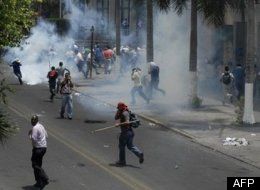
OTTAWA - A Canada-Honduras trade deal is coming under renewed fire following a spate of abuses by police in the Central American country, including the recent beatings of protesting teachers, the intimidation of journalists and the murder of two university students.

Trade Minister Ed Fast, who was not available for comment this week, highlighted the conclusion of trade talks with Honduras as one of the federal government's accomplishments in 2011. The prime minister lauded the deal during a trip to the struggling nation last August.

But human-rights abuses and soaring crime continues to plague the country.

Police used water cannons and tear gas on hundreds of teachers who protested missing paycheques in December. The same month, journalists protesting the deaths of 17 colleagues over the last two years were beaten with batons.

Journalists and university officials investigating the deaths of two students, allegedly at the hands of police officers, have reported being intimidated by other police officers.

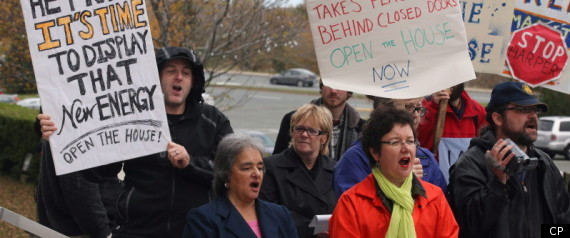
Last Occupy Camp Holds On In St. John's

The final known Occupy camp in Canada remains open for business, as it were, in downtown St. John's, and the city has no plans to evict Occupy Newfoundland from its seaside perch.

"They're not bothering anybody," said St. John's Mayor Dennis O'Keefe, who told CBC News city council is fine with the small group of demonstrators who have been camping out at a small city park since Oct. 16.

"They're not a danger to themselves. They're not a danger to the public. They are there because they want to express an opinion. But we do not have an issue with them at this point in time."

On Tuesday, city workers and police evicted Occupy Fredericton from a public square, leaving Occupy Newfoundland as the only public protest camp left standing in Canada.

A string of them were set up across the country after Occupy Wall Street ignited the imagination of activists who have been speaking out against corporate control, the super-wealthy and economic injustice, among other issues.

Occupy Newfoundland is set up at Harbourside Park, a scenic park that sits between Water Street and the nearby harbour. Because there is limited pedestrian traffic in the area, the Occupy camp does not interfere with daily life in the city.