
Democracy Gone Astray

Democracy, being a human construct, needs to be thought of as directionality rather than an object. As such, to understand it requires not so much a description of existing structures and/or other related phenomena but a declaration of intentionality.
This blog aims at creating labeled lists of published infringements of such intentionality, of points in time where democracy strays from its intended directionality. In addition to outright infringements, this blog also collects important contemporary information and/or discussions that impact our socio-political landscape.

All the posts here were published in the electronic media – main-stream as well as fringe, and maintain links to the original texts.

[NOTE: Due to changes I haven't caught on time in the blogging software, all of the 'Original Article' links were nullified between September 11, 2012 and December 11, 2012. My apologies.]

Monday, March 19, 2012

Sears Covers CEO Lou D'Ambrosio's $803,856 Commuting Bill

NEW YORK — Sears Holdings Corp. paid its chief executive $9.9 million last year, including incentives the ailing department store operator offered to lure the former technology executive, according to an Associated Press analysis of a regulatory filing.

Lou D'Ambrosio, who became Sears' CEO in February 2011, received a signing bonus of $150,000 plus a base salary of $930,769 and $8 million in stock awards, according to a filing the company made Friday with the Securities and Exchange Commission.

D'Ambrosio got another $852,037 in perks, including $803,856 for charter and commercial airfare and ground transportation to commute from greater Philadelphia, where he lives, to Hoffman Estates, Ill., where Sears is based. And he received $29,985 for temporary housing in Hoffman Estates. Sears paid part of the income taxes due on those benefits.

Sears operates stores and websites under the Sears, Roebuck and Kmart brands, as well as the Lands' End catalog and online retailer. D'Ambrosio is a former CEO of communications company Avaya Inc., and he held several positions at IBM Corp. in 16 years with the company.
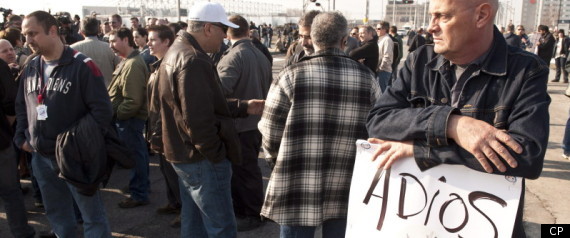
Aveos Layoffs: Employees Block Entrance To Air Canada Building In Montreal

MONTREAL - Some 200 workers laid off by a company that maintains Air Canada planes are blocking access to one of the airline's buildings in Montreal.

The disgruntled workers are among more than 2,000 employees laid off over the weekend by Aveos Fleet Performance.

The protesters are not allowing Air Canada staff to enter a building near Montreal's Pierre Elliott Trudeau International Airport.

Police officers are on the scene, but are not forcing the Aveos employees to leave.

A few kilometres away, another group of laid-off workers is blocking an Aveos building.

Aveos announced Sunday it is shuttering three plants in Montreal, Winnipeg and Vancouver.

Of the 2,400 workers who have been laid off, three-quarters are in Montreal.

Original Article
Source: Huff
Author: Canadian Press

Equalization Payments In Canada Need To Be De-Politicized, Analysts Urge

OTTAWA - The inner workings of one of the country's biggest government programs need to be de-politicized and handed over to an arm's-length group of neutral technocrats, a new study suggests.

The politics of the $15-billion-a-year equalization program have become destructive over the last 10 years, say political scientists Daniel Beland and Andre Lecours.

As provincial and federal governments prepare for a new agreement on distributing equalization payments, they should be thinking about ways to cool the political heat the subject generates, the two argue in an essay for the Mowat Centre for Policy Innovation.

"Reducing toxic political dramas like the ones witnessed over the past decade is most certainly a good thing for the country and its unity," they wrote.

The current equalization formula expires in 2014. Federal and provincial governments need to know soon how transfers will work after that, in order to budget accordingly.

Human Rights Watch Attacks Mandatory One-Year Detention Of Illegal Immigrants In Tory Anti-Smuggling Bill

OTTAWA — The mandatory one-year detention of illegal immigrants proposed under the Tories' new anti-smuggling bill violates basic human rights and breaches Canada’s international legal obligations, says Human Rights Watch.

The international rights advocacy group headquartered in New York is urging Canadian MPs to vote against the bill, which it claims punishes victims as young as 16 who lean on human smugglers to escape persecution, rather than the criminals themselves.

“Canada should go after people who profit from human smuggling, not people fleeing persecution," Bill Frelick, Human Rights Watch’s refugee program director, wrotes in a blog for The Huffington Post Monday.

Bill C-31 would violate international human rights laws by allowing for a year of mandatory detention without review for certain groups of people, including 16 and 17 year olds, Frelick argued.

“Subjecting 16- and 17-year-old children to mandatory, unreviewable detention backtracks on Canada’s commitments to children,” he said.

Why Liberal, NDP candidates want riding that Jack built

One of the most left-leaning ridings in Canada goes to the polls Monday in a by-election that is expected to come down to a battle of Liberal versus New Democrat.

The race in Toronto-Danforth was made necessary by the death last August of Jack Layton whose successor as NDP Leader will be elected by party members later this week. That contest has centred, in large part, on whether the New Democrats should move further into the ground occupied by Liberals or stick to their traditionally socialist roots.

Mr. Layton trounced his opponents in the riding last spring, taking more than 60 per cent of the popular vote. But the count was much tighter when he first won the riding in 2004, defeating incumbent Liberal Dennis Mills.

Although there are now 11 people vying for the seat, Craig Scott of the NDP and Grant Gordon of the Liberals are the two presumed front-runners. Conservative candidate Andrew Keyes did not return calls for this article.

As the lines between the two parties blur on the national level, The Globe asked Mr. Scott and Mr. Gordon on Sunday to explain how they are different to each other, and how the legacy of Mr. Layton has affected their campaigns.

Original Article
Source: Globe
Author: gloria galloway 

Herky-jerky budget talk raises doubts about Tory discipline

The weeks that lead up a budget are prime time for governments to telegraph intentions, soften up targets, make people expect bad things and deliver better.

The minute a budget it tabled, most of what voters hear are complaints about shortcomings. That’s just life in a democracy, not some dastardly conspiracy.

To offset this phenomenon, the Harper government (certainly not the first to do so) has in the past spent millions to tout its initiatives, and it is gilding its lilies again this spring. For a government pushing a culture shift in spending, this may come off as more than a bit audacious once the budget is tabled. If there was risk of a backlash in the past, the risk is higher now.

Watching Ottawa use paid advertising to promote the last few budgets might have been easier for Canadians to accept, given the unusual circumstances. One point of these budgets was to reassure people the sky was not falling, in order to help ensure that it wouldn’t fall. You could make a case that in the midst of unprecedented anxiety, the ad campaigns were designed to help shore up faltering confidence, and in so doing help make stimulus spending more efficient. (I’m not saying it's a strong case, just that a case could be made then – and today maybe not so much.)

Government announces funding for War of 1812 bicentennial

The Canadian government has announced close to $5 million in funding for 24 projects commemorating this year's bicentennial of the War of 1812, including almost $1 million to help create a series of interactive exhibits at Vancouver's Canada Place to "bring the heroes and stories of the War of 1812 to life" more than 3,000 kilometres west of the conflict's most famous battlegrounds in southern Ontario.

The geographic breadth of the funded projects is in keeping with the government's framing of the war as a seminal event in the evolution of Canadian nationhood, one that citizens from coast to coast to coast should better understand and reflect upon during the upcoming three years of anniversary commemorations running until late 2014.

"Canada would not exist had the American invasion not been repelled during the War of 1812, and for that reason, the War is a defining chapter in our country's history," Heritage Minister James Moore said in a statement detailing the latest round of War of 1812 funding from the federal government. "We invite all Canadians to learn more about this important part of our past and to take part in many of the activities and events that will pay tribute to our heroes."

First Nations the real target of government's war on environment

I may be a little more preoccupied with the government campaign to marginalize environmental groups (more than most) so apologies to those who feel I've been harping on this too much.

Speaking of harping … it's Harp Seal hunt season and there is no ice in the Gulf of St. Lawrence for to the seals to give birth (yet the government has given hunters a quota to kill 400,000 pups). Climate change is putting the seals and seal hunters out of business. A sensible government, one might think, would be putting the fossil fuel industry out of business in response. Instead, of course, it is trying to put people like me out of business.

Or is it?

Are environmental organizations the real target of the Harper government? Is curtailing the power of the environmental movement what all this talk of "radicals" and meddling "foreign interests" is about? It might be if we had any real power and were more than just a nuisance.

Only way to beat Tories is join NDP-Grit forces, says pollster

Veteran pollster and keen political observer Frank Graves has some sobering insight for the thousands of New Democrats set to elect their new leader this week: short of a “good old nuclear scandal” neither the NDP nor the Liberals are likely to displace the governing Conservatives in 2015 unless they somehow, in whatever way, join forces.

“The more I look at the political landscape and why it’s so dramatically different today than it was five years ago, the more I’m convinced that neither the NDP nor the Liberals are going to be able to safely, or within any margin of confidence, replace this government as long as they remain competitive separate parties,” Mr. Graves told The Hill Times last week when he was asked to ponder for printed history what’s at stake as several thousands of New Democrats, and thousands more online, prepare to cast ballots in what could be the most important decision they have collectively made since selecting Jack Layton to lead them out of the wilderness in 2003.

“That’s my view, barring that old favourite political disruptor, a good old nuclear scandal, and if this robocon thing does escalate into that, there’s a smoking gun or a deep throat, then who knows, that actually could change the stakes,” Mr. Graves said.

Hurray for Health Reform

It’s said that you can judge a man by the quality of his enemies. If the same principle applies to legislation, the Affordable Care Act — which was signed into law two years ago, but for the most part has yet to take effect — sits in a place of high honor.

Now, the act — known to its foes as Obamacare, and to the cognoscenti as ObamaRomneycare — isn’t easy to love, since it’s very much a compromise, dictated by the perceived political need to change existing coverage and challenge entrenched interests as little as possible. But the perfect is the enemy of the good; for all its imperfections, this reform would do an enormous amount of good. And one indicator of just how good it is comes from the apparent inability of its opponents to make an honest case against it.

To understand the lies, you first have to understand the truth. How would ObamaRomneycare change American health care?

For most people the answer is, not at all. In particular, those receiving good health benefits from employers would keep them. The act is aimed, instead, at Americans who fall through the cracks, either going without coverage or relying on the miserably malfunctioning individual, “non-group” insurance market.